Monday, March 19, 2012

Killer lilies are a no-no for kitties!


Image credit: Field of Lilies by Andrea Andrade

We’ve set our clocks forward and have seen crocuses poke their heads up from the frozen earth, and the first thing that many of us want to do is to celebrate spring with some lovely, fragrant lilies – especially the beautiful white trumpet-shaped Easter lilies that appear everywhere this time of year. Unfortunately, for those of us with cats, this is probably the worst way to usher in good weather.

Easter lilies (Lilium longiflorum) are incredibly poisonous to cats. Well, all lilies, really - Tiger Lily ( Lilium henryi and lancifolium spp.), Day Lily (Hemerocallis spp.), Asiatic lily (Lilium asiatica), Stargazer lily (Lilium orientalis) and the rest of the Lilium family. (Not sure if you have a lily? Wikipedia has images of many of the lily species which will help with identification.) All parts of the lily plant are dangerous, including the flowers, stamens, stems, leaves and roots – even the pollen. If a cat gets pollen on its coat and then grooms, it could still cause fatal illness. Cats that get pollen on themselves should be thoroughly bathed as soon as possible.

Most of the time, we only know that a cat has eaten a lily because some part of the lily appears in a very inconveniently placed puddle of vomit. Many people may even initially write it off, thinking, “Oh well, Fluffy got into the spider plant again. Guess I’ll go get the carpet cleaner.” (Spider plants are non-toxic, by the way, so Fluffy can eat away at them all she likes!) However, when it comes to lilies, it is imperative that you seek emergency medical treatment for your cat as soon as possible to ensure proper and effective treatment. In approximately 2-4 days after ingestion of the plant, your cat may begin to show signs of kidney failure. If enough toxin is absorbed to cause acute kidney failure, then the likelihood that your cat will respond to treatment is poor.

A cat affected by lily intoxication will initially show signs of an upset stomach (gastritis): vomiting, a lack of interest in food and lethargy. These initial signs may appear within 2-12 hours of ingestion and may disappear after 12 hours. The cat may improve briefly or appear to act normal before the condition progresses to serious acute renal failure within 48 to 72 hours.

Once a cat’s kidneys have been damaged to the point of failure, they will show a variety of signs such as lethargy, vomiting, increased thirst, and urinating large quantities (in some cases, urine production may stop altogether - anuria). Affected cats are also likely to be dehydrated. If left untreated, death can occur in as little as 3 days.

Diagnosis and Treatment:
There is no “lily poisoning test”, diagnosis is usually made due to someone witnessing the cat eat the lily or vomit part of the plant. Blood tests that check the kidneys (BUN and creatinine levels) will help confirm ingestion, though severe increases are not likely to be seen immediately. If your cat’s kidney values are normal after eating part of a lily plant, this is GOOD! It means that treatment is more likely to be successful.


Within 6 hours of exposure
, depending on how quickly the cat is brought to the veterinary hospital, doctors and staff may try to induce vomiting and/or give medications to prevent further absorption of the toxin. Even if blood values are normal and the cat vomits up the lily parts you will likely be advised to hospitalize your cat for monitoring and IV fluid administration for a minimum of 24 hours. If your cat is treated immediately after ingestion, prognosis is good.

Up to 48 hours post-exposure, immediate hospitalization and intensive IV fluid therapy will be recommended. The length of time that your cat will need to be hospitalized depends on how badly his kidneys have already been affected, and how he responds to treatment. Prognosis is guarded to poor – mild to moderate kidney damage may be permanent.

Two to four days post-exposure, depending on laboratory testing of the kidneys, humane euthanasia to end suffering may be the only option. Prognosis is very poor – severe, irreversible kidney damage may result in the inability to produce urine. Left untreated for longer than 18 hours, one can expect death in almost 100% of cases.

If you or anyone in your household suspects that your cat may have ingested any part of a lily, no matter how small, please seek immediate veterinary attention. Hesitation may mean the difference between life and death for your cat!

**Celebrate Pet Poison Prevention Week March 18-24 by sharing this article with at least one other person. You might save a life! **
Calla Lily

Peace Lily
Note: While Calla lilies (Zantedeschia aethiopica) and Peace lilies (Spathiphyllum spp.) are not true lilies, they are still toxic to a lesser degree and can cause oral irritation, intense burning and irritation of mouth, tongue and lips, excessive drooling, vomiting, difficulty swallowing


Lily of the Valley
Peruvian Lily
Lily of the Valley (Convallaria majalis) is also not a true lily, however, it is also toxic and can cause vomiting and cardiac problems such as irregular heart beat, low blood pressure, disorientation, coma, and seizures. Peruvian lily (Alstroemeria spp.) is another lily to be aware of. While many florists advertize it to be non-toxic, large amounts of this lily-lookalike can cause stomach irritation, vomiting and diarrhea. Peruvian lilies come in all colors and are also valued in floral arrangements due to their long life as a cut flower.
  For further information:
ASPCA Toxic Plant List
Pet Poison Help Line – learn the common signs of poisoning, 
make a pet poison first aid kit and more!
PSA website: No Lilies for Cats  - FAQ about lily poisoning
Why veterinarians hate Easter - a Veterinarian’s story
The dangers of lilies – a cat owner’s story 

Thursday, March 1, 2012

Meet Miss March!

 
Ember 
Age: 10yr
Weight: good body condition. 10.70#
Gender: spayed female
Demeanor at the vet’s office: Nice girl, I mind my manners!
Feline friends: I prefer humans, and I am an only cat

How she found her home:  I found my home by being the smallest, loudest, most pathetic little kitty at the Oakland County Animal Care Center when my adopted Dad went to find a kitty to live with him.  I was in a cage all by myself because I was sick with an upper respiratory infection, thus the pathetic part.  But that infection didn't compromise my meowing and I let it be known, "Look at me!" thus the loudest part.  That was what convinced Dad to adopt me.  After adoption, I walked around the house for a week, making the loudest meows out of any kitty they have ever had.
How she got her name: I was part of the family for a little while before I got my name.  Dad had recently retired from a local Fire Department, and they liked the name as it related to something from that job.
Her greatest adventure: When I was first adopted, I had two older brother kitties who mentored me and I stayed indoors.  After my first year at home, I became an inside/outside kitty.  Now whatever I want to do, I get to do it.  My first adventure outdoors was on the Fourth of July, when Mom and Dad both thought the other one had put me back inside the house before they went to a beach party.  When they realized I was still outside, Mom came back to the house to walk down the street looking for me and calling for me.  This was interesting for Mom, as she got to meet and talk to some neighbors she had not met before; each one had a comment about hearing and seeing an adorable little kitty (me!) in their yard and describing where they thought I went.  Mom found me a half a block away.  There was one more adventure where I went exploring for about three weeks before Mom & Dad found me and brought be back home.  That adventure was a little scary.  After that, I've liked to stay in my yard and the yards of my next door neighbors.  I do enjoy visiting my next door neighbors, I especially like to go into one's garage with him when he is working and visiting the other ones when they are in their hot tub.
Favorite sleeping spots: Dad built me an outside "kitty perch" which is a little open platform with carpet on the floor and a roof overhead and has a carpeted ramp up to the platform.  It is at about their eye level and at a point in my back yard where I have a perfect view of all the important areas of the back yard and driveway.  I use it all the time.
I do like to be near Mom and Dad when they are settled in watching TV.  I'll either sit on the back of the lazy boy and be a 'headrest' for Dad, or sit on Mom's lap when she's on the couch.  Mom is allergic to me, so she always makes me wait until she puts a towel on her lap before I jump up and settle in.  If Mom's sitting on the couch without her towel on, I sit on the floor and stare at her until she gets up and puts the towel on so I can get on her lap.  Sometimes, I take a nap in the living room with Dad.  I know this is going to happen when he starts closing the blinds and putting a pillow on the couch.  I wait until he's fluffed a blanket over him and jump up to lay on his side; I face his feet and know I'm in the right spot when the tip of my tail just reaches his chin or nose; then I just try to purr hard.  Dad says I'm like a little vibrating heating pad, and he calls this an "Ember Nap."
Otherwise, I like to sit in the bay window at the front of the house and look outside (I do not like the big garbage trucks when they thunder down the street outside) or lay in my kitty bed which is on the floor over a heat vent.  I also like to play with a little green catnip mouse I got from Exclusively Cats when they took care of me while Mom and Dad went to Iceland.

Thursday, February 2, 2012

Meet the Fabulous February Felines!


Jerry and Kramer
Age: 10 months
Weight: at their wellness visit in July, Jerry weighed 5.8# and Kramer weighed 5.5#. Since they're youngsters, they weigh more than that, now!
Gender: Neutered males
Demeanor at the vet's office: Nice boys!

Jerry and Kramer are brothers who will be a year old in March. They're about three times the size that they were in the photo, when they were 4 months old! They do everything together, including eating, sleeping, and playing. They love to groom each other. They also love to sleep with Mom and Dad on the bed every night. They love chasing each other up and down the three floors of their house. They sound like horses running down the hallways!

Don't let their peaceful and unassuming photo fool you - these boys are chock full of energy and mischief! They are voracious eaters who won't even wait for Mom or Dad to put their food on plates...they try to eat the food straight out of the can or bag.

Jerry is the love bug, and a mama's boy. He tries to monopolize all of Mom's attention. Jerry loves laying with Mom on the couch and watching TV.

Kramer is the explorer and the "crafty" one whose favorite game is stealing Mom or Dad's socks and hiding them around the house...then biting them to shreds! Jerry loves to jump in any open kitchen cabinet after they are opened. They're great, but they are still definitely acting like rambunctious kittens, so they're a lot of work!

Monday, January 2, 2012

Meet Mr. January!


Peabody
 
Age: 14 years
Weight: 12.4#
Gender: Neutered male
Demeanor at the vet’s office: Grumbly. “Leave me alone!”
Feline friends: Lewis and Clark
 
FAVORITE TOY: Peabody enjoys catnip - especially the plants growing wild outside. He likes playing with a string, and 
corrugated cardboard scratchers, but his favorite toy is a soft plastic milk ring. He likes to play with it around barriers, 
such as table legs or around doors. When he is done playing, he carries it and drops it in his water dish. The milk ring is in 
his water dish every day.
 
FAVORITE TREAT: He is not interested in meat, but in fat. If his family eats chicken, he wants the skin or fatty bits. Same 
with any other meat - don't give him meat - just the fat.  
 
FAVORITE SLEEPING SPOT: He has several favorite sleeping spots. In the summer, he likes the padded settee in the guest 
bedroom, in front of the window. In the winter, he will take any of the living room seats, or the cat bed under the sofa in front 
of the heat vent. He loves the area rug in the living room when the sun streams in - stretching out in the sunny patches.
 
HOW HE FOUND HIS HOME: Peabody’s family found him at "Meet Your Best Friend at the Zoo" day on June 7, 1997. It 
was their 7th wedding anniversary. They were looking specifically for a male tuxedo cat. He was the first one they spotted. 
As adorable as he was, they kept looking. After seeing all the remaining tuxedo cats among the hundreds of cats there, they 
were relieved that he was still there, although some of his littermates had been adopted.
 
The rescue group told us his family that he was 8 weeks old, but it is suspected that he was closer to 6 weeks as he was so 
small and had blue eyes. His new family took him home in a cardboard carrier with holes in the sides, and he kept poking his 
cute little white lips and chin through them. They tried out names they had picked out, such as Mr. Bean and Jasper and Clark, 
but his new mom finally said "he is such a Peabody" and he became Peabody.
 
A DAY IN THE LIFE OF PEABODY: Peabody starts his day poking his mom’s shoulder to get her out of bed. If she manages 
to get up before that, he is sitting by the heat vent behind the toilet, waiting for her. He is extremely food-focused. He is on a 
wheat-free diet, but is really interested in any other food the other cats get, or wheat-free dry food, which we have to limit as it 
makes him sick.  
 
He has always been keenly interested in the garage. Every night, while his family watches TV in the family room, he sits at the 
door trying to get it open to go in the garage. He cries and howls and paws at the door. After 7 years, they gave up, and let him 
go out there now. He likes to sit on their cars.
 
If his family is up too late, Peabody cries and howls at them to go to bed. He runs ahead of them and keeps looking over his 
shoulder to make sure they are following. By the time they are ready for bed, he is gone. His family settles in, and about five 
minutes later, he starts crying at the bottom of the stairs. He cries and howls this pitiful meow, very loudly. His mom finally 
calls his name and tells him to come up, and runs up the stairs. 
 
He is not soft-footed by any means. When he goes up and down those hardwood stairs, he sounds like a full-grown person. 
 
Peabody has always enjoyed going outside and exploring his property or the immediate neighbors’. Two years ago he went 
missing for two nights. His family was beside themselves, as they had seen coyotes in the area. They thought he might be 
locked in the neighbors' garage, as his mom saw them leave shortly before he went missing. When the neighbors came home, 
they opened the garage for him. No Peabody. The next day, the neighbor looked for him in there, again - no Peabody. Then his 
dad looked for him, again. Nothing. The day after that, the neighbor called and thought the cat was in the garage - somewhere 
in the second floor storeroom. Peabody’s mom went up there and called him. She finally heard a tiny little meow. She and the 
neighbor had to move a bed, a dresser, and an old crib before they finally found him in the corner rafters. 
 
Since then, he hardly leaves the deck. If he goes out at all, he is back in 10 minutes. Now he needs to teach that trick to his 
housemates, Lewis and Clark.

Monday, December 19, 2011

Feline Inappropriate Urination: Acting out all over the house!

When medical issues have been ruled out, and husbandry issues have been resolved, if a cat is still eliminating outside the box, it is likely to be due to a behavioral issue.  Unfortunately, while litterbox environment and medical issues are relatively straightforward to address, behavioral issues can be complicated.

New furniture can stress your cat.
One of the most common causes of behavioral inappropriate elimination is stress. Stress can come from a variety of sources.  It can be due to a bold or aggressive animal re-establishing his territory or a timid, shy animal urinating because he is a “victim” of his social environment (being passive-aggressive). A change to the household that disrupts the cat’s schedule may also be a contributing factor to a cat choosing not to use the litterbox -- such as a new baby, visitors staying in the home, a child going off to college, a change in someone’s work schedule, a move to a new home, new furniture, a new pet, a family vacation, renovations to the home, a visit from a plumber or other repair-person, etc. In some cases, the behavior will resolve on its own after the event (such as vacations, visitors, and renovations), and in other cases, the behavior may be ongoing (new furniture, a baby, a new home). Each type of stressor may have several solutions.

For example:
If your cat eliminates inappropriately when you go on vacation, you may find that you can curb the behavior by boarding the cat while you are gone, hiring an in-home sitter versus having a neighbor stop by the house once or twice daily, or by taking your cat with you. Discussions with your veterinarian may even lead to recommendations for medicinal therapy while you are gone to alleviate anxiety.

If you are planning on getting a new pet or having a baby, preparing your cat for the new addition may head off any potential behavioral issues. Also, making sure to introduce the new pet to the resident cat on a gradual basis will help lessen the stress your cat may feel about a new addition.

When planning to move to a new home, it is often helpful to establish the cat in the new home prior to moving day, if possible, so that their first exposure to the new home is not amidst chaos. If your cat can be set up in a room with all his familiar things and you can avoid moving things into that room right away, that will also help. If your cat can’t be moved ahead of time, then moving your cats into a room that will be little-disturbed on moving day, such as a bathroom or walk-in closet may also help. Let the cat become accustomed to the moving-day room before allowing him out to explore the whole house. That way, if something about the new house is frightening, he has a safe place to retreat to.

Sometimes inappropriate elimination can become so ingrained in a cat that even once the stress has been removed, the behavior continues. If this is the case it is a good idea to seek advice from your veterinarian as to how to re-train your cat. 

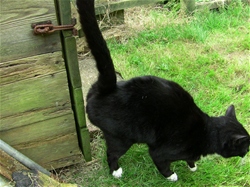
Spraying posture - standing near a vertical surface, tail erect
If a cat chooses to eliminate near a door or window, it is likely that either the presence of feral/stray or wandering neighbor cats may be causing your cat stress, anxiety or frustration or stimulating your cat to mark his territory and warn off these tresspassers. It is important to determine if your cat is urinating or spraying, as these behaviors are approached differently. Spraying is generally performed in a standing position with the tail raised, and the urine is deposited on a vertical surface such as a wall or piece of furniture (though it may run down the wall and puddle on the floor). Spraying tends to deposit small amounts of urine as compared to the size of the urine clumps you find in the litterbox. The tail may appear to quiver or vibrate. When your cat is urinating, he will squat and deposit a large amount of urine on a horizontal surface.
Urinating posture - squatting

It is most commonly the male cat that sprays, but it is not unheard of for female cats to spray, also. Spaying and neutering your cats will help prevent this issue in most cats, as the lack of male and female hormones will dull the desire to mark and maintain territory, and the need to advertise sexual availability – which are the primary reasons that cats urine mark. However, about 10% of neutered males and 5% of neutered females also spray. In households with more than seven cats, the likelihood of spraying is high. 

If outside cats frustrate your cat, you may be able to address the problem by discouraging stray cats from visiting your house. A plant called Coleus canina, also known as the “scaredy cat plant” or the “pee-off plant” is a deterrent to cats, dogs and foxes. Coleus plants are those that you often see with brightly colored leaves. This species of Coleus has green foliage and small, spikes of pretty blue flowers in the summer. The plant only smells to the human nose when touched. In Michigan, Coleus plants are annuals, but can easily be propagated and cuttings can be kept in a frost-free place over winter. They prefer a dry, sandy soil and lots of sunlight and should be planted every 1-2 yards for best results.
Coleus canina flower

Cats also hate the smell of the herb rue. It has beautiful blue-tone leaves and tiny yellow flowers. Cats are also usually deterred by the smell of citrus, so placing orange or lemon peel in your yard may help deter strays. Similarly, coffee grounds, blood meal, cayenne pepper, lavender oil, lemon grass oil, citronella oil, peppermint oil and eucalyptus oil can be used near areas where outdoor cats like to hang out.

Avoid feeding birds or squirrels in your yard if your cat is bothered by stray cats.

Motion detectors that trigger sprinklers can be used to deter them from coming onto your property. Additionally, you can discourage your cat from looking outside by closing blinds or shades, or making the windowsill inaccessible. Double-sided tape, tin foil or strips of carpet runner on the sill may also deter your cat. 

Spraying can also result from territorial disputes between cats in the same household. They may need to be separated and reintroduced slowly, using food treats to reward and encourage peaceful behavior. This re-introduction can successfully develop good relations between cats in some cases, even if the spraying has been going on for a long time.

While the presence of other cats, lack of access to prey species or sexual maturity are the most common reasons that cats perform spraying behavior, other causes can be new or unfamiliar scents in the home (such as new furniture, or digging out the Christmas tree from the attic or bringing a live tree into the home) or frustration due to lack of mental stimulation. Often, spraying new items with a pheromone called Feliway can help lessen your cat’s desire to mark. This product mimics the scent of cat cheek gland secretions. Many cats will not spray on areas that have this scent. Increasing the amount of playtime for an under-stimulated cat may help ease frustration.

Behavior-related elimination issues are often addressed with anti-anxiety medications, such as Prozac (fluoxetine), BuSpar (buspirone), Elavil (amitriptyline), and Clomicalm (clomipramine). Anxitane is a neutraceutical (nutritional therapy) supplement of L-Theanine that has also been shown to aid in decreasing anxiety in cats. Medications are useful in helping to decrease behavioral inappropriate elimination, but they should always be used in conjunction with changes to the home or other environmental changes with the goal of hopefully weaning the cat off the medication, if possible.
More information about inappropriate elimination:
Lovin' the Litterbox: Husbandry Reasons Why Your Cat May Not Use the Litterbox
Kidneys and Crystals and Stones, Oh, My! Medical Reasons Why Your Cat May Not Use the Litterbox
Breaking the Cycle of Smell: How to Stop Habitual Elimination Problems

Friday, December 9, 2011

Feline Inappropriate Elimination: Kidneys and Crystals and Stones, oh my!

Struvite crystals
Struvite crystals in urine - the most common type we see
Even if your cat is currently using the litterbox and not eliminating elsewhere, he or she may be visiting the litterbox less frequently than necessary, which can lead to urination issues down the road. We strongly recommend making your cat's litterbox situation as ideal as you can to help prevent urination issues.

Why is it a bad idea to urinate infrequently? If a cat holds his urine in his bladder for a long period of time, the urine becomes more concentrated. Concentrated urine has more “stuff” in it – more cells, more protein, more body by-products, etc. and the more stuff that is in the urine, the more likely it is to stick together and form crystals and stones. Urinary crystals and stones are uncomfortable and can lead to some of the medical reasons why cats avoid the litterbox.

This is one of the reasons that, even if we suspect a medical issue, we will discuss ways in which you can make your litterboxes more pleasant for your cats. Many of the elimination problems we see are complex and may have several contributing issues that need addressing. Treating the medical condition in conjunction with making changes to the litterbox will often speed your cat's recovery, and encourage them to return to the litterbox sooner.

**NOTE: many times, a cat will not 100% stop using the litterbox - they are fastidious about their environment and instinctively want to use the box. Most cats will use the box sometimes and eliminate elsewhere other times, so just because your cat is still going in the box sometimes doesn't mean that there isn't a medical problem. Also, just because your cat has always used the litterbox before doesn't mean that there isn't something about the box they don't like. Again, cats want to use the box, so are often very tolerant about litterbox situations that they consider to be sub-par - they just go less frequently, or they tolerate the box as-is until something else in their life changes.**


There are a number of medical reasons why a cat will stop using the litterbox:

Urinary crystals look like sand
Once removed from the bladder and dried, crystals look like sand.
--Urinary crystals or stones: Crystals and stones can be found in any part of the urinary system – the kidneys, the ureters, the bladder or the urethra. In male cats, these situations can quickly become an emergency, as clumps of crystals or small stones can become lodged in the tiny tube that leads from the bladder to the outside of the body (the urethra). This blocks the passage of urine, which means that the urine has nowhere to go, except to backup towards the kidneys. This causes the kidneys to start to shut down, since they can’t pump out any more urine. We call these cats “blocked cats”. Their bladders feel hard and firm, their bellies are tender, and the bladder can be in danger of breaking, like an over-inflated balloon. These kitties may be straining in the litterbox and not producing anything, or may just dribble a few drops of urine in the box. They are painful and may not eat, or may vomit near the litterbox. Again, this is an emergency, and a cat in this situation should be seen by a veterinarian as soon as possible!

Urinary crystals tend to show up well with an ultrasound but not on x-ray. Urinary stones will often show up questionably on ultrasound but will show up better on x-ray. There are a rare few stones that will not show up on x-ray, however (we call these "non-radiodense" or "non-radio-opaque" stones). Because of this, if the presence of a stone is suspected, it may be recommended or necessary to do both an x-ray and an ultrasound to confirm its presence. Because of the size of urinary stones, it is not likely that they can be diagnosed with just a urinalysis because they will not pass out of the bladder.

X-ray of a urinary bladder with stones
A urinary bladder full of stones.
Sometimes, a cat may show no real indication of bladder stones or bladder discomfort.  One of our technicians, Jennifer, has a cat named Marley whose only indication that he had stones in his bladder was that he stopped squatting in the litterbox.She was frustrated because he was standing in the box and urinating a good stream of normal-looking urine over the edge of the box. She thought that he was having problems with hip arthritis, but when the x-rays were taken, the hips looked normal and there were 9 stones visible in the bladder! A quick urinalysis indicated that there was microscopic blood in his urine but no crystals or infection. Shortly after that, he had surgery to remove the stones from his bladder (a cystotomy) and after he recovered from surgery, he started squatting to urinate again. He must have felt so much better!

For females, the situation is less dire, but the symptoms are similar – straining in the box, you may see bloody urine, dribbling, crying in the litterbox, or inappropriate elimination.

X-ray of a cat with kidney stones
Dr. Bailey's cat, Tic Tic, has kidney stones in both kidneys.
If the stone is in the kidney, it is less treatable. In some cases, the stone may pass out of the kidney and become stuck in the tube that goes from the kidney to the bladder (the ureter). In this case, the kidney may stop working. In other cases, the stones are so big they will not pass, but surgical removal involves the risk of damaging the kidney's delicate filtration structures. In some situations, a change in diet can help dissolve the stones, or if the stones are limited to one kidney, the kidney can be removed.

These problems are one of the reasons that we recommend that cats eat 6-9 oz canned food daily. Canned food helps dilute the urine and helps prevent the formation of crystals and stones.

X-ray of a constipated cat
This x-ray is of a cat that is severely constipated.
--Constipation: Cats that cannot pass stool are uncomfortable, and may strain unproductively in the litterbox, only to defecate elsewhere later. They also may vomit near the litterbox. They may pass small amounts of diarrhea around a solid stool that they cannot pass. Some of these symptoms may be easily confused with straining to urinate, or a blocked cat, so don't feel bad if you call for an appointment for straining to urinate and discover your cat is constipated, and don't assume that your straining cat is constipated only to find out later when your cat is very ill that he was blocked.

Cats with a history of urinary crystals or stones should have a urine sample and/or x-rays checked every 6-12 months for the rest of their lives in order to prevent recurrence. They should also eat canned food only to help keep their urine dilute and the pH more neutral to help prevent recurrence. If your cat absolutely will not eat canned food and has a history of urinary crystals or stones, a prescription-grade dry diet may be necessary.

For these reasons, it is good to occasionally monitor your cat's behavior in the litterbox and become familiar with what is normal for your cat, so that if something changes and you become concerned, you can describe it accurately to the veterinarian.

--Diabetes: Cats with undiagnosed or uncontrolled diabetes drink large amounts of water and also urinate large volumes. These cats may not be able to get to the litterbox in time to urinate, or they may object to a flooded litterbox that has not yet been scooped. They may also just not feel well and choose to urinate elsewhere because they feel poorly. Cats with diabetes also tend to eat well but lose weight. Long-term, uncontrolled diabetes can lead to a life-threatening situation called Diabetic Ketoacidosis (DKA), which usually requires hospitalization and intensive care.

--Hyperthyroid disease: Cats with overactive thyroid glands also drink a lot and urinate a lot. These cats have an overactive metabolism – high heart rate, increased hunger, weight loss, and often high blood pressure. Just like diabetics, they may not be able to get to the litterbox in time to urinate, may flood the box and then not want to use it again, or may just feel poorly and choose to urinate elsewhere as a result. Sometimes, these cats also have soft stools, and may defecate outside the litterbox. They also tend to have high energy levels and may “talk” a lot, especially at night (we call this "inappropriate vocalization"!).

--Kidney Disease: Cats can lose up to 75% of their kidney function before they start to show signs of illness. Like diabetics and hyperthyroid cats, these cats will usually drink more and urinate more, but they are more likely to feel poorly and eat less. Because their kidneys are not filtering the toxins from their bodies normally, the waste products of normal life tend to build up in the blood stream and cause them to feel nauseous and lackluster. Just like diabetics, they may not be able to get to the litterbox in time to urinate, may flood the box and then not want to use it again, or may just feel poorly and choose not to urinate in the box.

Bacterial culture growing bacteria
Bacterial culture is a very good way to help I.D. bacteria in the urine.
--Urinary tract infection: Occasionally, cats will develop a bacterial infection in their bladders. This could be due to poor grooming around the rear end, often due to weight issues. Some cats are naturally susceptible to urinary tract infections, or may become more susceptible due to a medical issue, such as diabetes. Normal urine is sterile while in the bladder. It isn't until the urine passes out of the body that it picks up bacteria. Because of this, the best way to collect the sterile urine is with a needle inserted into the bladder. Any urine that passes through the urethra will have bacterial contaminant from the external genitalia and fur.

Sterile urine collected directly from the bladder will not grow bacteria on a culture plate. Urine that has an infection will grow in little dots and lines called "colonies" - usually in less than 24 hours. These colonies can then be easily classified by looking at them under the microscope and noting their patterns of growth, as well as the color and smell of the colonies. Some antibiotics work better for some types of bacteria than others, and the doctors can make better decisions about which medication will best treat the infection. In some recurrent cases where the cat is hard to medicate or has not been fully treated in the past, the culture plate may need to be sent in to a reference laboratory for more specific testing (called a "culture and sensitivity") that includes testing for antibiotic sensitivity or resistance.

It is also because of antibiotic resistance that antibiotics should be given regularly for the entire course of the prescription, and not stopped when the symptoms of the infection go away. A few individual bacteria that linger can become a whole new infection that is stronger and more resistant. Some cats that have chronic recurrent urinary tract infections may really have one infection that never gets fully treated because the course of antibiotics is not long enough, the antibiotics are stopped too soon, or a urine culture is never rechecked after treatment to show that the infection has fully resolved.

In the case of a bacterial infection, white blood cells to fill the bladder to combat the bacteria, inflammation of the lining of the bladder may lead to blood in the urine, and there is also usually a change to the pH level of the urine (changes the acidity). These changes can make it quite painful to urinate, and the cat, not knowing that it is sick, may link the litterbox to the pain and decide to go elsewhere, in search of a comforting surface to urinate on.

Because of these issues, it is important to check a urine sample, bloodwork, and/or x-rays when a cat is urinating or defecating outside the box in addition to making changes in litterbox husbandry.

More information about inappropriate elimination:
Lovin' the Litterbox: Husbandry Reasons Why Your Cat May Not Use the Litterbox
Acting Out All Over the House: Behavioral Reasons Why Your Cat May Not Use the Litterbox
Breaking the Cycle of Smell: How to Stop Habitual Elimination Problems