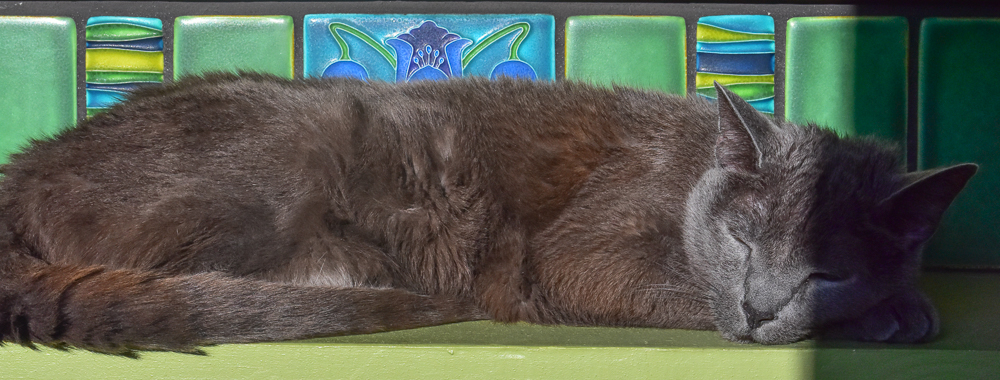
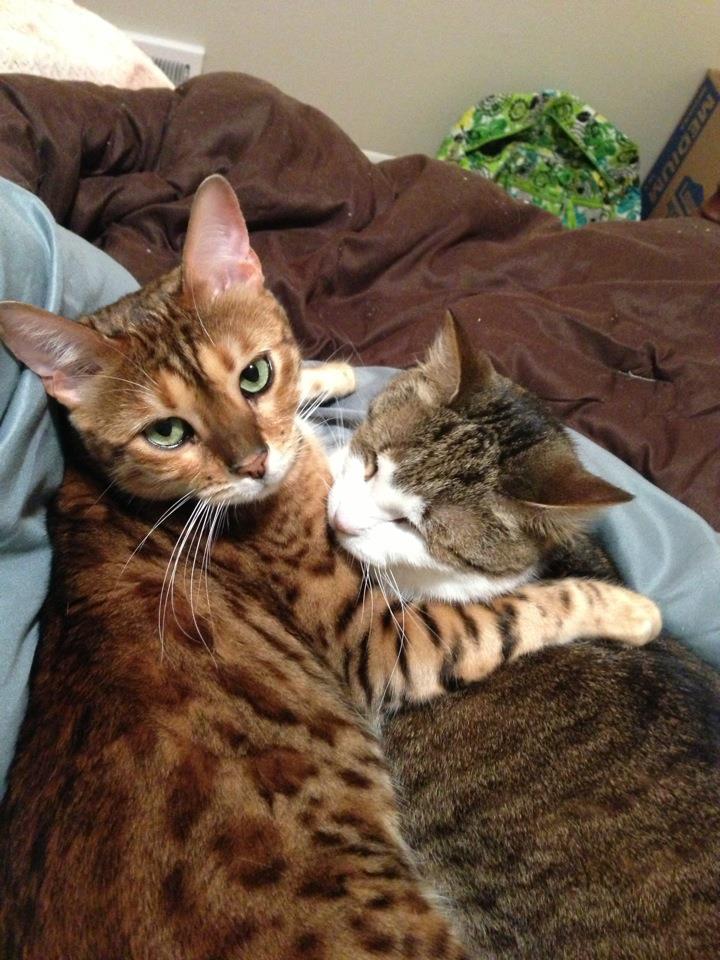
Joey's Mom writes:
"Joey's about a year old and a couple months ago he had to have all of his teeth removed due to severe stomatitis. He stopped eating wouldn't play and was just miserable and in constant agony. The doctors at ECats performed the surgery to remove all of his teeth and Joey is happy and healthy now. He plays with his brother Chandler all day long, and he is reliving all of the kitten months that he missed out on!! He is like a brand-new cat and it makes me so happy to see him so active and playful. His brother Chandler has a hard time keeping up with him sometimes! Joey and Chandler are my little buddies and Joey is definitely a trooper. He deserves to be named cat of the month!"
His Mom writes:
"I adopted Ollie from the Madison (WI) Humane Society back in 1999, when
he was 3 months old. He was found in barn, but that's all I knew about
him. I had to nurse him back to health from a bad upper respiratory
infection, which terrified me because I knew next to nothing about
taking care of sick kitties! While a bit of a scaredy cat, Ollie has
always been a cuddly with those he knows well.
Over time, his personality
has blossomed, and whether it's age, loss of hearing, or just years of
love, he is growing into a much more social kitty in his twilight years,
even coming out when strangers are in the house.
In April, Ollie underwent radioactive iodine treatment for his
hyperthyroidism. We are all hopeful that his treatment will lead to many
more years together!"
Dean
Winchester (formally Garbaj) was adopted from a rescue in February he
is about a year and a half old and we have had him for 10 months. He
only uses 3 of his legs because of a birth defect but that doesn't stop
him from running all over the place. Dean Winchester likes sitting on
the couch and watching tv, tormenting the dog, snuggling and sleeping in
the Christmas tree.
Dean Winchester's mom shared this with Elizabeth Lake Animal Rescue, the rescue that she adopted him from: Dean Winchester was an absolute ham on Christmas. He
was in everyone's laps, demanding to be pet. I tried to get a picture of
him and his kitty siblings but the girls wouldn't cooperate. He has gotten so big and
has done a complete 180 from when we first got him. He used to only want
to be around me and now he wants to be loved on by anybody who walks in
the house.
This
is Bowie, she is 4.5 years old. She was a special needs kitten born
front legs bow legged and a broken tail. In addition, she only has half a tail. With
physical therapy and massages, her legs have straightened out. Bowie likes:
sleeping in her favorite chair or playing in her box, she loves her
food and stealing my lunches! The cutest thing is her purr, it's a
chortle. She is an American Shorthair.
In the past, we have had an annual photo contest for cats to be included in the Exclusively Cats Calendar Contest. We sold the calendars to help raise money for cats in crisis, or charitable cases that we take on, such as everyone's favorite cat with a congenital esophageal stricture, Foxy!
Unfortunately, the cost of the calendar production has continued to rise, and the number of calendars sold has dwindled, and this does not seem to be a good way for us to raise money for these charitable cases anymore. Instead, we have now partnered with the Veterinary Care Foundation to establish an official 501(c)(3) fund for our patients in need. One hundred percent of any donation to this organization in the name of our hospital goes directly into a fund from which we can then request:
To provide charitable funding for emergency medical care for sick and injured animals brought in by “Good Samaritans”
To provide support to qualified clients in need of financial
assistance by providing emergency grants to help supplement the cost of
care
To provide support to pets of families in crisis
To provide care for pets harmed or displaced due to local disaster (such as weather, fire, etc).
We love how excited people get about the photo contest, so while the calendar is currently not in publication, we would like to continue the photo contest on a monthly basis with the same submission guidelines we previously had for the calendar. We now request that each submission be accompanied by a short (or long) biography of the cat (or cats) in the photos. Instead of a calendar, each cat will become the Facebook header on our Facebook page for the month and will be honored with a post on our blog, so that
everyone can continue to meet and appreciate all of the amazing cats
that we see as patients!
We hope to honor our first Cat of the Month on January 1st, so send your photos and bios in ASAP so we can start the voting!
If you enjoy the Cat of the Month and are making a photo submission, please consider donating to the Exclusively Cats Veterinary Hospital Fund (affectionately and unofficially referred to as "Foxy's Fund" by some of our staff) at the Veterinary Care Foundation. It is not required, but humbly appreciated if you choose to make a contribution towards the care of our less fortunate patients.
Marley and Curie: buddies. Gone but never forgotten
In 2012-2013, I lost two cats to cancer within 7 months of each other - one to Hodgekins-like lymphoma, and one to an adenocarcinoma of the lung. Both had been battling cancer for over a year. I had two other elderly cats at home, two small children, and I was emotionally and financially drained. The last thing on my mind was adopting a new cat. But as these things generally happen, an innocent kitten from Elizabeth Lake Animal Rescue found his way into my heart - before he had been officially put up for adoption by the rescue. (This was not Julian...)
Chillin' in a basket
Once the new kitten, Miles, came home, all he wanted to do was play with my older cats. Mina and Serendipity would have nothing to do with him, and I felt bad for him. Two months went by. Meanwhile, a "teenage" cat had been brought into the hospital for Trap, Neuter and Release into a feral colony. Trisha was hopeful that she could find him a home so that he did not have to go back out in the cold October weather, because he was so friendly. I wasn't sure, at first, because he was a little older and seemed shy, but I agreed to take him home and give it a try.
When I first got him home, he and Miles hissed and growled at each other and it didn't look promising. I isolated Julian from the other cats for a gradual introduction, but he launched out of the isolation room and an hour of "chase the cat" ensued before I could get him back into his isolation room again. In contrast, Miles had submitted to isolation with grace, which was helpful, since he had intestinal parasites that needed treatment before he could join the rest of the cats in the house.
After a week or two, however, Miles and Julian became fast friends. While they do not sleep together,
they play constantly. The sound of gallumphing cat paws echoes through the house as they leap and dance and chase each other up and down the cat trees and up and down the stairs. Despite this friendship, relationships between the young cats and elderly cats in the house have been strained. My cats participated in two behavior studies offered by Dr. Deporter at Oakland Veterinary Referral Services testing the response of Intercat Aggression to different pheromones - one which seemed to work, and one that did not. Over time, with the use of pheromones, calming treats and positive reinforcement, relationships between the cats have improved, and they all seem to tolerate each other, if not enjoy each other's company.
Snoozin' after surgery
I have started clicker training Julian to keep his mischief at bay. He is responding well to clicker training, and has learned "come", "sit up" and "spin", so far. He is
easily bored, and will alleviate that boredom by chewing on books,
rugs or, more recently, my three-year-old's toys. Miles, in contrast,
enjoys gnawing on wood, eating stickers, setting his tail on fire and
stealing the food out of your hands at the dinner table. In Julian's
defense, the toy he ate WAS shaped like food - a carrot - but
unfortunately, he had to have surgery to have it removed.
Julian is a joyful cat - he loves to play, and will bring various toys to play fetch up and down the stairs for hours on end. He follows me around the house, right on my heels, and tries to anticipate what piece of furniture will be nearest my stopping point in the house, so that when I reach my destination he can already be there, waiting for
affection.
His eyes say 'I love you' every day.
He is not a quiet lap-sitter, but rolls on your lap and head-butts any book, magazine, electronic device, craft or other item held in your hands until you find yourself sitting with your arms in the air and he is standing on his hind legs on your lap, trying to head-butt whatever is out of his reach (including your chin!). I have placed bird feeders near the windows in our house, and he can often be found holding long, in-depth conversations with the birds and squirrels that visit them. He has a deeply satisfying purr and his tail is always flagged straight up in the air. He is a little bit of a bully towards the other cats in the house, but mostly because he seems to have become the self-appointed leader, and wants to keep everyone else in line. Overall he is an amazing cat!
Katee, in the video above, has a cough, and her owner is concerned.
Just
like people cats can have a cough that sounds different from one-another. Their
cough can be loud or quiet, wheezy or honking, congested (productive) or
dry.The may cough once, a few times or
have coughing jags (paroxysmal coughing).At cat may have a different cough associated with different illnesses as
well, so it could manifest differently at different stages of the cat’s life.
One
challenge in obtaining history regarding a cough is that clients and
veterinarians alike sometimes write it off to normal “hairball' problems. In
fact, the cough is often due to respiratory disease including chronic
tracheobronchitis. Tracheobronchitis in cats is common and results in recurrent
coughing followed by gagging. It is the gag that may trigger vomiting after a bout of coughing, which can confuse the issue.
Illuminating this history is difficult and one must first ask the question,
then explain the distinction, then mimic or demonstrate with video the
difference between vomiting and coughing. If we don't have a high index of
suspicion, if we don't have the time to get a good history, and if we don't
have the tools to open the client's mind and help them to understand the
distinction, then we will not get this history.
Attributing
a cough to a hairball is a misnomer with virtually no scientific basis. This
notion will likely never be expunged from lay dogma. There is no documentation
in the literature of uncomplicated trichobezoars (hairballs) causing coughing in cats.
Coughing has been reported in complicated surgical cases of gastric
trichobezoars in man, but has not been reported in cats.Cough attributed to gastroesophageal reflux
disease in man is common (over 20% of chronic coughs), but this has not been
described in the cat1 (Tatar).It is possible that an esophageal location of
a trichobezoar could compress pulmonary structures and thereby elicit a cough,
however, this too has not been reported.
While
white petrolatum, Vaseline, is often recommended and administered to cats for
treating constipation and/or trichobezoars, giving Laxatone (or any other
flavored white petrolatum) orally has never been shown to change the
consistency or the slipperiness of the stools or aid in the passage of hair in
the stomach.Theoretically, if you want
to lubricate the rectum you could administer Vaseline in that manner, but giving
it orally ends with petrolatum simply being incorporated into the stool.
Searching
PubMed (Aug. 2012) reveals no published studies in man, or animals, that
demonstrate any the effectiveness of these products. While there is not a
significant risk (and some cats love this stuff) some reported concerns would
include passive steatorrhea and fat soluble vitamin deficiencies. There are
over 50 published reports related to the efficacy of liquid paraffin for
constipation in man, but none in cats. There is one report of liquid paraffin
being superior to lactulose in children. The use of Vaseline in cats may be
intended to result in the same effect, but they are very different products.
Mineral
oil, of course, should be avoided because it can be easily and silently
aspirated. Aspiration of mineral oil does not elicit a cough reflex (like
aqueous based products) leading to lipid-like pneumonia.
If
constipation is a concern (difficulty passing hard stools, straining) and a
stool soften was needed then one could consider canned foods, adding water to
the existing diet, water-soluble fibers, PEG3550 (Miralax), and lactulose.
The
ongoing recommendation of administering product containing white petrolatum as
a means of dealing with constipation or ‘hairball’ is a fallacy that should not
be perpetuated.
It has come to our attention, recently, that there are a number of breeders
and websites that claim that the Bengal breed is immune to Feline Leukemia
virus. Unfortunately, this is not the case. There are multiple reports across
the nation of feline leukemia positive cats that are Bengals. This myth
probably arose due to the origins of the Bengal breed.
The Bengal cat originated in part due to Dr. Willard Centerwall's research
at Loyola University in the 1970's - breeding Asian Leopard cats to domestic
cats in order to study the inheritance of Feline Leukemia. Asian Leopard Cats
are considered to have some PARTIAL immunity to feline leukemia, but Feline
Leukemia Virus has been detected in some Asian Leopard Cat cell lines.
Unfortunately, when Dr. Centerwall passed away (in the 1980's, we believe), his
research was not continued, so no studies have been done to determine how much,
if any, partial immunity has been inherited by later generations. According to
a European source, pet quality Bengal cats (4-5th generation removed or more
from the Asian Leopard cat cross is considered to be a domestic cat and a
"purebred Bengal") generally have in average only 12.5%
"wild" blood in them (F4 generation = 6-14%, F5 generation 3-12%), ,
which argues that the likelihood that they have any partial immunity is very
unlikely. Needless to say, the fact that there are Bengal cats out there that
are testing positive for Feline Leukemia Virus is the strongest argument
against the claim that they are immune.
Bengal kittens
All felines are at some degree of risk of developing feline leukemia if
exposed to the disease - Florida panthers, lions, tigers, etc. Indoor cats are
at very low risk of exposure, but any outdoor cat that is not 100% supervised
while outside is potentially risking exposure. This is why we recommend that
all cats be tested for Feline Leukemia after adoption (or after being found as
a stray) and that cats with high risk lifestyles be regularly vaccinated for
Feline Leukemia, regardless of their breed.
Kinsey  aka Kinsey Leigh
Breed: Silver Mackerel British Shorthair
Age: 1 1/2 years
Gender: Spayed female
Weight: 9.0 lbs - great body condition
Demeanor at the vet: Super sweet girl!
Kinsey is our Southern Belle.  Originally from Arkansas, she moved north to Michigan and has never looked back.  She spends her days chasing after her brother Bentley and leaping on to anything and everything.  She is definitely a Momma's girl and enjoys evenings on the couch giving and getting love.
Never wanting to be left out, and true to her breed, wherever you go...she goes.  Whether it's folding laundry or making dinner, Kinsey is always there to give her own kind of special help.
Helping with luandry
She has made our lives, and her brothers, all the better.  As all cat lovers know, our pets are truly a part of our family.  Kinsey is our "little girl" and thanks to the love and care she gets from ECVH, we look forward to many, many years of love to come!

Enjoy these lovely photos of sweet Ms. November!
This is how excited your cat looks when you have to give him a pill, right?
Many times when we see sick patients, people are just as concerned with the
fact that they will have to give medication to their cat as they are about the actual
diagnosis. Medicating a cat can be HARD! Many people are worried about
frightening or stressing their beloved feline, or sticking their fingers into a mouth with
so many sharp teeth. But giving your cat a pill or other kind of medicine is
not impossible. We've gone through the process, step by step, and included a couple of the many videos out there, with tips and tricks.
First of all, if you have a young cat, you may want to try getting him used
to the idea while he is young and healthy. You may want to practice
periodically opening his mouth and placing a small bit of canned food on his
tongue so that he begins to accept the idea that when you put something in his
mouth, it ends with a yummy treat. If he is cooperative, give him a treat
afterwards, too. This way, if he becomes ill in the future, he is already used
to the process of getting medication, and is not having to learn about it when
he feels sick.
When you are ready to give medication, get all your supplies together
before gathering up your cat. Get the pill out of the vial, or draw up the
correct measure of liquid medication. Get your treats ready, a towel, any
helpers you need, and THEN go looking for your cat.
For giving either a pill or liquid, place your cat on a flat surface, with
his head facing away from you. Pull his rear end in close to your body, so that
he cannot back up. Use one hand to hold your cat's head. Place your hand over
the top of his head like a winter cap with ear flaps. Your thumb and fingers
should wrap around the sturdy cheek bones - the cat's head is a triangle or
wedge shape, so holding the widest part in your hand allows the greatest amount
of control.
Gently guide his chin into the air. This causes the jaw muscles to relax,
and makes it easier to open the mouth.
If you are giving a liquid medication, place the tip of syringe in the
corner of your cat’s mouth, and squirt the medication into the space between
the cheek and gums (the "cheek pouch"). Hold onto your cat's head
until he swallows the medication, and then reward him with a yummy treat.
If you are giving a pill or capsule, hold the pill between your thumb
and first finger of the hand that is not holding your cat's head. Use your
middle finger to open your cat’s mouth by slipping it between his tiny incisors
and then slide the pill down the center of the tongue to the back of the mouth.
Again, hold his head until he has swallowed the medication and then reward with
a treat.
If you are using a pill popper to hold your pill for you, you will use a
technique that is similar, though you should slide the pill popper into your
cat's mouth just behind the canine teeth, and your cat will open his mouth
reflexively. Then "shoot" the pill over the back of the tongue, and
continue to hold his head until he swallows the pill. Reward with a yummy
treat.
If your cat is wiggling, struggling or using his claws, place a thick towel
across your cat's shoulders and then wrap downward around your cat’s neck and
front legs to protect yourself, and help hold him still. You may want to enlist
the aid of a second person in cases where your cat is quite wiggly. Your helper
can hold your cat's body while you focus on giving the pill.
We do not recommend hiding the medication in your cat's food, since many
medications are bitter tasting and can make your cat dislike his regular diet.
However, if you cannot medicate him any other way, find a food that your cat
will eat that is a different flavor than his normal diet, and offer only enough
of this food to mix with the medication. Then offer your cat his regular diet.
However, many cats will simply eat around the medication and you will find the
pill remaining in the dish. If your cat does this, you will need to either
medicate your cat manually or find another alternative.
Pill pockets or other treat wraps are another option, which can be used to
hide a pill or capsule inside. The pill pocket is cup shaped, so that you can
place the medication inside and seal it, then offer it as a treat. We recommend
offering some empty pill pockets, first, so that your cat is less suspicious of
this new treat.
In many situations, there may be other alternatives available.
Compounding pharmacies can formulate many medications as a liquid with a
pleasant flavor, such as tuna or chicken. This medication may have a shorter
expiration or need refrigeration, or may be more expensive than the pill form,
however, many people find the tasty flavorings make the medication process much
easier.
Compounding pharmacies offer alternative forms of traditional medications individually prepared for each patient
Some medications are also available as a transdermal gel. This special
medicated gel is able to be absorbed through the skin rather than requiring
oral administration. Typically, these medications are applied to the inside of
the tip of the ear. Only a few medications are well-absorbed through the
skin, and not every cat's skin absorbs the medication as well as expected, so
it is important to test cats' response to the transdermal medication regularly.
It is also important to remember to use gloves or finger cots to administer
this medication, since it can be absorbed by human skin as well as cat skin.
Other medications may be available as a transdermal patch or as an
injection. Many people are surprised at how well cats tolerate injectable
medications! For many people, once they have learned how to give an injectable
medication, they find it much easier than giving a pill or liquid.
Unfortunately, not all medications are available
or effective as transdermal applications. And injectable medications are
sometimes only available to be given IV or into a vein, or may sting badly. IV
medications or medications that sting should be administered by a professional
such as a veterinarian or veterinary technician, not given at home. Yourveterinarian will be able to help you choose
the type of medication that works best for you and your cat, and most
veterinary staff members are very willing to help demonstrate effective
medication techniques.
Answer: Oleic acid. This fatty acid is found in squashed ants, cat pheromones (including synthetic pheromones like Feliway) and olives,
which explains why some people report that their cats go crazy over olives.
The facial pheromone of cats has been determined to be
anywhere from 43-65% oleic acid, which suggests that when cats "go
nuts" over squashed ants or olives, they are reacting to a smell that
tells them "this is a wonderful, familiar thing that belongs to you".
Because cats rub this facial pheromone on areas that make them feel comfortable, the synthetic pheromone, Feliway, seeks to reduce unwanted behaviors that cats perform when they are stressed by the environment (for example: moving to a new home, interacting with a new cat, traveling...). These behaviors include urine marking, scratching, hiding, and over-grooming.
On the other hand, oleic acid has a very different message to send to ants. The release of the oleic acid odor signals to the other ants that an ant has died and needs to be moved to the colony's ant-graveyard. E. O. Wilson discovered in the 1950's that if you dabbed a tiny bit of oleic acid on a live ant, other ants in the colony would pick it up and move it to the graveyard repeatedly, until the ant had cleaned itself thoroughly enough to remove all traces of the oleic acid.
Olives don't need to feel comfortable or bury their fallen comrades, so why is oleic acid in olives? Scientists think that some plants developed high levels of oleic acid to encourage insects like ants to bury their seeds. Since olives carry a seed, a fallen ripe olive, full of oleic acid would potentially attract ants or other insects to carry the olive or its seed back to the ant graveyard and "plant" it, allowing a new olive tree to grow.
So, while these things all have something in common, we do not recommend rubbing olive oil or squashed ants in areas where your cat has been inappropriately urinating, nor do we recommend feeding your cat olives to cheer him up. And we DEFINITELY do not recommend using your cat or an ant as a garnish on your Greek salad or in your favorite martini.
We'd love to hear whether your cat is intrigued by olives or crazy for ants...or both!
A meeting scheduled with Ellen from Elizabeth Lake Animal Rescue to adopt an adorable kitten named Sushi who had been brought into Exclusively Cats for a wellness exam. The plan was to adopt one little kitten. The meeting went well and Sushi was coming home.
Before leaving, Ellen said "I thought you might want a friend for Sushi." She stepped aside so Crash was visible in his cat carrier. He looked scared and Ellen said he had been overlooked for several months by others seeking a pet. He was not a kitten and he had lost his tail in an accident. It looked like a very strange, mangled stump. It was love at first sight and the deal was sealed. Crash and Sushi were instant friends and inseparable.
Crash is a dog in a cat's body. He comes running when he is called (his run resembles a deer prancing), he greets people at that door, he is always friendly and eager to please. He is the favorite of many family members and friends, as he is very generous with his love.
Our cat family has grown since that meeting and Crash Nubbins is always the first to welcome a new member. We are so happy that we took him home, that day. Love this cat!!!!