Showing posts with label cats. Show all posts

Monday, July 10, 2017

Case Report: Cessna - His tail's not all it's cracked up to be...


Cessna

This handsome 8 year old came to see us for the first time in May, this year, with a particular tale to tell. His owners had found him on April 18th, with an injured tail and a trail of blood through the house, leading back to their daughter’s bedroom and under her bed, where he loved to sleep. His owners had no idea what could have happened to his tail.


Cessna's damaged tail bone
They rushed him to a veterinary hospital on emergency basis and they repaired the injury by amputating the injured tip of his tail. About a month later, he returned to the hospital, having traumatized it again. He had been wearing an Elizabethan collar all the time and still managed to injure himself.  In addition, he was hiding, no longer social and good natured. It was recommended that the rest of his tail be amputated. Cessna’s family was uncertain that was what they wanted to do, so they brought him to Exclusively Cats Veterinary Hospital for a second opinion.


On May 24th, there was no sign of infection, and the tail tip seemed to be healing well, so we re-bandaged it and attempted to manage his apparent chronic pain with a prescription for Tramadol. At this visit (and previously, at the other veterinary hospital), Cessna was notably quite grumpy and intolerant of much handling.


Cessna's new, short tail
Cessna’s hind end was very sensitive and his owners were not able to look at his tail at home, and was also very difficult to medicate. On May 30th he managed to remove his bandage and get at his tail, again. On June 16th, Cessna’s family found a tick on him and wanted to have us look at him. He had been doing well on the Tramadol, but still seemed bothered by his tail. At least, however, he was not attacking it anymore. On the ride into the hospital, he started attacking his tail again, and urinated and defecated on himself. His family was distraught because they felt that he was miserable and could not live with this issue. They wondered if he needed his entire tail amputated. We took x-rays of the tip of his tail, and it appeared that due to his attacks, he had either exposed a sliver of bone, or some nerve tissue or tendons. At this time, his owners opted to pursue another tail amputation, and another 2 inches of tail needed to be removed. The concern about amputating completely was that if the entire tail was removed and he was still painful, he might start attacking his hindquarters and cause irreparable damage to himself. We applied a pain patch, gave him a mild sedative, an epidural, and a cocktail of other pain medications. He recovered from surgery well, and we sent him home on phenobarbital for pain control, sedation, and suppression of hyperesthesia-like symptoms.
Abnormal bone-like material in one of the tail joints


He went home again, but went into hiding. He started attacking his tail again on the 18th. His appetite decreased and started trying to bite his mom when she medicated him. He hid under the bed and defecated on himself when his family members tried to get him out from under the bed.


Cessna was a little embarrassed by his Thundershirt, at first...


His family was beginning to lose hope. Cessna was miserable, and they wondered if it wouldn’t be kinder to euthanize him. He was no longer the loving cat they had known, and he seemed to be in constant pain and distress for no known reason. We examined his tail again and reviewed the x-rays from the previous hosptal and discovered an abnormal joint much closer to the base of the tail that did not flex as nicely as the rest. We x-rayed the area and discovered a very small round mineralized object located in the joint space between two tail vertebrae. This is likely abnormal bony growth due to arthritis. Because it is located between two vertebrae, it likely sends shooting pain down the length of the spine whenever he moves his tail. Since the pain was radiating down the length of the tail, Cessna was attacking the part of his tail that he could easily reach, and not the area that was causing the pain.


We amputated the tail behind the affected joint, leaving about 3-4 inches of tail for him to wave, and crossed our fingers. He received another pain patch, a local nerve block and was started on a medication regimen of gabapentin for neuropathic pain, phenobarbital again, and Onsior for inflammation. In addition, Cessna started wearing a Thundershirt. He stayed with us at the hospital for 18 days as we balanced his pain medications – little enough that he could walk around, eat, and use the litterbox, but enough that he would ignore his tail. Over the time that he was here, he grew continually more affectionate and well-mannered. He began asking for attention, rather than hiding. He was allowed some exercise time to sit in the office with the doctors while they worked on paperwork, and he sat on the cat tree with Mr. A.


Cessna became more outgoing after a while


At first, the Thundershirt was hard for him, because he wanted to curl up in a ball and not move with it on, but by the time he was discharged, he was jumping up into laps for cuddle time. Our entire staff enjoyed his antics as he became more adventurous and learned how to steal tuna fish from Dr. Demos, or snuck through the door to visit the receptionists. On July 6 th, we took his sutures out and for the rest of the morning, he was angry at his tail again, so we gave him an injection of Simbadol, which is a long-acting pain medication. We suspect that his tail was a little painful again, because we meddled with the tail and scrubbed it to clean the incision area.


On July 7, he went home to his family, and the purrs that rumbled out of his chest were so loud they could be heard across the room! We are hoping that he continues to improve over the next few weeks so that we can stop his medications and continue with just the Thundershirt. We’ll have him wear the Thundershirt for another couple weeks after that before we have his family try to take it off. At that time, we hope that his life can get back to normal – his long tale cut short for good reason!

Environmental enrichment (tuna in a cup) becomes Cessna's preferred method of keeping his tail safe

Monday, July 13, 2015

Is it ok to feed my cat dog food?


If you have both dogs and cats in your house, you may occasionally catch your feline friend snacking out of the dog bowl. Some people may even wonder why they need to buy separate foods for their cats and dogs since they seem to want to share. All those dry kibbles look the same and all those meaty moist chunks look pretty similar, too. Are they really so different?

As we are fond of saying in feline medicine, "cats are not small dogs", and there are some significant differences between the two species when it comes to digestion. 

1) Food moves through a cat's digestive tract more quickly than a dog's, both because it is shorter, and because it is speedier.

2) A dog's caecum is more developed than a cat's, allowing more breakdown of plant material

3) The intestinal lining is different

4) Dogs have some plant-crushing molars while cats do not have any teeth suited to grinding plant material

5) Cats require more dietary protein than dogs (a minimum of 8% more, by AAFCO standards)

6) Cats cannot make the amino acid taurine from their diets like dogs and people can

7) Cats cannot make nicotinic acid from tryptophan well

8) Cats cannot turn beta carotene to retinol, so need dietary vitamin A supplementation

9) Cats cannot make linoleic acid from arachadonic acid well, but they need both fatty acids in their diets

10) Cats cannot cope with high levels of carbohydrates

Everything that a cat cannot make in large enough amounts to fulfill their dietary needs must be supplemented in their diet. Dogs, in contrast, can make these nutrients from the food they eat, so dog food does not contain extra supplements of taurine and vitamin A, sufficient levels of protein, etc.

What happens when a cat is fed a diet lacking in these nutrients?

A lack of vitamin A can cause changes to the retina, development of cataracts and other eye issues, muscle weakness, and weight loss or poor appetite.

Nicotinic acid is related to vitamin B3, and a lack of this nutrient causes weight loss, weakness, poor appetite and diarrhea. Cats also have different thiamin and folic acid requirements than cats.

Fatty acids are essential for skin and coat health, immune function, and control of inflammation. Arachidonic acid also is involved in the health of the kidney.

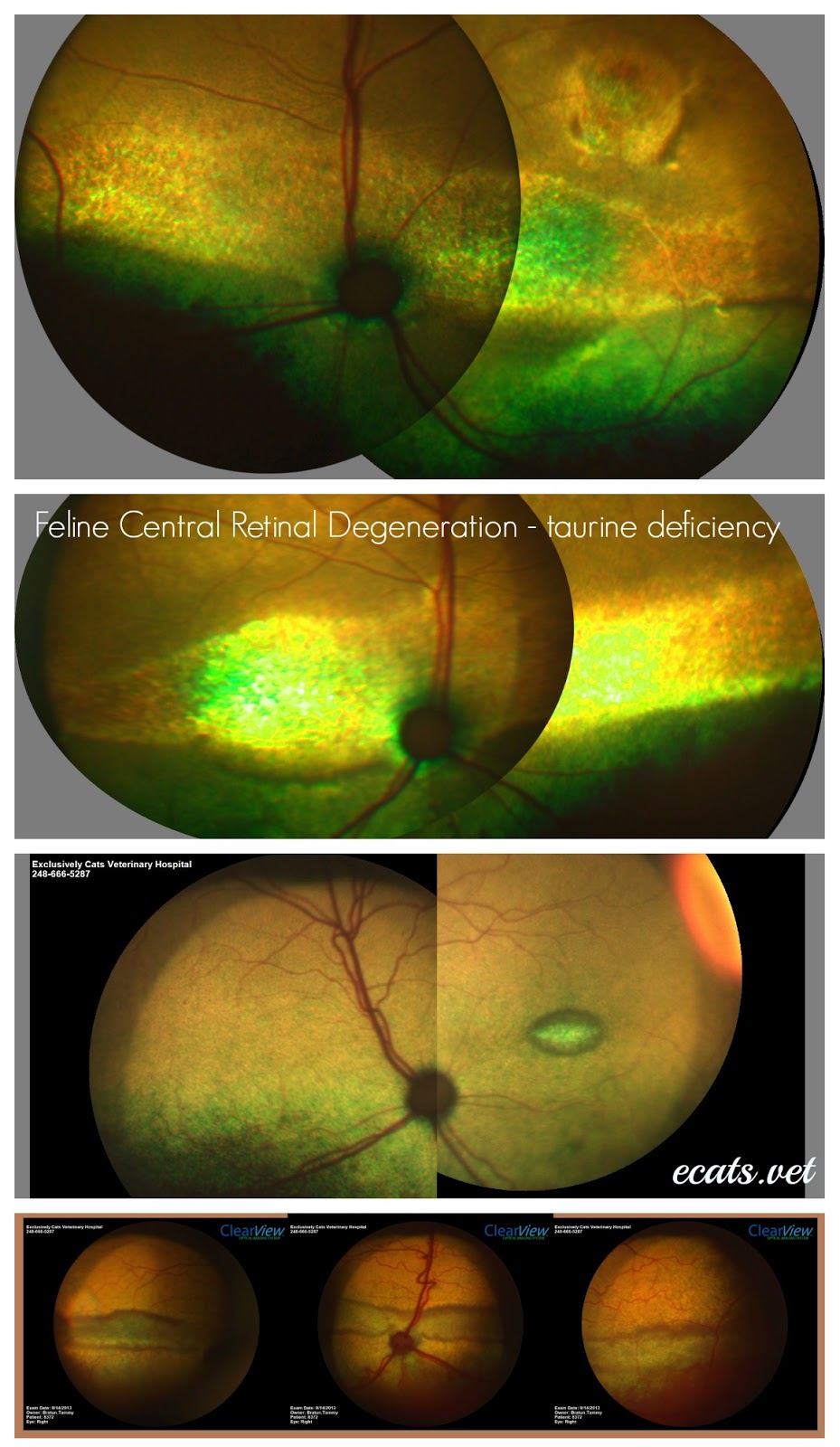
Most importantly, however, a lack of taurine in the diet can cause irreversible damage to the heart retina of the eye (central retinal degeneration). Taurine is an amino acid that is found in muscle meat. It is found all over the body, but is concentrated in the brain, eye and heart muscle. It helps with digestion and absorption of fats and fat soluble vitamins, the formation of bile salts, and is involved in eye health, brain and nervous system function, heart function, immune function and female reproduction and fetal growth.

It can take as few as 10 weeks for the cone photoreceptors of the retina begin to deteriorate when a vision are handled by the cone receptors of the eye, while low-light vision is the responsibility of the rod receptors in the retina. After 20 weeks of low-taurine diet, many of the cone receptors will be completely unresponsive, and eventually the rod photoreceptors will also be affected. A very classic and unique lesion will form equally in both eyes, and if left untreated, blindness is the end result.
cat's diet is low in taurine. Color and daylight

Besides these eye issues, taurine deficiency can cause dilated cardiomyopathy. Before it was understood that cats had a special need for supplemental taurine in their diets, the leading cause of dilated cardiomyopathy in cats was taurine deficiency. In 1987, the connection was made between the heart disease and the low level of taurine in many diet, and cat food standards were corrected. Now, DCM is rare. The wall of the heart, the myocardium, contains the highest concentration of taurine anywhere in the body of the cat. With a deficiency, the heart muscle weakens. It cannot contract as well as it needs to to pump blood, so blood pools in the chamber and the ventricle swells. This can lead to the formation of a large blood clot, or can lead to congestive heart failure. If caught early, the damage to the heart can potentially be reversed, but the changes to the retina are permanent.

 Taurine deficiency can also cause a decrease in blood proteins and white blood cell numbers, which can affect immune function.

Most cats that develop a taurine deficiency do so because they are eating a low-quality diet, dog food, or a home cooked meal that is poorly balanced (even if you feed muscle meat, cooking can degrade or destroy taurine, so it may still need to be supplemented). Preventing taurine deficiency is achieved by feeding a higher quality diet. However, in some cases, a cat may develop a deficiency even when fed a high quality diet, and in these cases, taurine supplementation beyond a normal diet is necessary.

Because of these special nutritional needs of cats, it is not a good idea to feed your cat a diet of dog food alone. If your cat occasionally snacks from the dog bowl, you shouldn't be too concerned, but your cat should have plenty of nutritious cat food readily available.