Showing posts with label health myths. Show all posts

Monday, November 23, 2015

Feline Leukemia and Bengal Cats


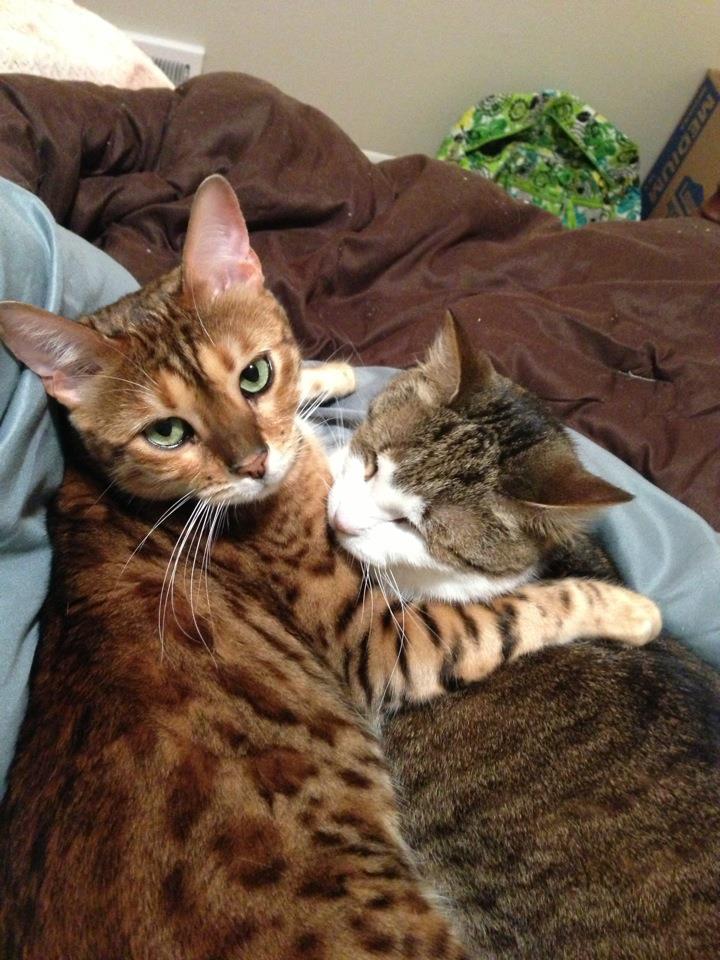
Bengal cat (left) and domestic shorthair (right)
It has come to our attention, recently, that there are a number of breeders and websites that claim that the Bengal breed is immune to Feline Leukemia virus. Unfortunately, this is not the case. There are multiple reports across the nation of feline leukemia positive cats that are Bengals. This myth probably arose due to the origins of the Bengal breed.

The Bengal cat originated in part due to Dr. Willard Centerwall's research at Loyola University in the 1970's - breeding Asian Leopard cats to domestic cats in order to study the inheritance of Feline Leukemia. Asian Leopard Cats are considered to have some PARTIAL immunity to feline leukemia, but Feline Leukemia Virus has been detected in some Asian Leopard Cat cell lines. Unfortunately, when Dr. Centerwall passed away (in the 1980's, we believe), his research was not continued, so no studies have been done to determine how much, if any, partial immunity has been inherited by later generations. According to a European source, pet quality Bengal cats (4-5th generation removed or more from the Asian Leopard cat cross is considered to be a domestic cat and a "purebred Bengal") generally have in average only 12.5% "wild" blood in them (F4 generation = 6-14%, F5 generation 3-12%), , which argues that the likelihood that they have any partial immunity is very unlikely. Needless to say, the fact that there are Bengal cats out there that are testing positive for Feline Leukemia Virus is the strongest argument against the claim that they are immune.

Bengal kittens

All felines are at some degree of risk of developing feline leukemia if exposed to the disease - Florida panthers, lions, tigers, etc. Indoor cats are at very low risk of exposure, but any outdoor cat that is not 100% supervised while outside is potentially risking exposure. This is why we recommend that all cats be tested for Feline Leukemia after adoption (or after being found as a stray) and that cats with high risk lifestyles be regularly vaccinated for Feline Leukemia, regardless of their breed.


History of theBengal Cat

Recurrent Demyelination and Remyelination in 37 Young Bengal Cats with Polyneuropathy
 

Friday, September 16, 2011

Does An Apple a Day Keep the Veterinarian Away? - Feline Health Myths, Part 5

Myth: Cats lose weight because they are old.

A thin cat with poor hair coat associated with poor diet
Unhealthy weight loss is often accompanied with a change in hair coat.
Reality: This is a great myth to talk about right now, since September is Senior Cat Month!  It is generally true that older cats will lose weight, but old age is not a cause of weight loss. Cats don’t diet, so your obese cat is not likely losing weight because he didn’t like his silhouette in the mirror. If you look more closely at these older cats that are losing weight, some may be eating normally, some may be eating less, and some may be ravenous! 

The older cat that is eating normally or less than usual: Is your cat drinking more water than usual? Are you noticing larger clumps of urine in your litterboxes when you scoop? Your cat may be showing signs of kidney disease.

Is he no longer jumping up on the counters like he used to? Do stairs seem to intimidate him? If so, then your cat may be suffering from arthritis, or may be experiencing some changes to his vision. His food may be in an area where he can no longer easily access it.

Does he drool? Or does his breath smell bad? Many cats seem to ignore extremely painful dental disease, but others will decide not to eat as much food if their teeth are painful.

Are there no other signs besides weight loss? Or maybe your cat’s stools are less than ideal – runny or malodorous? It is possible that your cat has chronic inflammation in the intestinal tract, or lymphoma, which is a cancer that attacks the intestinal tract.

A cat eating dry kibbleThe older cat that is ravenous and/or vomiting: If your cat is vomiting more than usual or ravenously hungry, it can be a sign of hyperthyroidism. The thyroid gland is located in the neck region and can become overactive as cats age. The gland may grow in size, too, and can sometimes be felt by running a finger over the underside of the neck. This has effects on the metabolism, heart rate and energy level of a cat, generally speeding things up. This gives them less time to digest their food, which can cause runny stools. The changes to the heart can cause high blood pressure and can cause damage to the heart muscle itself. A high energy level may make your cat seem kittenish again, but may also cause him to keep you up at night with inappropriate yowling or high activity levels. Thyroid problems can also cause increased thirst and urination which can mask kidney damage. Fortunately, hyperthyroidism is very treatable – but the sooner it is treated, the less lasting damage is done to the body.
Another reason your cat may be ravenous or eating normally but losing weight may be diabetes. Often diabetic cats will drink more and urinate more than normal. They eat a lot because their bodies cannot use the sugar (glucose) that is in their food to make energy. Instead, the sugar is circulated in the blood and then eliminated in the urine. In order to make energy, the body starts to use another method to produce energy, which can result in muscle loss and a severe medical condition called ketoacidosis.

A large, obese orange tabby cat showing his belly
A word about healthy weight loss in obese cats:
It is a good idea to encourage weight loss in overweight senior cats, to avoid problems such as arthritis, diabetes, high blood pressure, or other heart and respiratory complications.

Just like with humans, there is no easy quick weight-loss miracle - getting a cat to lose weight in a healthy way takes time, and a combination of diet and exercise. An overweight cat on a weight loss plan should not lose more than half a pound in four weeks. 

One pound of weight loss may not seem like much, but for a 10 pound cat, it is 10% of its body mass - that's equivalent to 15 lbs. in a 150lb. human.  

The American Veterinary Medical Association recommends wellness exams every 6 months in senior cats because they age much more quickly than humans do. If you have noticed that your cat is losing weight or if it has been more than 6 months since your senior kitty’s last exam, it might be time to schedule a checkup!

Tuesday, August 30, 2011

Does An Apple A Day Keep the Veterinarian Away? - Feline Health Myths Part 4

Myths: 
1) All orange cats are male.
2) All calico cats are female.
3) Rare calico males are worth a lot of money, and cannot reproduce.


Rainbow and CC - a cloned cat and her "mother"
Reality:  Feline coat color genetics can be very confusing. One of the great scientific experiments 10 years ago was that of cloning a cat. Rainbow was her name, and CC (Copy Cat) was her clone - they have the exact same DNA, but they look quite different. Rainbow is a calico and CC is a brown tabby and white cat. This just helps to illustrate how complex this situation is! 

1) Orange cats can be male or female.

First, a little about genes: The gene for orange coat color is classified as a sex-linked gene because it is carried on a sex chromosome. The genes that make us male or female are on the X- and Y-chromosomes. An X from the mother and an X from the father makes XX or female. An X from the mother and a Y from the father makes XY or male. The male is the one who determines the sex of the offspring.


Orange tabby cat with a typical "M" marking
Orange tabby cat with a typical "M" marking and faint leg stripes
The orange gene doesn’t add orange hair coloring to white fur, it actually changes black pigment into a reddish pigment. The orange gene is carried only on the X chromosome. Since a normal male has XY chromosomes, he only needs to inherit one orange gene for him to be an orange cat. A normal female is XX genetic makeup so she must inherit two orange genes to be an orange cat. If she inherits only one orange gene, only some of the black color will be converted to orange, so she will be a patchy orange and black coloration called a “tortoiseshell” or “tortie”.


Also, if you look closely, all orange cats have tabby markings. Sometimes the tabby markings may be limited to just the “M” above the eyes, or stripes on the legs or tail, but they are always there. They are also visible in the orange areas of tortie cats. This is because the gene that turns off tabby to give solid color cats does not work on the orange color.


Since females must have two orange genes to be a pure orange cat, they are less common than male orange cats, but they are not considered to be rare. If two orange cats breed, they will have orange offspring, because both the X-chromosomes in the mother and the X-chromosome in the father will all have the orange gene.


The genetics of orange or ginger coat color is explained in more detail in Tortoiseshell and Tri-Colour Cats (orange is caused by the same gene as tortoiseshell).

Ginger, our favorite tortoiseshell cat
Ginger, our favorite tortoiseshell


2) Tortoiseshell and calico cats can be male or female, too! 

How can this be, since we just learned that of the male has the orange gene, all his black color will be changed to orange?

First, "tortoiseshell" refers to a mottled coat pattern of orange and black with very little white. This coat pattern can also be grey or blue-ish and cream, but is then called "dilute tortoiseshell".
Cleo, a lovely calico
Calico coat patterns have large areas of white with distinct orange and black patches. Interestingly, the Japanese word for calicos is mi-ke and translates into "triple-fur" - a very apt description!  Calicos can have single-color patches or tabby striped patches. If they have stripes, they can also be known as "patched tabbies", "tortie tabbies" or "torbies". Calicos can also have the dilute blue or grey and cream coloring.


There are three ways that a male cat can end up with calico coloration:

1)     Chimerism – Something happens during the pregnancy to cause two embryos to fuse together. If one has genes for black coat color and the other has genes for orange coat color, and one or more of the embryos are male, the result may be a tortoiseshell or calico male. This scenario is most common in animals that give birth to large litters…just like cats. These cats will be fertile, however, their offspring will not be calicos or tortoiseshells, since they can only pass on one X-chromosome at a time.

2)     Klinefelter Syndrome – XXY chromosomes. Since it has a Y chromosome, this cat will be male, but since it has two X chromosomes, it is able to have one X-chromosome with the orange gene and one X-chromosome with the black gene. These cats will be sterile.

3)     Somatic Mutation – During development, an orange male develops a black patch, which happens similarly in human babies with port wine stain birthmarks. These cats will be fertile. 


3) While calico and tortoiseshell males are rare, and scientifically interesting, they are not really more valuable than other cats, even if they are fertile males.  
The offspring of these cats will not have any more likelihood of being calico males or male tortoiseshells than any other cat, so their total "worth" is usually as much as their breed is worth. For example, a Grand Champion purebred calico male Persian will be worth more money than a stray calico male off the street. The genetics of tortoiseshell males is explained in more detail in Tortie Tomcats.


There is, however, a superstition is that these cats are good luck.


Of course, we all know that the true worth of a cat is in its personality and affection, and the joy that it brings to our homes - male or female, calico or not!  

Monday, August 22, 2011

Does An Apple A Day Keep the Veterinarian Away? - Feline Health Myths Part 3


Myth: My cat doesn’t need to go to the vet because it is indoor only.

Reality: Over the last five years, the number of times pets visit their veterinarian has decreased significantly. Over that same time period, the incidence of preventable diseases has also increased in cats. In the 2011 State of Pet Health report released in April, the number of cats with fleas increased by 12% and is now double the number of dogs seen with fleas annually. The number of cases of cats with roundworms (which are communicable to humans) increased by 12.6%. The number of cats diagnosed with tapeworms increased by 15%. However, what is interesting is that the greatest increases were seen in diseases that are unrelated to whether cats go outside. Diabetes in cats increased by 16%, ear infections in cats have increased by 34% and dental disease now affects about 88% of all cats over the age of 3 years.

Partnership for Preventive Pet Healthcare logo
The American Veterinary Medical Association (AVMA), one of 16 veterinary health organizations engaged in the Partnership for Preventive Pet Healthcare, recommends yearly checkups at the minimum for all pets, whether they go outside or not. Disease in animals is very subtle, especially in cats. Cats are not pack animals like dogs, so their instinct is to hide their illness from others. It often isn’t until they are very sick that cats show obvious outward signs of poor health. Cats will continue to eat normally despite badly infected, diseased teeth. Kidneys can sustain loss of up to 75% of their function before cats or dogs begin to show outward signs of illness. Often the first obvious sign of high blood pressure (hypertension) in cats is sudden or gradual blindness.

Often the first sign of a problem is weight loss. This loss can be subtle and gradual, so it is important for your veterinarian to have a history of healthy weight trends for your cat. Even if you feel your cat is in perfect health, he should have an annual checkup – in fact, the annual exam is probably of more importance than vaccinations. At Exclusively Cats Veterinary Hospital an individualized vaccination schedule for your cat is always determined by multiple factors, such as age, health status, previous vaccination history and any previous vaccine reactions.

The doctor’s physical exam includes:
  •  a dental exam – are there any painful teeth or abnormalities to the mouth?
  •  a weight and diet assessment – is your cat overweight, underweight, just right. Could any change of weight or other health factor be due to a change in diet?
  • Dr. Bailey examines a white cat named Buddyan assessment of your cat’s skin and coat – does your cat have fleas? Dandruff? Itchy skin? Is there hair missing anywhere?
  •  an assessment of the ears and eyes – are your cat’s deep ear canals clean? Is the eardrum visible? Are the eyes clear? Does your cat show any signs of losing sight?
  •  an assessment of the heart and lungs – are there any unusual sounds in the chest? Is the heartbeat regular and normal, or is there a murmur?
  •  an assessment of the abdominal organs and the musculoskeletal system – are your cat’s kidneys normal in size and shape? Is there anything in the abdomen that feels out of place? Does your cat sit, walk and stand normally?
  •  Is your cat using the appropriate parasite control for its lifestyle? Are any previously discussed issues resolved or recurrent?
In addition to the exam, the veterinarian will discuss your cat’s lifestyle and condition with you. During your visit, be sure to bring up any health-related or behavioral issues, or even general cat care questions you may have. The staff should be more than willing to answer your questions and help make your relationship with your cat the best it can be!

Depending on what the veterinarian finds on physical exam and discusses with you during your visit, he or she may recommend additional tests such as a blood panel, fecal exam or urinalysis.

Tuesday, August 16, 2011

Does An Apple a Day Keep the Veterinarian Away? - Feline Health Myths, Part 2


Myth: Cats must be 6 months old before they are spayed or neutered. Cats must have one heat cycle/one litter before being spayed.

Reality: At Exclusively Cats Veterinary Hospital, the safety of the anesthetic protocols and the skill of our surgeons enable us to offer spaying and neutering to healthy kittens as small as 3 pounds or as young as 3 months of age. 

It is not a good idea to wait for a heat cycle or one litter of kittens before spaying because every heat cycle your cat has increases her likelihood of getting mammary cancer later in life. Also, each heat cycle runs the risk of your desperate kitty dashing outside to find a male cat and coming home with kittens. There are so many unwanted cats in shelters and rescues that finding a place for a litter of kittens can be difficult and also each kitten in the litter that does find a home means one more cat that has to stay in the shelter.

Cat population pyramid
One of the reasons to spay and neuter your cats
Previous concerns about early spaying and neutering were that if spayed early, the cats might:

-Be smaller
-Become obese sooner in life
-Not be physically mature
-Not develop normal feline behaviors or might lack a desire for activity

The American Veterinary Medical Association endorses early spaying and neutering.
Research has found that young cats rebound more quickly from surgery. Years ago, it was advisable to wait until the patient was older to perform surgery because safe pediatric anesthetic techniques were not available. Much progress has been made in the realm of anesthetic safety, and this is no longer a reason to delay.

Studies were conducted on animals ranging from 7 weeks old to 12 months old, following their development after spaying and neutering. Those kittens aged 7 weeks did not develop any differently than those who were 12 months old. The studies showed similarities in skeletal dimensions, body weight and composition, physical maturation, secondary sex characteristics and behavioral development regardless of the age at which the surgery was performed. The only notable difference found was that the animals neutered at 6 to 7 weeks of age were more likely to have immature external genitalia at maturity, however this has no known clinical significance. The benefits of neutering are the same at either age: reduced risk of reproductive disorders and of mammary cancer.

There are now no known benefits to waiting for sexual maturity, the onset of heat cycles or the production of a litter of kittens before spaying your female cat, and much more risk of your cat developing mammary tumors, an infected uterus or escaping outside in search of a male to breed with. The incidence of mammary tumors in cats is reduced by 91% in cats spayed younger than 6 months of age.


Myth: A cat purrs because it is happy.

Reality: Cats do purr when happy and relaxed, but also when scared or in pain. There are many hypotheses on why this is, but there is no firm answer.

Purring is thought to calm the cat, as kind of a self-reassurance. It is also thought to be a signal between a mother cat and her kittens that "All is well," since mother cats and kittens both purr while the kittens are nursing. It is also thought that perhaps purring can be used as a signal to other cats or animals that the cat is harmless and non-threatening in an attempt to avoid being hurt, rather like the cat is saying, "I come in peace!" 

Smiling cat photoOther scientists conjecture that purring triggers a cat's brain to release a hormone, which helps it in relaxing and acts as a pain killer. An article in a 2003 Scientific American magazine notes: “cats purr during both inhalation and exhalation with a consistent pattern and frequency between 25 and 150 Hertz. Various investigators have shown that sound frequencies in this range can improve bone density and promote healing.” 

Many cats have specific purrs that they use when asking for food or attention, and these more insistent "solicitation purrs" are used to get a person's attention. The pitch and frequency of the purr mimics the sound a human baby makes when it cries, which makes humans more apt to take notice.

Whatever the reason behind the purr, it never fails to make people smile.

Monday, August 8, 2011

Does An Apple a Day Keep the Veterinarian Away? - Feline Health Myths, Part 1

Historically, cats have been the subject of a variety of myths, both positive and negative, so it comes as no surprise that their health is a subject of myth as well.

Cats should drink milk.

Small kitten drinking milk
Some cats don't tolerate milk, some do
Reality: While most cats do love dairy products, most cats are lactose-intolerant because they lack the certain enzyme needed to digest it. Too much milk in your cat's diet can actually cause vomiting. In the wild, cat species do drink their mother's milk until they are weaned - around 6-8 weeks of age - and then never touch a drop of milk again. This myth likely started because farmers would put out saucers of milk for young kittens as they transitioned from a milk-only diet to a diet of barn rats and mice - a diet that is a bit rougher of a transition than to that of the highly palatable and readily available commercial diets of today's typical indoor kitty.

Spaying or neutering a cat will cause it to gain weight.
Reality: When spaying or neutering occurs around 6 months of age, it coincides with a cat's natural decrease in metabolism. This is the time that cat owners should switch from kitten food to a quality adult food. Making sure that your cat is balancing dry food with 3-6oz daily canned food will help with weight control, as canned food contains about 80% water. Your cat will feel full while taking in fewer calories than if she were eating a dry-food-only diet of highly concentrated calories. Think about it this way: eating a bowl of salad or hearty soup is often more filling than an calorie-equivalent serving of potato chips or cookies.

The other factor in feline weight gain is usually inactivity. As a cat matures, he tends to play less frequently and less vigorously - possibly as much due to how we interact with our cats as due to their age. We must often come up with ways to keep our mature cats active and interested in activity, such as food puzzles, scheduled "play times", and training sessions with a portion of the daily kibble as a reward. Yes, you can teach an old cat new tricks!

Pregnant women should not own cats.
Reality: It is true that some cats are infected with the parasite Toxoplasma gondii which can cause a disease called toxoplasmosis. It is possible for this disease to be contracted through the cleaning of the litterbox. However, this disease can also be contracted through the eating of undercooked meat (50% of cases), eating unwashed produce or through gardening without gloves, so cats are not the only culprit.

Instead of thinking of re-homing your cat, have other people empty the litter box daily. Toxoplasma oocysts (eggs) aren't infectious for the first 24 hours after they're excreted, so daily cleaning (which your cat prefers, anyway) will decrease the risk of tranmission even further.If no one else can clean the litter, wear gloves and a mask to clean and wash your hands thoroughly afterwards. Don't plan to get a kitten while pregnant, and try to limit your cat's hunting. If you feed a raw diet, it would be best to discontinue doing so while pregnant, both to decrease the risk to your cat, and also to limit the handling of raw meat while pregnant.

Cats are nocturnal.

Cat eyes shining in the dark
Glowing tapetum lucidum
Reality: While cats can see in 1/6th the light that humans can, making it appear that they can see in total darkness, they do need some light to see. The tapetum lucidum ("bright tapestry") is a shiny cover across the back of the retina that helps reflect and enhance ambient light, which increases the cat's ability to see in low light. It is also what makes cats' eyes "glow" in the dark, or in flash photography.  In actuality, most cats are highly active in the early morning and early evening, making them "crepuscular" animals rather than "nocturnal".

Garlic is a good, natural flea repellant for my cat.
Reality:  Whether or not garlic is a good flea repellant, all members of the genus Allium (onion, garlic, leek, chives, shallots, and scallions) can be poisonous to both dogs and cats. Toxicity can cause damage to the red blood cells (RBC), resulting in Heinz body anemia. In particular, cats are 2 to 3 times more susceptible to RBC damage from these components than other species. While specific studies have not been done with garlic as to the safe levels of ingestions, acute onion toxicosis occurs in animals that eat more than 0.5% of their body weight at one time (less than 2 Tbsp. for a 10lb. cat). However, smaller doses given regularly over a period of time will cause the same problem.

Dietary ash and magnesium are what cause feline urinary crystals.
Struvite crystals in urine
Reality: While this was thought to be the main cause of crystals in the urine ("crystalluria") in the past, many pet food manufacturers responded to these concerns by decreasing the amount of ash (and phosphorous) and magnesium in their diets. What we know now is that maintaining a more dilute urine and more neutral pH by feeding primarily canned foods is the best way to prevent cats from developing urinary crystals. In addition, thoughtful litterbox husbandry - making sure the litterbox is a pleasant place for your cat so that he visits regularly to empty his bladder instead of holding his urine, and providing sufficient quantities of fresh water and encouraging your cat to drink by adding ice cubes or providing a pet fountain will help as well.

There are many more myths out there, so stay tuned for Part Two! Are there any myths you have heard that you want us to address?