|
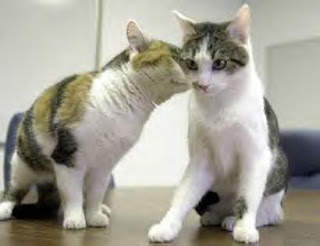
| Siberian Cats are advertised as hypoallergenic cats |
Is there a hypoallergenic breed?
Dr. Bailey’s quick answer: There's no such thing.
The rest of Dr. Bailey's answer: The classic allergen, Fel d 1, was originally identified as a feline salivary allergen, so
the hair served as a carrier of the allergen. I am sure the "cat
allergy" syndrome is far more complicated than we even understand
currently. For instance, Fel d 1 is pleomorphic (has many forms)! It really depends
on what individual people are allergic to - different allergic folks react
differently to other cats. We have sent cat owners to the E.R. after they
arrived at our practice (but they live with one or more cats at home!). Is this simply dose related, or was it exposure
to different allergens? Some studies have shown that darker colored
cats seem to cause more allergic signs than lighter colored
cats. Calm cats are less likely to cause allergy issues than calm cats, and pregnant or nursing females or unaltered males are more allergenic than spayed and neutered cats. Other studies have shown that males are more allergenic than
females, mean females cause less reactions than nice females. I guess you could
tell an allergic friend to get a calm but mean, light-colored spayed female cat.
I am allergic to cats, but I take far more antihistamines now than I did 10
years ago; and when I started working with just cats (over 20 years ago)
allergies were not an issue. I did not have a cat as a child. I
guess I can blame my mother? (Children raised with cats tend to be less likely to suffer pet-related allergies.)
What is this Fel d 1?
Originally, it was thought that cat hair caused allergies, but as more research was done, it was discovered that a protein in the saliva called Fel d 1 is deposited on the cat's skin and coat when it grooms. The protein then enters the environment when the cat sheds hairs and skin flakes (dander). This protein is the major cause of most cat allergies.
More recently, it was discovered that there are at least EIGHT different proteins that cats produce that can cause allergy symptoms, and that they are not all located in the saliva. The major allergen, Fel d 1 is even found in many different forms in many places on (and in!) the cat.
Now for some veterinary technical-speak...
These are the known feline allergens:
Fel d 1 = Secretoglobin.
This molecule is pleomorphic! This is the allergen culprit in 90% of cases. Fel d 1 is found primarily in the sebaceous gland in the skin, but also in small amounts in the salivary gland, male cat urine, and
perianal glands.
Fel d 2 = Albumin
Fel d 3 = A cystatin
Fel d 4 = Lipocalin. Another major allergen, a urinary protein - This is the culprit in about 60% of allergies.
Fel d 5 = Oligosaccharide
galactose-alpha-1,3-galactose (alpha-gal) on cat IgA (secreted in saliva)
Fel d 6w = Feline IgM also??
Fel d 7 = von Ebner
gland protein isolated from the tongue (Can f 1 homologue)
Fel d 8 = Latherin-like
protein isolated from the submandibular gland (homology to Equ c 5)
Most secondary cat allergies are caused by Fel d 2 (feline
albumin) or Fel d 4 (feline lipocalin). Serum albumin accounts for about
the largest number of cross-reactions between cats and other animals.
About 25% of people who are allergic to horses also react to
Fel d 4. These individuals are considered horse/cat cross-reactive.
It is known that some cats and some breeds shed less Fel d 1
than others, but little to no research exists yet as to the levels of the other allergens (2-8) in
these cats.
What if I discover I have a cat allergy, and I love cats - what can I do?
Cats tend to
cause more allergy symptoms than dogs because their
dander is sticky and light, and travels everywhere easily. If you have cat allergies, you can try having
someone who isn’t allergic brush cats daily and then clean the brush thoroughly
to minimize dander. You can also use a damp washcloth to wipe down cats
regularly. It is important to note that vacuums with HEPA filters will help eliminate allergens in
the environment, but regular vacuums will spread them. Ask your veterinarian about healthy diets for your pets to prevent
dry skin and cut down on dander.
If you do what you can to
minimize pet allergens, but still
have symptoms of pet allergies, you may want to see an allergist. An allergy specialist can
help you pinpoint what may be causing your allergies — it may be that your
allergies are worse in the winter, not because you are cooped up indoors with
your cat, but because you are allergic to environmental factors that are worse
in the winter when all the doors and windows are shut (such as dust mites). Your doctor can then
recommend treatments such as allergy shots or medication to help control your
allergic reactions. Many times, if your allergy is complex, being able to
manage some of the allergens will help you tolerate the others, so you may find
as you treat your other allergies, you become more tolerant of your cat.
The jury is still out on whether kittens are less allergenic than adult cats. James Seltzer, MD, a spokesperson
for the American College of Allergy, Asthma & Immunology says that in general, kittens shed more allergens than cats. Although
the levels seem to drop at 6 to 12 months of age, "they still cause
allergies," says Dr. Seltzer. This is due to the fact that kittens are growing and shedding their epidermal layer more rapidly. Others suggest that kittens are less allergenic because many of the proteins that cause allergies are related to pheromones and sexual maturity (remember - spayed and neutered cats are less allergenic) which kittens have in lower supply. Also, kittens are smaller. It is likely that adult and juvenile cats activate different allergies because of different protein levels. Your cat may "outgrow" your allergy or conversely a cat you have lived with for a while may begin to cause more problems as he grows older - just another important reason to spay and neuter your pets; it will help keep the allergen levels down!
 |
| Allergy shots or "hyposensitization therapy" can help people with cat allergies. |
Dr. Seltzer says that allergy shots (desensitization therapy - routine injections of allergens in order to decrease allergic response) are more likely to be successful for
those allergic to cats than those who are allergic to dogs. "Allergy shots for cat [allergen] can be effective in as many as 65% of people, but it does take a year or two often to start working."
The good news? Research has
shown that in most cases, people tend to become desensitized to the cats that live in their
own home over time. They may be able to tolerate the one cat in their home but
break out with runny eyes and sniffles when they bring their cat to the vet.
Research has also shown that kids raised in homes with a pet tend to
have fewer allergies, themselves. And children raised in homes with
multiple pets tend to have a lower incidence of allergies than those with only one pet - 66-77% lower! In addition, preliminary research seems to shows that
children raised in a home with pets tend to have
fewer illnesses in the first
years of their lives.These studies are exciting to animal lovers, but they really don't answer the question as to whether the cats and dogs are the CAUSE of the increased health, or whether people who own pets just live a healthier lifestyle - or at least a lifestyle that is more beneficial to the immune system.
But I know I have heard about hypoallergenic cats!
 |
| Patented hypoallergenic cats? |
Studies suggest hypoallergenic cats and dogs can cause just
as many symptoms as the regular kind, says Dr. Seltzer.
Allerca is a company that launched in 2004 to produce pets free of the
major allergens, Fel d 1 (cats) and Can f 1 (dogs). Prices for cats ranged from
$6,950 to $26,950 and dogs are available for $15,950. They ceased breeding these animals in January 2010 - many suspect this is because the
animals still were causing reactions in allergic individuals despite the high price tag and company claims.
"The problem is that removing these proteins from the skin, saliva, and other
secretions may not be enough," says Dr. James Sublett, the vice chair of Arlington Heights-based American
Academy of Allergy, Asthma and Immunology’s Indoor Environments
Committee. As noted above, animals produce other
symptom-triggering allergens. "Both dogs and cats have what we call minor allergens, so it's not only
the major allergens," he says. "Most people have a sensitivity to
minor allergens too."
Aren't there certain breeds that are less allergic?
Siberian cats are strongly recommended by many cat enthusiasts as a hypoallergenic breed."There are no scientifically validated studies to show
that any particular breed of cat, whether it's Siberian or anything else, is
quote 'hypoallergenic'," says Martin Chapman, PhD. He's the president of
Indoor Biotechnologies, an allergy testing company that provides the kits for
most of the world's studies on allergen exposure.
As can be seen in the information provided on
this site, while the
Fel d 1 protein in 2 Siberian cats exists in much lower numbers than in two other cats, there is still
some protein present. This test of fur allergen levels is cited by many Siberian breeder websites
as evidence the breed is hypoallergenic, However, many others criticize this study, since only 4 cats were
included, all the samples were submitted by a Siberian breeder, and one mixed
breed cat tested with allergen levels of over 60 times higher than the highest allergen level tested in
cats anywhere else (62,813
micrograms). The fact remains that many people report that they are less sensitive
to Siberian cats than the general population of cats at large. However, individuals with allergies to other animals (especially
horses and rabbits), or food allergies to eggs and pork meat often react to low Fel
d1 Siberians.
A not-for-profit association of breeders, (
Siberian Research Inc), was
founded in 2005 to study allergen levels and genetic diseases in the Siberian
breed. As of March 2010, fur and saliva samples from over 300 Siberians have
been submitted for analysis, many directly from a veterinarian. Salivary Fel d1
allergen levels in Siberians ranged from 0.08-27 mcg per ml of saliva, while
fur levels ranged from 5-1300 mcg. The high-end of these ranges is consistent
with results from prior studies, though the low end is below expected results. All Siberians tested were found to produce some Fel d1, with the highest
levels being found in Siberians that have silver coloured fur. About 50% of
the Siberians tested were found to have Fel d1 levels lower than other breeds, while under 20% would be considered "very low". Within the low group, males and
females had comparable allergen levels.
Other breeds that are variously considered to be "hypoallergenic": Balinese, Bengal, Burmese, Colorpoint Shorthair, Cornish Rex, Devon Rex, Javanese, Ocicat, Oriental Shorthair Russian Blue, Siamese and Sphynx
 |
| Devon Rex |
Some of these breeds have fewer hairs per follicle or even lack hair completely, which provides less surface area for allergens to cling to. Other breeds also have lower Fel d 1 proteins, like the Siberian cat. There is no guarantee that a hypoallergenic breed is going to be a cat that you can tolerate, if you have allergies.
While little research exists about allergen levels in other breeds, or about minor allergen presence in any breed, this information does seem to suggest that some people with allergies may find some breeds more tolerable versus other breeds. Definitely, this is an area that could use much more research so that cat lovers with allergies can enjoy feline friendship with the rest of us crazy cat people!
Further reading about hypoallergenic cat breeds:
Pet MD


.JPG)