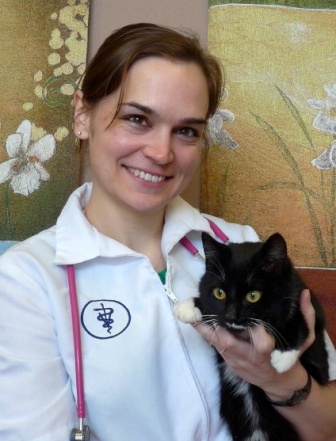
Showing posts with label veterinary. Show all posts

Monday, December 15, 2014

Care and Feeding of a Cat with an Esophagostomy Tube


If your cat has been diagnosed with pancreatitis, oral pain or other condition that makes it difficult or painful to eat, your cat may have had a feeding tube placement procedure recommended. The procedure is relatively quick and, with proper pain medications, painless. Once the tube is placed, a high-calorie, vitamin-rich diet can be given to the cat with minimal stress while he or she is brought back to health. In these cases, placement of a feeding tube often means that the cat is able to go home from the hospital much sooner than would be possible, otherwise.


The type of diet and vitamin or mineral additives that should be fed will be determined by the doctor, based on the individual needs of your cat. Generally a syringable diet will be mixed with water and nutrient powders and placed into the blender to smooth the mixture. Store the food in the refrigerator, and warm a portion of the food to body temperature (101.5 degrees F) in the microwave before using. Do not heat above body temperature!

For most cats with an esophageal feeding tube, food in the stomach may cause nausea, so start slowly. We generally recommend that the average 10 pound cat should start with 50ml of food through the E-Tube four times daily for two days, then increase to 55ml five times daily. Gradually increase the amount you are feeding.  Your eventual aim will be at least 300 to 350ml (over 1 cup) per day.  If  your cat continues to tolerate the feedings you may increase feedings by 5ml per day; up to 75ml per feeding if there is no vomiting. This will allow you to feed fewer times each day.  It is important that you feed enough so that your cat gains weight!

Administer the feedings slowly over 5-10 minutes; slower if vomiting occurs.  Observe for swallowing during the feedings.  Some vomiting (especially at first) is anticipated. If your cat vomits, you should wait an hour and start again. Be organized so things go efficiently with as little handling of the patient as possible.  If feedings are well tolerated, you may gradually become quicker. For some cats, quicker feedings will go more smoothly.

Be sure to flush the esophagostomy tube with 6ml of warm water after each feeding and replace the cap. If the tube becomes clogged, try flushing a small amount of diet cola through the tube with a small (1 to 3ml) syringe.  The esophagus is very stretchy, so your cat CAN eat and drink with this tube in place, however please do not allow your cat to consume grass if they are allowed outside. Grass ingestion is more likely to cause vomiting, and the more frequently your cat vomits, the higher the risk that they will vomit the tube.


Clean the ostomy site (the hole where the tube enters the skin) daily with warm water and surgical scrub. Warm soapy water is ok to use too. Report any concerns.

DAILY MEDICATIONS

It is likely that your cat will be on several medications if this tube is in place. An antibiotic should be given to prevent infection at the tube site. Cats with pancreatitis or hepatic lipidosis (fatty liver) will likely be taking anti-nausea medications such as metoclopramide (Reglan) or maropitant (Cerenia). Cats with certain liver diseases may be taking Denamarin or Ursodiol. Cats with kidney disease may be taking Calcitriol, famotidine (Pepcid), potassium supplements, or aluminum hydroxide. Some of these medications can be given in powdered form and mixed with food or water, others come as tablets and must be crushed before putting through the tube.

Your cat’s esophagostomy tube will be sutured in place and there will be a light bandage placed around his neck.   Observe closely to make sure your pet is not pawing at the tube or bandage.  

If  your cat vomits the esophagostomy tube—carefully use scissors to cut off all exposed tube protruding from the mouth.  Do not try to feed!   Your cat  will need to have the remainder removed and the tube replaced.  If the patient is comfortable, tube replacement can wait until morning. Call as soon as possible; if it is after hours and you are in doubt, contact the nearest emergency clinic.  The portion of the tube left in your cat’s neck can be used as guide for replacing the next tube through the same ostomy site, so don’t pull the remaining portion of the tube from your cat's neck.

If you end up at a veterinary hospital that is not familiar with the replacement technique, please direct them to this video.


Monday, February 17, 2014

The tooth about your cat's dental health

Fish breath got you down?
February is Pet Dental Health Month! Time to sit back and think about your cat's teeth!

Many people don't like to think about their cat's teeth - they're sharp, pointy reminders that your cat is a natural predator and would love to shower you with gifts of innocent birds and mice, or the occasional frog. We're reminded of their teeth when they love-nip our toes in the middle of the night, or when we get a whiff of fish-breath after dinner. However, the health of your cat's mouth is more critically important that you might realize!

Dental disease is linked to kidney disease, heart disease and other chronic illnesses. Regular dental cleanings can often prevent dental disease and the need to extract teeth. It also gives us an opportunity to address other mouth abnormalities - check for cancer, broken teeth, misaligned teeth, etc. Read on to learn more about some of the conditions that can affect your cat's mouth.


If your cat has misaligned teeth, they can poke painfully into the lip, tongue, gums or the roof of the mouth. Additionally, crowded, extra, or missing teeth can cause the same trouble.


Tartar and plaque can build up underneath the gum line and destroy the tooth from below.


 Because most dental disease begins at the root of the tooth, and cat cavities (called "resorptive lesions") start from the inside and work their way to the surface, what appears to be a healthy tooth can actually be a tooth that is in the process of being destroyed.

 Bacteria and white blood cells build up at the base of the tooth and can enter the blood stream or build up a pocket of infection called an abscess, which can cause facial swelling, fever, nosebleeds or sneezing, and poor appetite. Sometimes this can occur even when most of the tooth has fallen out.


 This tooth is filled up with pus (white blood cells and bacteria).


That missing tooth left a big open hole that can fill with bacteria and cause infection. Besides the large blocks of tartar on the upper teeth, there is a large, painful cavity on one of the lower teeth, and a very painful area surrounding the exposed roots of another tooth affected by dental disease.


 This painful condition is "stomatitis" - a severe and extremely painful swelling and inflammation of the mouth. Ouch!


If your cat has never had his teeth cleaned before, you may wonder what happens during a dental cleaning or dental surgery. To find out, you may want to read more about why dental care costs so much in veterinary medicine.

Ask any one of our patients who has had a bad tooth removed! You may not realize it, but while most cats will not stop eating if their mouth is painful, they may play less, sleep more, and lose weight. Many people are simply amazed at the positive change in their cat's attitude and health after their teeth are cleaned. Ask Rowan!

Wednesday, November 6, 2013

Chewy gets a leg up!

Chewy is a 9 week old male kitten that was found by Dr. Bailey's son, Christopher. He had been attacked by a dog and had a broken leg. Christopher, a current veterinary student at MSU, brought the kitten back to Exclusively Cats to have Dr. Bailey treat him.

The left rear leg is broken


Another view of Chewy's legs, showing the healthy right leg and the broken left leg
While many small fractures of the hind limb can be stabilized with bandages and splints, a severe fracture like this one requires surgery. As you can see, the bone has been broken all the way through and the ends do not want to meet. Dr. Bailey had to place pins in the bone in order to stabilize it so that it can heal.

Chewy's leg required three pins to fix it in place, along with an outer brace.


Now that his bone is supported by the pins, it will remain end-to-end so that healing can occur. Meanwhile, although Chewy is restricted to resting in his cage, he can bear weight on the leg.


 You can see him scurrying around in this video.


Hopefully, with time and care, Chewy will be able to start looking for his forever home!
Here is Chewy with his external brace - it is a rubber tube filled with a hardening material so that it could be cut and fit to Chewy's tiny leg.


February 2014 update: Little Chewy has been getting around without any troubles for quite some time, now, and has found his permanent home with Dr. Bailey and his wife, Liz.

Monday, October 28, 2013

Raising Orphaned Kittens Part 3: When to call the Veterinarian


One of the hardest parts about fostering orphaned kittens is that kittens can easily get sick. Sick kittens should be dealt with quickly, because they are small and fragile, especially if they have no mother cat.


If one or more of your orphans becomes sick, you should call a veterinarian and discuss the problem. The veterinarian may or may not advise you to bring the kitten in.

At home, you can take your kitten's temperature, if you feel comfortable doing so. You will need a regular thermometer (preferably one that you will not want to use again!) and some KY jelly.  Put some KY on the tip of the thermometer and stick just the tip into the kitten's anus. The kitten will likely protest. Hold the thermometer there until the thermometer beeps (or for about a minute if it is a mercury thermometer). If the kitten's temperature is over 103 or under 99, it is important to call the veterinarian.

Abnormal signs to watch for in a kitten:
  • Discharge from the eyes or nose.
  • Poor appetite
  • Lethargy (lack of energy)
  • Diarrhea 
  • Vomiting
  • Weight loss or failure to gain weight
  • Coughing or sneezing
Emergencies requiring immediate veterinary attention
  • Continuous diarrhea
  • Continuous vomiting
  • Bleeding of any kind 
  • Any trauma: hit by a car, dropped, limping, stepped on, unconscious.
  • Difficulty breathing.
  • A kitten that does not respond or that hasn't eaten for more than a day.

WHAT TO LOOK FOR:

-Watch closely for respiratory signs.  Kittens have weak immune systems, especially when raised away from their mother, as they are not getting any antibodies from their mother. They can easily and quickly succumb to disease and infection if not treated appropriately. 
-Aspiration pneumonia is a concern for bottle-fed kittens; be careful when feeding and give them only what they can swallow at one time. Make sure to feed them in an upright position to decrease risk. 
-Watch stool and urine output closely, and observe for any signs of constipation from the milk formula. Some formulas can increase the risk of diarrhea and some can increase the risk of constipation - either one can be a significant issue for tiny kittens.
-Watch for lethargy/or inappetance.
-If you ever have any questions about kittens’ health please call your veterinarian.

Diarrhea and parasites of the digestive tract
Diarrhea is common in kittens and can have many causes including: parasites, viruses, bacteria, food changes, stress, overfeeding. Because kittens can become dehydrated very quickly, make sure to discuss your kitten's diarrhea with your veterinarian sooner rather than later. If the diarrhea is severe, lasts more than 3 or 4 feedings, or contains blood or obvious parasites, you should call a veterinarian and bring in as much as possible of the feces in a Ziploc bag.

Several causes of diarrhea in kittens involve protozoan (single-celled) parasites, such as coccidia, giardia, and tritrichomonas.  These parasites are common in kittens, and occasionally found in adults.  They are not generally treated with common de-wormers, but antibiotics. For diagnosis of these parasites, especially giardia and tritrichomonas, extremely fresh stool is best for diagnosis.

Most large intestinal worms do not cause diarrhea, but can be very debilitating to kittens in large numbers. Sometimes, if the numbers are large enough, or many worms are dying, the dead worms will pass in the stool. More often, the diagnosis for these parasites is by seeing the microscopic worm eggs in a stool sample. If you see spaghetti-like worms in the stool, you are seeing roundworms. These worms can come up in vomit or stool. The cysts of roundworms can persist for years in soil and be spread to other cats or human children, so it is important to deworm cats as directed by a veterinarian.

If you see rice-like worms on the stool or in the hair around your kittens' tails, you are seeing tapeworm segments. These rice-shaped pieces of the worms are mobile when they exit the body, so they may work their way off the stool or kitten and into the environment. They are not infective at this stage. They are spread by fleas or by eating rodents. Tapeworms do not generally cause diarrhea, but it is advisable to treat your kitten for tapeworms, especially if you know that he has had fleas in the past.

Several types of bacteria, including Clostridium, are potential causes of diarrhea in kittens, and all require microscopic examination, bacterial culture, or PCR testing for diagnosis. These are among the fecal pathogens that can be spread to people if adequate hygiene is not observed after handling sick kittens or litterboxes. Most bacteria respond quickly to antibiotics prescribed by a veterinarian.

Finally, there are a number of viral causes of diarrhea, with feline distemper (also known as panleukopenia or feline parvo virus) being the most devastating. If distemper is suspected, seek veterinary care immediately. Treatment for distemper involves aggressive nutritional supplementation and hospitalization, and you may have a number of kittens die if an entire litter is exposed.This is one of the reasons that you should make sure any older cats in your household are up to date with their annual vaccinations before bringing a kitten into the home. Thoroughly disinfect anything that has been exposed to the sick kittens with a bleach solution.

Ear mite
Ear Mites
Ear mites are tiny arthropod parasites which live in the ear canal. Common signs of ear mites are ears full of coffee-ground-like crumbling debris, itchy ears, head shaking.In very large infestations, you may actually see the pinpoint white mites moving in the debris in the ear. They are highly contagious, but easily treated.

Failure to thrive
Once in a while, one or more kittens in a litter that were healthy and vigorous at birth will begin to "fade" after a week or two of life. They will stop growing, begin to lose weight, stop nursing and crawling. They may cry continuously and lose the ability to stay upright. The mother cat may push them out of the nest, where they often chill and starve to death. Kittens fade very quickly - they will not last 48 hours without veterinary care, and probably will not recover even with intensive care.
There is no clear cause or reason for this condition - it has been linked to birth defects, environmental stress and infectious disease. Early veterinary treatment is imperative, but even with tube feeding, rehydration and monitoring, many, if not most fading kittens will die.

Feline Leukemia (FeLV) and Feline immunodeficiency (FIV)
FeLV and FIV are retroviruses cats get from other cats (or their moms). Testing for disease can help you make the decision whether to foster a kitten, or whether to add kittens to a litter or keep them in isolation. It is often a good idea to have positive test results confirmed.

In the early stages of FeLV, infected cats appear healthy but over months to years, they develop severe, ultimately fatal disease. In very young kittens, it is advisable to test at least twice as some kittens can be transiently positive, or falsely negative.

On the other hand, testing for FIV is more difficult until after a kitten is four months old. The good news about FIV is that it is much harder to transmit than FeLV, and cats that have been infected with FIV can live long, healthy lives, often not experiencing detrimental disease symptoms until the age of 8 years or more.

A flea on a flea comb
Fleas
Fleas are insects that love to feed on kittens. Each flea only consumes a small amount of blood, and most adult cats are relatively unaffected by large flea infestations, however fleas commonly attack in large numbers and an infestation in a kitten can lead to severe anemia and even death. It is essential that your home be free of fleas before bringing home a small kitten.

If your foster kitten enters your home with fleas, it is important to remove them without causing harm.  Fleas can be transported from the kittens isolated in one area to the main part of the house on clothing, shoes, etc. Therefore, it is also important to treat any other animals in the home with monthly flea prevention or a stray flea, flea egg, pupa or larva may cause an infestation in your house - any unprotected animal in the house can then become a reservoir for the infestation.

Check with your veterinarian before applying any commercial flea products to your kitten, as some flea medications can be harmful to cats. One safe way to remove fleas from very young kittens (less than 6 - 8 weeks) is daily flea combing. Keep a jar of soapy water near you to dip the comb into as it comes off the cat full of fleas. Try not to moisten the kitten too much, and make sure to thoroughly dry your kittens after you are done combing.

If the Kitten is 4 Weeks old and over two pounds in weight, Capstar can be given orally up to once a day to kill adult fleas. This product starts to work within 30 minutes and is effective against adult fleas for 4-6 hours. It does not have any affect on, eggs, larva, or other adult fleas in the kittens environment.

If the kitten is 6 weeks old or older, you can use topical monthly applications available from a veterinarian. Despite your best efforts at flea control, you should plan to treat the kittens for a minimum of 90 days to ensure that all the fleas are out of the household. For more information about flea control, please refer to our blog article "Fighting Fleas Fairly...For Good!"

Upper respiratory tract infection (URI)
Upper respiratory infections are very common in kittens, especially if they have been through a shelter situation and exposed to other cats. These infections are caused by airborne viruses and bacteria which are contagious and spread very quickly.

Signs of URI to watch out for:
  • Sneezing and discharge from eyes or nose
  • Congested breathing
  • Loss of appetite
  • Lethargy
  • Dehydration
Vomiting
If your kitten is vomiting, it is possible that the kitten is eating his meals too quickly. You should watch him when he eats and not allow him to eat too much too quickly. If your kitten vomits 2-3 times in a row, it should see a veterinarian. Vomiting can be another sign of distemper in kittens, so it should not be taken lightly.

Monday, October 21, 2013

Case study: Sally - Progressive Retinal Atrophy (PRA) in cats

Sally
 Sally is a 3-year-old Abyssinian cat that was rescued from a hoarding situation. She was one of 84 cats rescued. Eighty of the cats in the household were too ill or debilitated to survive and had to be euthanized. After adoption, it was discovered that Sally was Feline Leukemia positive. She is shy, but sweet, and her owners brought her in to us because she suddenly appeared to lose her sight. She began bumping into things and lost her fear of the dog. If you notice in her photo, her pupils are very dilated, and her owners had noticed this at home, too. Her regular veterinarian sent her to us because high blood pressure was suspected.

What does high blood pressure have to do with eyesight?
The retina lines the back of the eye

The retina is a thin membrane lining the inside of the eye that receives light and translates it into electrical impulses for the brain with special cells called photoreceptors. There are two kinds of photoreceptors - rods that process black and white or dim light vision and cones that process colors or bright light. If the retina or its photoreceptor cells become damaged in some way, the eye has trouble converting waves of light into signals that the brain can understand, interfering with a cat's vision.

 One of the ways that cats can lose their vision is by developing hypertension lesions in the retinas - tiny blood vessels are damaged and regions of the retina lose their ability to function as they lose their blood supply. These lesions look like bubbles in the retina. If a cat's blood pressure remains elevated for a long period of time, the retina can completely detach and lose its connection with the nerves that transmit visual impulses to the brain. Once this has happened, a cat becomes irreparably blind. If the hypertension is diagnosed and treated early, as in these photos, the retinal lesions can heal over time.

Retinal lesions appear like bubbles in the back of the eye

The same eye 2 months after starting blood pressure medication


 Notice that not only are the lesions gone, but the blood vessels appear more visible.

The first thing that we did when Sally came in was check a blood pressure reading. Her blood pressure was 150mmHg, which is a normal pressure in a nervous cat. Hypertension was not the culprit in this case. So, what could be the problem?

The next thing that happened was that Sally received a full physical exam from Dr. Demos, including an eye exam. This is what Dr. Demos saw when she looked in Sally's eyes...
Something very important is missing, here!
There are no blood vessels in this retina!
This is a characteristic feature of something called Progressive Retinal Atrophy (PRA). PRA is a recessive trait in certain breeds of cats such as the Abyssinian, the Somali and the Ocicat. Perisans and Siamese are also often at risk. There are a number of other breeds that have also been identified to carry the mutated gene in small numbers.

Other key features of this disease are a granular appearance to the retina, signs of retinal thinning, and a reduction or thinning of blood vessels. Increased reflectivity of the retina and dilation of the pupils are symptoms that owners can easily see at home. Later stages show pigment changes to the retina and a degradation of the optic nerve. These changes usually happen equally to both eyes at the same time.
Sally's pupils stay dilated, even in bright light

The most common form of PRA in cats is involved a progressive degeneration of the rod and cone receptors in the retina.The cat's eyes develop normally as a kitten, but as the cat gets older, the cat will begin to experience night-blindness and may tend to avoid stairs or darkened areas of the home. It will progress to total blindness by the age of 3-5 years. This is problematic not only for the cats themselves, but for the breeders of high-risk breeds, because often the disease is not apparent until after the age at which many cats have already participated in a breeding program. If you are interested in a purebred cat, it may be a good idea to ask your breeder about PRA and whether their cats have been genetically tested for the mutation.

Unfortunately, this is a problem for which there is no treatment. However, the good news is that cats adapt well to being without their sight due to their superior hearing, sense of smell and sense of touch (whiskers). You can read about the amazing cat, Homer, who caught flies out of the air without the aid of sight!

If your cat starts to show reluctance to move around at night, or has trouble jumping onto furniture, or starts to bump into things, it would be a good idea to have your cat's eyes checked by his or her veterinarian, as well as having a blood pressure exam performed.

Monday, October 14, 2013

Raising Orphaned kittens Part 2: What to do, week by week


You've decided to raise the litter of orphaned kittens you found...

 You have all your supplies, you're ready to go, but just like caring for a 2 day old human infant is different than caring for a 9 month old human baby or two year old toddler, the age of your orphaned kittens is crucial to deciding how much to feed and how often.

0-7 days:

Feeding: 1/2 tablespoon formula every 2 - 3 hours with a kitten bottle.
If the mother, or a surrogate mother is available and healthy, the kittens should nurse vigorously and compete for nipples. Newborns can nurse up to 45 minutes at a time. When the mother cat settles down in the nest box, the kittens should bee-line to the nipples and begin to feed with minimal fussing. If the kittens wander excessively or cry excessively, there could be a milk supply issue. Check at least once daily to make sure all the kittens are nursing, if not more frequently.

Environment: Keep the nest box temperature at a toasty 85-90 degrees. The number one danger to newborn kittens is hypothermia, or a low body temperature. They cannot keep themselves warm on their own (thermoregulate).

Behavior & Training : By one week of age, the kittens should weigh 4 oz. (1/4 pound), and will be sleeping 90% of the time. They will eat the other 10% of the time. Handling should be minimal to allow babies to sleep and eat in their snug, warm nest.

1-2 Weeks of age:

Feeding: Bottle-feed formula every 2 - 3 hours until kittens are full but not bloated- usually kittens will eat at least 1/2 tablespoon of formula per feeding.

Environment: Keep the nest box temperature at a toasty 85-90 degrees.

Behavior & Training : Kittens at 2 weeks of age will weigh about 7 ounces (just shy of 1/2 pound) and have pink skin, and round bodies. If you pinch their skin gently, it should spring back into place quickly. Kittens should wiggle energetically when picked up, and should migrate towards its mother when placed back down. Healthy kittens rarely cry.

To tell whether kittens are male or female, look under the tail. Females will have two holes close together - the vulva is a vertical slit or teardrop below the anus. Males will have two holes farther apart - the opening for the penis is separated from the anus by a little bump (the scrotum) which may be difficult to see or feel at a young age. The best thing to do is find two kittens who look different under the tail and compare. By the time the kittens are ready for forever homes, it should be much more obvious, so don't despair if you can't tell this early what you have.

2-3 Weeks of age
Feeding: Bottle feed formula according to the manufacturer's instruction about every 2 - 3 hours until kittens are full but not bloated- usually kittens will eat at least 1/2 tablespoon of formula per feeding.

Environment: Floor temperature of the nest box can be a little cooler, now - about 75-80 degrees.

Behavior & Training : If there is a mother cat (queen), she will begin to spend more time out of the nest, though she won't wander far.

Kittens should weigh about 10 oz (about 2/3 pound). Their ears will start to stand up. Kittens will start to crawl around day 18 and can usually stand by day 21. Kittens will start to play with each other and explore their environment. Their baby teeth will start to come in (erupt) during this period.

The next six weeks are a critical socialization period. Kittens will learn how to act like a proper cat by watching their mother and interacting with their litter-mates. Additionally, human handling during this period is very important, too. Interaction with children may be too frightening, since even gentle children can be awkward with tiny kittens, so should be supervised closely while visiting. 

3-4 Weeks of age
Feeding: Bottle feed formula per manufacturer's instruction every 2 - 3 hours until kittens are full but not bloated- usually kittens will consume at least 1/2 tablespoon of formula per feeding. At this stage kittens may start lapping from a bowl.

Environment: Floor temperature of the nest box can be much closer to normal room temperature - 70-75 degrees from this point onward.

Behavior & Training: Kittens should weigh about 13 ounces (0.8 pounds). Their eye color will start fade from blue to the adult color, but may not reach its final color until 12-16 weeks of age. Kittens can now focus on the world with an ability similar to adults. They will start to groom themselves, though their mother will continue to do most of the serious cleaning.


4-5 Weeks of age
Feeding: By 4 weeks, your kittens should be eating and drinking from a saucer. Now is the time to start gradually weaning them. Introduce solid food by warming some pate-style canned food and mixing it with a small amount of water or formula to create a soupy gruel that they can lap at.

Without a mother cat to show them what to do, kittens will invariably walk, sit, play, slide in and track food everywhere. Offering gruel on the tip of a finger or wiping a little across a kitten's lips or teeth will help them associate the smell of food with eating behavior. Because it will take several meals before the kitten will end up with more food in its stomach than on its fur, you should continue to offer a decreased amount of formula by bottle-feeding - about 3 tablespoons (1-1/2 oz.) formula every 8 hours. This will simulate the weaning process.

This is a critical time to continue watching the kittens' weight. They should continue to gain weight through the transition from milk or formula to solid food.  If a surrogate mother or the actual mother is present, the kittens will continue to try to nurse, but she will become more and more agitated by this process. Just like small children who gain comfort from pacifiers or thumb-sucking, kittens will continue to perform nursing behavior even after they no longer gain any nutrition from it. Most cats will eventually grow out of this behavior, but it can persist long term in some cats.

Fresh water in a stable, shallow bowl.

Behavior & Training : This is the age that you can also start litter training. Make sure to provide a low sided box, as kittens are not very big. Use a low box with one inch or less of litter. As mentioned in our previous article, a disposable cake pan is perfect. Cut-off cardboard boxes also work well.

Most people think that cats need to be trained to use the litterbox, but in fact, it is an instinct for them. Even kittens raised without a mother cat will gravitate towards a box full of sandy litter and figure out what to do pretty quickly. You can speed the process by placing a kitten in the box after a nap, after meals, and after play, and (the first time or two) guiding him gently to dig in the litter. However, even if you don't do this, they will discover the box on their own.

Just like young children who are potty training, it is good to make sure that wherever the kittens are, a litter box is handy. Otherwise, they may get distracted and find themselves too far from the box with a very insistent need to go! Since most kittens are born with some type of intestinal parasite, make sure to keep the litter box very clean to prevent cross-contamination and re-infection. Cats also do not like their litter to be near their food, so make sure there is a good amount of separation between the two.

5-6 Weeks of age
Feeding: Feed four times daily, gradually thickening the gruel. At this age, you can introduce dry food and water. If your foster litter has a mother, she will continue the weaning process. If your kittens are reluctant eaters, you can try mixing any non-onion-containing meat-flavored human baby food with a little water, but this is not a long term solution, because cats need taurine in their diets or severe developmental issues of the heart and eyes can occur.  

Behavior & Training:  A good rule of thumb from this point forward is that a kitten should gain one pound a month. At 4 weeks, they should weigh about 1 pound, at 8 weeks (2 months) they should be about 2 pounds and at 12 weeks (3 months), they should weigh about 3 pounds. At this age, kittens can start to roam around the room, under supervision. The strongest, most curious kitten will figure out how to get out of the nest. The others will quickly follow. Male and female cats should start to become more easily distinguished as male anatomy develops.

Play with your kittens daily! Kittens love to climb and explore, so sit on the floor and allow them to get to know you. This game allows them not only to get exercise and develop muscle coordination, but to become comfortable with humans. Some kittens may be fearful at first; do not force yourself upon them. You can sit in the room and read or watch quiet television or listen to quiet music, and allow shy kittens to become desensitized. This is a very important step in allowing kittens to develop a confident, social attitude. As they become more adventurous, you can start to introduce other sounds, such as vacuum cleaners and dishwashers. Many very shy and secretive kittens were not abused as kittens as so many people believe, but were just never introduced to the normal noises and activities in a human home at an early age.   


6-7 Weeks of age
Feeding: By this age, your kittens should be eating canned and dry food well. You should offer food to them at least three times daily. Watch for any bullying among littermates, and ensure that all kittens are getting their fair share. They may not eat much at a single sitting, because their tiny stomachs are acorn-sized, but they like to eat at frequent intervals throughout the day. This is how a cat instinctively wants to eat, even as an adult - they spend most of the day hunting and only eat for a few minutes at a time. Frogs, bugs, rodents and birds do not make large meals.

Behavior & Training: By this time, you have "mini-cats." They will wash themselves, use scratching posts, play games with each other, their toys, and you, and many will come when you call them.

7-8 Weeks of age

Feeding: Offer wet food 3 - 4 times a day (each kitten will be eating a little over one can of food per day). Leave down a bowl of dry kitten food and water for them to eat and drink at will. If you have a litter with a mother, she will allow very little nursing.


8+ Weeks of age
Feeding: Offer wet food twice daily. Kittens should have free access to dry food and water all day.

Behavior & Training:  If all your kittens are two pounds in weight, you can start to consider finding them homes at this point, however, a large amount of social development occurs in the next 4 weeks, so the longer the kittens can remain together, the better it will be for their long-term happiness. At 3 pounds in weight, we recommend early spay or neuter surgery. It is much easier to find homes for kittens that have already been spayed or neutered and have had some vaccines and a clean bill of health from a veterinarian.

Remember: A healthy kitten is playful, has bright eyes with no discharge, a sleek coat, and a plump belly. Younger kittens are content to sleep between feedings. Normal body temperature for a kitten is 100 - 102.5. Unfortunately, kittens do become ill and sometimes die while being fostered, so it is important to take steps to prevent disease and treat it appropriately as soon as it appears.

Monday, July 15, 2013

Indoor cats can get fleas, too!

Cat in the garden with purple flowers
Most people know that outdoor cats are at risk for picking up fleas - especially those cats that like to lounge in the shade under bushes where other animals spend their time. But, did you know that even indoor cats can get fleas?

Sometimes, the fleas are brought into the house by unsuspecting owners, on pants legs, on shoes, or other outdoor items. Most times, it is not the adult flea that comes inside. They have a large warm food source, already, why would they want to jump off into the great unknown and leave a good thing behind? Instead, the female flea is almost constantly laying eggs, which roll off the host - a rabbit, a squirrel, a stray cat - and into the dirt. There, the eggs can hatch, and the flea larvae can eat and grow under the bush until it is time to
Microscope image of a flea larva with a full belly of blood, cat hair in the background
Flea larvae are only a little thicker than a cat hair. Under the microscope, we can see this larva has eaten some flea dirt (adult flea feces - digested blood) which gives it a reddish color.
form the pupal cocoon. Once the pupa stage is reached, the flea is pretty much indestructible. No amount of pesticide is going to hurt that cocoon. After a period of time, that cocoons can be picked up by a human and transported inside. Once inside, when conditions are right, the adult fleas hatch and find a food source - your pampered indoor pet.

Other ways that an indoor cat can get fleas is from visitors to the home - with or without their own pets. We often find out that just before a cat starts scratching, Aunt Sally might have visited along with her Jack Russell Terrier, or maybe the kids just got home from visiting Grandpa Frank and his indoor/outdoor cat Puma. Or, maybe everyone just got back from camping in the Blue Ridge Mountains and the cats were rolling around in the luggage.

Sometimes, your cat will show signs of itchiness such as scratching or excessive grooming if he or she is bothered by the fleas. In cases where cats actually have an allergy to flea saliva, cats will develop hair loss and/or sores in a classic pattern - usually around the base of the tail and the neck. Other signs of fleas are more subtle. Your cat may be noticeably spending more time up off the floor, may be more easily irritated than usual or may have no signs of discomfort at all.

To check for fleas, use a fine-toothed comb and comb your cat from neck to tail, concentrating under the chin and near the base of the tail. Afterwards, check the comb for fleas or flea dirt. If you find a flea, you win! Well, not really, but at least you will know that your cat has fleas. Unfortunately, because cats are such good groomers, just because you don't find fleas, it doesn't mean they're not there. Sometimes, it can be very difficult to catch them in a flea comb - they're fast, and they're flat, and they know how to hide!

Cat flea on flea comb.
A cat flea caught in a flea comb. Look fast - he's going to jump!


Flea dirt is another indicator of the presence of fleas. Flea dirt, or flea feces, can be recognized as tiny black specks about the thickness of a hair, often curved, that turn red when water is added and they are rubbed on a white towel. If you find flea dirt, you have fleas, even if you don't find the naughty critter himself. If a flea has been on your cat long enough to produce flea dirt, he's been there a while! If you find a flea but no dirt, then it's likely the flea hasn't been around long.

Flea pyramid and life cycle
The flea life cycle
The best way to be certain that fleas never enter your home is to make sure that your cat is receiving a monthly flea prevention medication along with his or her heartworm prevention. We usually recommend the all-in-one product Revolution because it also prevents heartworm infections and has some additional effectiveness against ear and skin mites, ticks and some intestinal parasites. Advantage Multi is another good topical product that is similar. However, if your cat is already taking Heartgard heartworm prevention, you may want to choose Frontline or Advantage instead.

If you already have noticed a flea problem, make sure to read our tips on fighting fleas. It is important to
remember that if you see adults fleas on your cat, you are only seeing 5% of the problem, so one application of flea preventive is never enough to solve the problem. Your best weapons against fleas are prevention and patience. 

Monday, July 8, 2013

Exclusively Cats Veterinary Hospital Welcomes a new doctor to our Feline Residency Program!

Introducing:
Lauren E. Demos BVMS, HonsBSc

In July 2013, Dr. Demos will be joining our practice!

Dr. Demos grew up in Green Bay, Wisconsin. Dr. Demos graduated Summa Cum Laude from Northern Illinois University with an undergraduate focus in acoustical physics, jazz performance, and computer music, and was a four-year recipient of the prestigious Northern Illinois University Scholar Award.  She subsequently attended Murdoch University in Perth, Australia, performing post-graduate research on feline papillomaviruses and earning her Bachelor of Veterinary Medicine and Surgery.

As a student Dr. Demos sought out a number of internationally respected feline clinics in the U.S and Australia for externship experience (including Exclusively Cats).  In her final year of vet school, she elected to pursue advanced studies in feline medicine at our practice. After graduating from Murdoch University Dr. Demos practiced as an associate veterinarian at a feline clinic in Wisconsin prior to her return to Michigan.

Dr. Demos has always had a strong attraction to feline medicine.  Her particular interests in feline medicine include cardiology, infectious diseases and dentistry.  In January 2014, Dr. Demos will officially start her residency in Feline Practice.  Our feline residency program is one of only five available in the world! 

She is passionate about promoting feline health and medicine through education and has lectured at local and international conferences. She enjoys sharing her knowledge with others, and during vet school, she assisted in teaching various courses to veterinary students. Most recently, she was selected to represent the American Association of Feline Practitioners as their Future Leader at the 2013 American Veterinary Medical Association Leadership Conference, and has continued on their Board of Directors in an inaugural executive board internship.

In her spare time, she enjoys relaxing with her clowder of five cats (Dragon, Mia, Haku, Mayday and Nomad). Alternately she enjoys running marathons, mountain biking, surfing, and kayaking.


Monday, June 10, 2013

Welcome Home! 5 tips to help introduce a new cat into your household.


Two adult cats snuggling.
Marley (left) was introduced to Curie when she was two yrs old and he was a tiny kitten. At first, she hated him...


Baby hugging a black cat
Introducing cats to children is similar to introducing a new cat
Have you thought about adopting a new cat in celebration of "Adopt a Cat Month" this June? If so, you may be wondering how to best handle the introduction of the new cat into your household to make things go as smoothly as possible with your existing cats. If you've already read our blog article about introducing your cat to a new baby, you probably already have some idea of how to introduce a new cat, but if you've never
done it before, you may want some suggestions.

1. Slow and steady - First of all, the best thing that you can do is NOT let the new cat out of the carrier right away. Place the carrier containing the new cat in the middle of the room and let your resident cats approach and investigate the new cat on their own terms. If they immediately seem curious, calm, and playful, you may be lucky enough to have cats that don't need a lengthy introduction. At this point, if the new cat is parasite-free and has been vaccinated and tested for diseases like Feline Leukemia and FIV, you can cautiously let the new cat out and observe face-to-face interactions. Be ready to step in and separate the cats if things get too tense.

It is ideal to have your new cat checked out by your veterinarian before you bring them into your home, but this is not always feasible or practical. If the new cat is not fully "vetted", you should not allow face-to-face contact until you have had the new cat checked out. You don't want to expose your resident cat to parasites or diseases. It is easier to treat one cat for ringworm, roundworms, fleas or ear mites than it is to treat your whole household. It is also not uncommon for a newly adopted cat to develop an upper respiratory infection shortly after adoption (no matter where they came from - breeder, shelter, stray, Craig's List...) because the stress of entering a new home can decrease the strength of the immune response. So, it may be prudent to keep your new cat separate for a few days, just to make sure he doesn't start sneezing.
Three cats snuggling
Delilah and Roger, the two cats on the right, are brother and sister. They were successfully introduced to 6 year old Joey (left) as shy adults. Their owners had planned to board Joey with us while on vacation, so while he was at our hospital, we were able to introduce them all in a neutral environment. They have plenty of toys, cat trees and other valuable resources at home - enough to share, their owners used a lot of positive reinforcement during the introductory period, and it also helped that Roger and Delilah came from an environment with lots of cats living communally. The adjustment period was very short and Joey transitioned smoothly from being a single cat to being a "big brother".

Otherwise, if your resident cat is hissing or growling or seems fearful, you should plan to keep the new cat separate for a while. Set up a spare room with food, water and litter and a cozy bed, and prepare to be patient. This room becomes a safe haven for the new cat, allowing him to establish a place that is "his" within the new home. This can help prevent future issues when he is introduced to the other cats in the home.

2. Scents-able suggestions - Your resident cat's biggest objection to the new cat is likely to be its smell. The new cat doesn't smell like your house - it smells like the rescue (hundreds of other cats!), the pet store (dogs!), or the outdoors (the scary unknown!). One way to accelerate the introduction process (if things are progressing smoothly) is to allow the new cat to sleep on some blankets or towels and then present these items to your resident cat. Once your new cat has spent a few days in the spare room (with plenty of visits for snuggles and pets to keep him from being lonely), switch the two cats. Put your resident cat in the spare room for a period to investigate the new smell in a non-threatening way. Let the new cat out and about in the house to allow him to explore and pick up more of the scent of the house. While he is out in the house, he will likely rub on furniture, play with toys and find a nice place to sleep. This will  deposit some of his own scent in the house, meaning that the smell of the "colony" will smell more like him.
Encourage play under a closed door and reward positive behaviors with treats. Here, Mr. B is spending some quality time with Mona Lisa, while she is boarding.

The addition of Feliway spray may help ease the transition, too. Feliway is a synthetic calming pheromone that will not only de-stress your cats, but will also help make them smell more similar. You can use the spray on individual items in the home, or place diffusers in both the room where the new cat is isolated, and in critical areas in the rest of the house where your cats spend most of their time.

Before you start to allow the cats visual socialization, feed the cats on either side of the door to the room where the new cat is staying. Cats are usually very food motivated, and being able to smell each other while enjoying a yummy treat will help them associate each other's smell with a positive experience. You can also encourage play underneath the door with feather toys or toys on strings that will encourage the cats to stick their paws underneath the door. Eventually, they may begin to play with each other in addition to the toys, with the door as a visual block to prevent aggression.

Once the new cat is starting to socialize with the other cats, reward any positive interaction or even calm non-interaction with treats.

3. Yours, mine and ours - Make sure that when your new cat comes out into the rest of the house, you adequately increase the number of litterboxes. There should be one more litterbox than the number of cats in the house, and ideally one box on every level in your home. For more about avoiding litterbox issues, please read our series of blog articles about inappropriate elimination.

Each cat should have its own food bowl and place to sleep, at a minimum. Much of the stress in a multiple
Multiple litter boxes in one spot
To a cat, this is only one litterbox.
cat household comes from competition for resources. A large number of food bowls, beds or litterboxes all in a row look like multiple resources to people, but to a cat, if they're all in the same location, they're all the same resource. Provide barriers between items to block cats' view of each other to decrease stress - for example, feeding one cat around a corner from the other.

4. Feline highways - Your new and resident cats may seem to be getting along well, without any fighting, but that may not mean that conflict is not there. We had a recent case where a cat in the home started urinating outside the litterbox after the introduction of another cat. Everything seemed quiet in the house, no fighting - the cats just avoided each other. However, after the owner went home and kept a close eye on the two cats, it became apparent that the new cat was blocking the resident cat from the litterbox. Every time he got up to go to the box, she would run up the stairs ahead of him, use the box, and then sit between him and the litterbox and just stare. Since there was only one box in the house, the poor fellow had no choice but to choose an alternative location to urinate! The addition of several more boxes in the house on different levels of the home made it so that there was no way for the new cat to block the resident's access to all litterboxes, and the problem resolved.

It is important that there be multiple access routes to all cat-related resources - food, water, litter, windows and beds - whatever your cat feels is most important. That may mean adding a new cat tree or two, some cat shelves on the walls, or putting out additional food and water bowls elsewhere in the house. Remember to "think vertical" - your cat does! Adding some elevated areas for your cat to climb or jump up to will increase the square footage of your cat's territory exponentially in your cat's eyes. Jackson Galaxy of "My Cat Fron Hell" on Animal Planet calls this process "Catification".
Cat shelves on the wall.
"Catification" can be very subtle.

It has been suggested that in order to minimize stress between cats in the same household, a minimum of 1.7m2 of floor space per cat is necessary. This is equivalent to just over 18 square feet of floor space per cat.   In a study of pairs of cats in homes, cats were observed to keep a distance between themselves of 1–3 meters, suggesting that cats housed together in the same room should be able maintain a respectful distance from each other (roughly 3-10 feet) (horizontal OR vertical distance, that is). Even cats that are best friends will spend about 50% of their time out of each other's sight. (from: The Welfare of Cats)

5. When your efforts fail - Depending on your cat, the introduction may take a few hours, a few days, weeks or months. As long as you are making slow progress, you haven't failed. The worst thing that you can do at this point is to become impatient and rush things. You can actually cause the problem to become worse if you do.

Key into your cats' signals. If either cat shows signs of stress or hostility at any stage of the introduction, stop and re-evaluate. Go back to a step in which all cats are calm and wait a few days to try again. You can extend each phase of the introduction by adding "baby steps". If cats are playing happily under the door, but opening the door causes hostility, you can prop the door slightly open with a door stopper, or set up baby gates, install a screen door, or use your imagination to make the introduction even more gradual.
Gray and white cat smelling an orange tabby through a screen
Non-threatening socialization through a screen door

Get your veterinarian involved. At Exclusively Cats Veterinary Hospital, our staff is well-versed in cat behavior and can offer specific recommendations that are tailored to your unique situation. In some cases, it may be necessary to add in a behavioral medication to aid the introduction. Some cats are hyper-aggressive or extremely shy and may need a course of anti-anxiety or calming medication in order to facilitate a good relationship. In some cases this medication may only need to be used for a short period, while other cases may need long term therapy.