 |
| Curie receiving Adriamycin administration | |
Cancer. Whenever people, myself included, hear the “C” word,
we enter into a state of despair. In its many forms, cancer is one of the most common problems
affecting humans and animals today, but still very poorly understood. We either
hear stories about or watch loved ones who go through terrible side effects of
chemotherapy – nausea, pain, infections, long hospital stays, hair loss, and
this is what we picture when the veterinarian mentions chemotherapy as a treatment
option for your cat’s cancer. However, human chemotherapy is much more
aggressive – we know what we are going through and why. People choose to subject themselves to the treatment in the hopes that they can soldier on. Should we make that choice for our cats?

In veterinary medicine,
the goal of chemotherapy is to control the cancer without causing excessive
pain and suffering in your pet. While some animals will experience side
effects, most tolerate the drugs we use much better than humans do. Cats do not
usually experience hair loss, though hair may be slow to regrow if shaved.
While some cats do experience nausea, most of the time, it is easily controlled
with anti-nausea drugs. Many cats will eat shortly after receiving a dose of
chemotherapy! Some cats will feel tired for about 24 hours after treatment, but
most will continue to keep their normal routines, and feel quite good.
 |
| Many small lymphocytes and two dividing cells or "mitotic figures" |
Many know that chemotherapy is a method of cancer treatment
that uses drugs to try to kill the cancer cells, but really, chemotherapy
refers to any kind of treatment that involves medication. By definition, taking
an aspirin for a headache is a form of chemotherapy, and it should not be a
“bad” word. Not all cancers are treatable with chemotherapy. One of the most
common cancers in cats is a cancer called lymphoma, which is also a very
treatable cancer.
My cat, Curie, has been with me since college. She was an
adult stray that showed up on a friend’s doorstep. I took her in, took her to
the vet, got her spayed, vaccinated and treated her for parasites. She’s had
bouts of dental disease issues, but otherwise has always been a healthy, hearty
girl. In 2010, she started to lose weight - gradually, at first, but I kept
bringing her in for bloodwork and it all looked fantastic, especially
considering she was over 10 years of age. So, I put down more food. I joked
that since all her bloodwork was so good, her weight loss must mean she had
cancer.
 |
| Many lymphocytes of varying sizes, suggestive of lymphoma |
The spring of 2012, I brought her in, and she was being
cranky (always a feisty girl, she’s gotten more cantankerous with age!) and so
we anesthetized her to draw her blood. Once she was asleep, we noticed two lumps on
the left side of her neck, right near her jugular vein. After we drew her blood, one of the
doctors collected a fine needle aspirate sample of the lumps and looked at it
under the microscope. It was determined that the lumps were probably enlarged
lymph nodes, based on the cells the doctor saw under the microscope. Enlarged
lymph nodes could occur due to some sort of infection in the body, or could be
due to lymphoma. We collected a slightly larger sample, called a TruCut biopsy,
and sent it into the lab for a pathologist to examine.
Meanwhile, her bloodwork was still great, she still seemed
to feel good other than her weight loss, and her x-rays came back with no sign
of metastasis (cancerous spread) to the chest or abdominal lymph nodes.
 |
| My little chatterbox the day before surgery. See the swelling on the left under her jaw? |
The pathologist determined that she had lymphoma. Often,
when only cervical (neck) lymph nodes are affected, surgery will cure the
disease. This is known as Feline Hodgkins-like lymphoma. We took Curie to
surgery and she did very well. The lymph nodes were much larger than they
appeared from the outside, and were very close to some important nerves. Dr.
Bailey was concerned that Curie might have some lasting laryngeal paralysis and
lose her voice, or might have some other nerve damage, but she recovered 100%
of her function and has been just as talkative as ever!
I started monitoring her neck at home, just as a precaution,
making sure to pet her under her jaw every evening when she sat on my lap while
watching television. Unfortunately, there are a lot of lymph nodes in the neck,
and while they looked normal at the time of surgery, about 2 months later, two
more lymph nodes in the same chain (on the same side) became enlarged. At this
point, rather than play “chase the cancer” through the rest of her cervical
lymph nodes two by two, and put her through more surgery, we decided to try
chemotherapy.
 |
| Curie's incision post-surgery. |
Curie started with a dose of Vincristine, and then we
checked her white blood cell count the next week. She seemed to feel no adverse
effects from her first dose, and her lymph nodes were back to normal size.
Every week after that, she returned for a CBC to check her white blood cell and
red blood cell counts, and then got a dose of chemotherapy. We usually use a
rotating cycle of drugs to treat lymphoma called the Modified Wisconsin
Protocol (Vincristine, Cyclophosphamide, and Adriamycin in the hospital and
Prednisolone given at home). We did have to delay one dose a week because she
caught a cold, and developed some anemia (low red blood cell numbers). After
some antibiotics and antivirals, and some injectable medication to stimulate
her red blood cell production (Iron, B12 and Epogen), she was ready to continue
the process.
 |
| Seven months post-surgery. |
There were only a couple times that Curie had any kind of
reactions. Both times she got cyclophosphamide, she vomited right after getting
the drug. If she has to repeat chemotherapy, we will pre-treat her with an
anti-vomiting medication before giving the cyclophosphamide. Five days after
her first dose of Adriamycin, Curie had a seizure. She had a seizure of unknown
origin in 2010, so we don’t know if this seizure was spontaneous or related to
the chemotherapy. The second time she got Adriamycin, she did not have a
seizure, but she did have some vomiting and diarrhea 6 days after treatment.
She also vomited two large hairballs – did she vomit because of the
chemotherapy or because of the hairballs or both? Who knows? Other than that,
in 9 weeks, she felt very good for the majority of the time. She gained a
little weight and then maintained it, when she had been losing weight for a long
time prior to starting chemotherapy. Her appetite improved – she actually
started knocking the butter dish off the kitchen counter, trying to get to the
butter – something that she has never done before in the last 13 years. In fact, before
this, she rarely got on the kitchen counters at all!
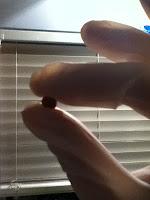 |
| Leukeran is a tiny pill |
|
Now that she has completed her injectable chemotherapy, and
her lymph nodes have reduced in size, Curie can take oral chemotherapy at home
(Leukeran and Prednisolone), as long as she continues to get a CBC checked
every three weeks to make sure her cell counts don’t drop too low. Her hair is a little thinner on her belly, she has fewer whiskers than she used to, and her hair still has not fully regrown from where she had surgery, but she still seems to feel good. In fact, when I head to the kitchen in the evenings to get her pills, she runs ahead of me because she knows that she will get her favorite treats afterwards!
As a
technician, I have always felt that cats seem to do well with chemotherapy, and
so far my experience with my own cat has reinforced that belief. While she is not as robust a cat as she was before she developed cancer, her attitude is the same, her habits are the same, and I know that it is unlikely that I would still have her at this time if we had not started chemotherapy. I am so happy
with how well she has done the last 5 months while being treated with chemotherapeutic drugs, and I hope that she continues to do well, and
eventually goes into remission.
****
 |
| Still begging for treats! |
One of the best ways to tell if your cat is handling
chemotherapy well is to see how they respond to their first dose or two. Usually, you
will see your cat improving in 1-2 weeks. My other cat Marley also has lymphoma
(in his nose, and therefore, inoperable), and I always notice that he stops
wheezing and sneezing about 5 days after a dose of chemotherapy. With
chemotherapy, it is fairly easy to evaluate, and help the doctor evaluate,
whether the chemotherapy is working after only a few doses. Committing to start
chemotherapy does not mean committing to the entire process – if at any time
your cat is not tolerating the treatment, or not responding well, the
chemotherapy can be stopped. In most cases, if chemotherapy is offered, it is
definitely worthwhile trying.
Possible side effects include:
- Suppression of the
bone marrow
The type of white blood cell that normally prevents development of serious
bacterial infections (neutrophil) can be decreased. If this happens the
cat can be at risk of developing severe life-threatening infections. This
is the most serious potential side effect, and it is one of the reasons
that we monitor the CBC while cats are being treated with chemotherapy –
weekly in the initial phase and every 3 weeks after that. If the
neutrophils are too low then further treatment is delayed until they have
returned to normal. The CBC also allows us to monitor for anemia (decrease
in red blood cells) and look for chemotherapy-related changes in the blood
smear. Monitoring the cat with these blood tests helps us identify and
treat problems before they become serious.
- Gastrointestinal side
effects (nausea, vomiting and diarrhea, inappetence)
With the most common drugs used at the recommended doses, digestive
effects are uncommon. A few cats will, however, develop various
gastrointestinal side effects. Most of the time appetite stimulants and
anti-vomiting medications easily manage these effects and keep the patient
comfortable. If more severe or long-term side effects occur, then the drug
causing them can be stopped and an alternative drug can be tried that may
be better tolerated.
- Extravasation of drug
Chemotherapy drugs that are administered into a vein can be extremely
irritating and painful if inadvertently given outside of the blood vessel.
If your cat is grumpy or wiggly at the veterinary office, he or she may
need sedation for the placement
of IV catheters or even while giving the chemotherapy drug in order to make sure that things go smoothly and
safely for all involved.
Additional resources:


