Friday, November 18, 2011

Celebrating Thanksgiving with your Cat

A cat with a Pilgrim hat on 

Do your cats hate the holidays? Do they run when company comes over? It might be a good idea to set your cats up with a special room in your house for the holidays - a quiet place where they can escape the hustle and bustle of friends and family getting together to celebrate. Make sure that their safe place has a litterbox, food, water and a comfy bed in case they hide for more than a few hours. Some cats readily overcome their fear of strangers and come out to mingle on their own, but most cats would just prefer to wait until after the house is quiet again before they emerge.

Sometimes, very timid cats may benefit from anti-anxiety medications at busy and chaotic times of year.

Some more curious cats may try to come help cook the turkey and stuffing - be careful about cats near hot stove burners, or getting shut in the pantry, especially if there are extra helpers in the kitchen that don't know your cat's habits.

When it comes time to sit down for your turkey dinner, you may want to make sure that your cats are celebrating elsewhere and not begging at the table for some gravy! While turkey is a very appropriate food for cats, be aware that some of the spices we may use are not. Sage is an herb that cats are extremely sensitive to, and can cause an upset stomach or depression of the nervous system. Onions and garlic can cause the destruction of red blood cells. Small bones can cause choking or bowel obstructions. Ingestion of broken bones can cause perforations of the intestinal tract, so if you offer turkey meat, make sure it is boneless.

In addition, cake batter has raw eggs that can carry salmonella, and bread dough can expand in your cat's stomach and become quite uncomfortable. Be aware that parchment paper, tin foil or saran wrap with yummy turkey drippings (or other tasty treats) on it could also be a hazard, as they are easily swallowed while a cat is licking the deliciousness off of them.

Watch out for the begging cat that weaves around your legs while you're carrying that 20-pound turkey to the dining room table!

And, of course, after the hustle and bustle is over, make sure to spend some quality snuggle time with your cat, letting him know how thankful you are that he's willing to put up with all these silly human shenanigans and share your home with you!

We at Exclusively Cats are thankful for all you loving cat owners that trust us with the care of your beloved companions! Happy Thanksgiving!


A cat dressed in Native American costume
(This and other adorable pet hats are available from "To Scarborough Fair" at Etsy.com!)

Monday, November 7, 2011

Hello, baby! - Preparing your cat for a new addition to the family


A tabby cat peeking out from under a couch  | Exclusively Cats Veterinary Hospital, Waterford, MI
Since babies are a big deal around E-Cats right now, this seems like an appropriate topic to write about! Many cats adapt quite well to new babies, but cats are creatures of habit and the chaos and excitement introduced by a new little one may make your cats disappear, or in some cases, eliminate inappropriately outside the litterbox. The most important tip is to try to keep your cats’ routines as close to normal as possible.

First: While a woman should not clean litterboxes during pregnancy, there is no need to get rid of the cat.

Second: Make sure that your cat is up to date on her vaccinations, is on a monthly parasite preventive, and has had a recent stool exam at the veterinary office prior to bringing the baby home. There are so many other things to think about with a new little one in the house that worrying about your cat’s health, or whether your baby could contract an illness from your cat should be dealt with before you’re distracted and sleep-deprived!

Cat on a crib tent  | Exclusively Cats Veterinary Hospital, Waterford, MI


Slowly begin to introduce baby items into your home. Set up the crib ahead of time. Try to discourage your cat from sleeping in the crib, since he won’t understand why you want him to stop sleeping there once the baby arrives. Once the baby arrives, naps are best taken with the door shut, or with a crib tent; placed over the top of a crib. While a cat does not steal a baby’s breath, as myths suggest, it is safer to make sure that the cat does not have access to a baby while it is sleeping. Another option could be to install a temporary screen door on your baby’s room until the baby is more mobile. Below is a link to one such crib tent at our Amazon Affiliate page.


A cat playing with a baby gym  | Exclusively Cats Veterinary Hospital, Waterford, MI
Allow your cat to investigate baby items, learning the scents of baby powder, formula, wipes and diaper cream.

While you are in the hospital, send home a used receiving blanket ahead of the baby so that the cats can become acquainted to the baby’s smell before they see him. When your cats investigate the blanket, give them praise or treats to reinforce calm, curious behavior about the baby versus fear.

A baby lying on a young cat  | Exclusively Cats Veterinary Hospital, Waterford, MI
One of the most disturbing things about a new baby, in a cat’s perspective, is the noise that babies make. Some cats run and hide when they hear a baby cry, others redirect aggressive behaviors to other members of the household – people or other cats – because they are stressed. It’s a great idea to get your cat used to the sounds of a new baby before they actually have to deal with it on a daily basis. You can go online and Google “baby cry sounds” or similar search criteria, or record the baby of a friend or family member. There is even a CD of baby sounds available for purchase. Better yet, have someone visit with their baby – no pinching him to make him cry, though! Offer your cats treats while they listen to the sounds of babies crying.

If your cat is of the more delicate or dramatic temperament, you may want to place some Feliway diffusers in the baby’s room or near places in the home that the baby will spend time. Feliway is a synthetic pheromone that smells like the scent that cats leave in areas when they are marking things that they like.

A cat sniffing a baby's head  | Exclusively Cats Veterinary Hospital, Waterford, MI
Allow your cat to approach by choice
Once the baby comes home, allow the cats to approach the baby on their own. Many cats, having had an introduction to scents and sounds of the baby prior to its arrival, will show hesitant curiosity and will come up to the baby and sniff it while you are holding her. Never leave your cats unattended with your baby. You may want to allow your cat to sit on your lap while you are feeding the baby so that you can talk to both your cat and your baby and make positive associations between the two.

Make sure that even amidst the changes to your life that you still find time to set aside just for your cats – grooming, playing or just sitting and enjoying each other’s company.

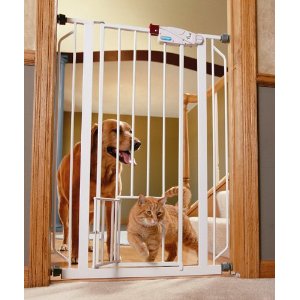
A cat passing through a cat-friendly baby gate  | Exclusively Cats Veterinary Hospital, Waterford, MI
Give your cat a way around baby gates
Cats on cat-shelves and walkways  | Exclusively Cats Veterinary Hospital, Waterford, MI
Give cats elevated escape from the baby
While your baby is still non-mobile, start to plan for when the little one starts to move around on his own. Think ahead about how to keep cat food, water and litter out of reach of your baby but still easily accessible to your cat. Provide your cats with elevated perches or other areas where they can escape from curious little hands and mouths. Some strategically placed baby gates can allow cats access to escape areas by climbing over (or under) while keeping your baby safe. You may even want to create a quiet little cat paradise area well stocked with blankets and toys in a childfree zone.


A baby chewing a kitten tail  | Exclusively Cats Veterinary Hospital, Waterford, MI
Tails are not for pulling!
You will also want to desensitize your cats to the kind of handling they might expect from small hands. Touch their faces, tails, toes, and in the ears and mouth – anywhere small hands might explore. This will decrease the likelihood that your cats will bite or slap at the baby if she gets to “fresh”. However, as much as you can train your pets to be tolerant, all animals, just like people, have a frustration threshold. You cannot teach an animal to endure repetitious pain, no matter how well-mannered they are. As your baby matures, small pats may become more vigorous or even become slaps. A 6 lb. baby sitting on a 12 lb. cat is more tolerable than a 20lb. child sitting on a 12lb. cat. You also have to teach your baby to be gentle and respectful of the pets in your home as well. There are children’s books on the subject, and it is a good idea to teach your child the term “Gentle!” as soon as possible – it works with pulling people’s hair and hitting as well as with pulling kitty’s tail!
Tabby cat sniffing baby's hand  | Exclusively Cats Veterinary Hospital, Waterford, MI
Teach babies as soon as you can to let a cat smell them before petting
A baby gently touching a happy cat on the head  | Exclusively Cats Veterinary Hospital, Waterford, MIAlso make sure to trim your cat’s nails well before the baby comes home. Some people may advise you to have your cat declawed if you are having a baby, for safety’s sake, but if you teach your cat and your baby mutual respect, you should have little to fear about your cat scratching your baby. In fact, putting your cat through surgery when it is already traumatized by the changes to the household may not be in the best interest of your cat’s health. Also, declawing cats over a certain age and weight can result in prolonged recovery – it can be done, but is a very unpleasant experience for your cat. If your cat’s paws are fully loaded and you are concerned, then you may want to try applying Soft Paws to her nails. This allows your cat to keep her claws, while making them safe for baby. Be aware, however, that Soft Paws need to be changed about every 4-6 weeks or the nails, which are still growing beneath the colorful caps, will grow into your cat’s paw pads – which can both cause pain and infection.

If you are having trouble acclimating your cat to a new addition to the home, you may want to involve your veterinarian. The doctor may have additional suggestions for your individual situation, or in some cases a behavioral medication may be recommended.

If you're a multi-species family, a great resource for information on introducing dogs and babies is Family Paws Parent Education.

Friday, October 28, 2011

What Should I Know about Cat Nutrition? Part 3

Answers to last week's ingredient question:
1) Meow Mix
2) Purina Naturals
3) Purina One Beyond
4) Science Diet Oral Care
5) Evo Turkey and Chicken Flavor
6) Before Grain Chicken
7) Fancy Feast Fish and Shrimp Feast


When considering the cost of the food you feed your cat, you may want to consider how much of the food your cat will require daily. Less calorie-dense foods will be fed in greater volume and may actually end up costing more than a more expensive bag of food that you can get more servings out of. When figuring out what you’re paying for, sometimes it is best to figure out cost-per-meal instead of cost-per-pound.
On the other hand, premium foods are not required to be made of any better or healthier ingredients than a regular complete and balanced cat food.


Here are three premium (dog) foods compared – you can see that some of them need to be fed in much greater volume than others!

      A.     Before Grain Made with Buffalo, Chicken Meal
B. Taste of the Wild High Prairie Canine Formula with Roasted Bison and Roasted Venison
C. Orijen Adult Formula All Breeds
D. EVO Turkey & Chicken Formula Dry Dog Food

Dry food is often easier to feed because it can be left for cats to nibble at free choice, and it is easier on the wallet because it is less costly than canned food, however many experts agree that dry foods should be fed in moderation -- some even suggest that the worst canned food is still better than the best dry food. If using a dry food, look for one that's high in protein and low in carbohydrates, and make sure your cat has plenty of water.

A cat eating kibble
The reason canned food is often better than dry is simple: cats are desert animals that instinctively get their daily water from their prey and have little thirst drive to look for water. Sure, your cat will drink water both when eating canned food and when eating dry, and may even drink more water when eating a dry-food-only diet, but studies have shown that even though they seek out the water dish more frequently, cats that eat only dry food may consume as little as half the daily water that a canned-food-eating cat takes in! Drinking less water means that your cat is perpetually mildly dehydrated, leading to super-concentrated urine and a higher risk of urinary crystals and bladder stones. Super-concentrated urine is also harder on the kidneys long-term, which could shorten the life of the kidneys.

Other benefits of canned food include: a higher protein/lower carbohydrate content, since we know that cats need very little in the way of carbohydrates in their diet; a greater feeling of satiety on fewer calories, leading to a better body condition; and most cats just plain like it better!

Two cats sharing canned food
There are mixed opinions on the presence of dyes and preservatives in cat foods. There's no proof that dyes or preservatives are unhealthy for cats, but little has been done to research the effects of these ingredients building up in cats' systems over time. Dyes can stain carpets and upholstery. Premium foods seldom contain dyes, but many supermarket brands do.

The naming of cats’ foods:
  • The 95% Rule
    A cat food may not be labeled "Chicken for Cats," or "Chicken Cat Food," unless it contains 95% or more chicken by total weight of the product.
  • The 25% Rule
    Foods labeled "Chicken entrĂ©e," "Chicken Dinner," "Chicken Feast," or the like, must contain 25% to 95% chicken. “Platter”, “nuggets” and “formula” are also common. Just because the name says “Chicken Formula” does not mean that beef, or fish are not added. The ingredient label is the real key to knowing what your cat is eating. Combinations, such as "Chicken and Beef Dinner" must contain a total of 25% to 95% of the combined meats, listed in order of quantity, and the second meat listed must comprise at least 3% of the total weight. (Imagine ordering a "steak and lobster" dinner and finding the "lobster" will barely fill a fork!)
  • The 3% Rule
    The “with” rule. A food labelled "Kitty Stew with Chicken" must contain 3% or more chicken. This is easily confused with the 95% rule. Turkey cat food has 95% turkey, cat food with turkey has 3% turkey.
  • "Flavor"
    Barely worth mentioning here, but if you see something similar to "chicken flavored," be assured that the product is unlikely to contain any chicken at all, as long as there is a "sufficiently detectable" amount of chicken flavor, usually the result of digests or by-products of the named animal versus actual meat content.

Additional resources for decoding cat food ingredients:
  
You Are What You Eat, Chemically
Now that we’ve talked in-depth about ingredients, don’t spend too much time trying to decipher that ingredient list. Most food manufacturers approach animal feeds with a chemist’s point of view. The bottom line of nutrition is the chmical component of the food – are the basic amino acids available to make proteins? Is the right blend of vitamins in there? Is the animal going to get an adequate balance of protein, fats and carbohydrates and maintain a good weight on this diet? Is the cat going to actually EAT the food? “Animals require nutrients, not ingredients," says Sherry Sanderson, DVM, PhD, University of Georgia, College of Veterinary Medicine. “You should be most concerned about the nutritional value of the end product, and less concerned about the ingredients that get you there.”

Preservatives in pet foods get a bad name, but they actually serve a very important function in dry pet foods, Sanderson says. Preservatives are antioxidants that prevent the fat in foods from spoiling (becoming rancid). Some fats can spoil very quickly. Once a fat spoils, it loses its nutritional value, not to mention it can become dangerous to eat.

Preservatives may be natural or man-made. Natural preservatives commonly found in cat food include vitamin E (tocopherol) or vitamin C (ascorbic acid). Man-made preservatives are synthetic forms of vitamin E such as butylated hydroxytoluene (BHT) and butylated hydroxyanisole (BHA).

Some web sites claim BHT and BHA can lead to cancer in pets. But at this time, little research has been done in this field – any suggested link between preservatives at the level found in pet foods and cancer growth is unsubstantiated by scientific peer-reviewed studies. Experts say you should never choose a dry cat food that doesn't contain preservatives, because the risk of feeding a potentially rancid diet far outweighs any perceived risks associated with preservatives.

If you prefer to feed your cat a diet without preservatives, it is recommended to feed preservative-free canned food only.

Natural Is Not Necessarily Organic
There is no standardized official definition for the terms "natural" and "organic" when it comes to pet food. Also, "Organic" and “Natural” are not one and the same. “Organic” refers to the way a food source is grown and processed. The FDA is currently working on developing guidelines for the use of the word "organic" on cat food labels.

"Natural" may mean the product has no artificial flavors or colors – both of which are not necessary in a cat’s food. However, it may indicate that there are no added preservatives, which can lead to spoilage in dry foods. A food that advertises itself as “100% all-natural” may be misleading because most complete and balanced pet foods have vitamins and minerals added to them, most of which are man-made. Few pet foods ever use artificial flavors.

Foods Your Cat Should Never Eat

Rules of Thumb for Feeding Your Cat

    Cat and dog looking at hamburgers
  •  Never feed dog food to your cat in place of cat food. It is deficient in essential nutrients cats require. Cats, unlike dogs, cannot convert certain dietary precursors into necessary amino acids and water soluble vitamins. A cat given dog food over a long period can develop taurine deficiency, vitamin A deficiency (night blindness), niacin deficiency, retinal degeneration, and other serious or fatal illnesses. Cats that nibble from the dog bowl from time to time are usually fine, as long as they get the majority of their nutrition from their cat food.
  • Specialty foods and even table scraps can be given as treats once or twice a week-but only after the regular diet is eaten. Cooked meats (including organ meats such as liver or kidney), cottage cheese, cooked vegetables, cooked fish, milk, and yogurt are foods with strong taste appeal that cats seem to enjoy. Only give them in small amounts and do not offer dairy products if your cat appears to be lactose intolerant (usually evidenced by diarrhea)
  • Never feed meats exclusively.
  • Treats should never exceed 20 percent of a cat’s total daily food.
  • Uncooked meat and raw fish should not be given because of the dangers of vitamin deficiency. Raw fish contains an enzyme that destroys vitamin B1 (thiamin). A deficiency of this vitamin results in brain damage. Fish is also deficient in vitamin E and raw meat in general has the potential to transmit diseases and parasites.
  • Vitamin and mineral supplements are not necessary or desirable if you are feeding a balanced cat food. Cats may actually overdose on vitamins A and D or calcium and phosphorus, either by giving the vitamins directly or by supplementing the diet with products that are high in them (such as raw liver or fish oils). Excess vitamin A causes sterility and loss of hair. Excess calcium, phosphorus, and vitamin D cause metabolic bone and kidney disease.
  • Cats have highly selective eating habits. The location of the food dish, noise, the presence of other animals, and other threats or distractions can adversely affect how much they are willing to eat. A cat in a boarding facility may refuse food for entire week (which can be dangerous) unless an appetite stimulant is given.
  • Most cats prefer to have their food served at room temperature or slightly warm.
  • Many cats will not eat if the food dish is located near the litter box.
  • Water is a very important nutrient for cats. Always have plenty of fresh water available. Some cats like to drink from faucets and pet fountains. Some cats like ice in their water, especially in the summer. Again, canned food diets are more likely to provide an adequate amount of water than are other types of food.
  • Many cats prefer to eat and drink out of dishes that do not contact their whiskers, such as wide dishes or plates versus small, deep bowls.
Additional resources:

Thursday, October 20, 2011

What should I know about Cat Nutrition? Part 2


Let's face it - feeding your cat is one of the most important functions you have as a cat caretaker! Here is some more handy information about feline nutrition.

A can of pet food, showing the label
What information is available on the food label?
Besides the AAFCO statement, all food labels must also include:
1.      Ingredient list by weight, with the heaviest ones first.
2.       The product name and brand name.  
3.       The species name (in this case, cat) this food is designed for.
4.      Size; how much pet food is in this bag or can. This information must be on the lower third of the front of the bag.
5.      Guaranteed analysis of the pet food stated as Crude Protein (minimum), Crude Fat (minimum), Crude Fiber (maximum), and Moisture (maximum).  
6.      The name and address of the food manufacturer or distributor – this must be made available in case of adverse reactions or recalls.
7.      How much to feed: Every cat food label must have recommendations regarding how much to feed cats of different sizes or ages. These guidelines usually overestimate the amount of food a typical cat needs to eat every day. Some people believe that this is a ploy on the part of the pet food manufacturers to sell more food. Others suggest that pet food manufacturers overestimate to make sure that no diet can be accused of causing unhealthy or undesired weight loss in a pet when fed as directed.

The pet food manufacturers that perform feeding trials on their diets maintain that these guidelines are based on calculations of what typical pets in their feeding trials needed to satisfy their energy requirements. Whatever the reason, many pets can safely be fed less than the daily recommendations on the packaging.

Ingredients: Now that we know what nutrients need to be in cat food, how does it get there?
  • Protein from a meat, fish, or poultry source
  • Taurine, an essential amino acid
  • Certain other vitamins, minerals, enzymes, and fatty acids
  • Water
A cat looking at stacks of canned diets
That is all cats need. They do not need carbohydrates. In the wild, the only carbohydrates a cat would get in its diet would be the stomach contents of its prey – partially digested grains and seeds, most commonly. Corn, wheat, and/or rice are often used as fillers for dry cat foods. Other ingredients, such as binders, flavoring, and coloring, are added by cat food manufacturers to satisfy the aesthetic wants of the consumer. Although preservatives are necessary, to keep foods fresh for our cats, canned food should not be allowed to remain out for a long period of time. Don’t be fooled into thinking that a food is good for your pet because it lists ingredients such as peas, carrots, cranberries, blueberries and the like. Pets don’t really need these ingredients to thrive, but they make for good marketing to the pet’s human. They can be a source of antioxidants and vitamins, but the amounts are probably not significant enough to make a difference.
Here are some of the most common ingredients:
A gray tabby cat eating kibble
  • Meat: Cleaned flesh from chicken, lamb, turkey, cattle, and related animals that have been slaughtered specifically for animal feed purposes. However, flesh means more than skin. It may include muscle, (including the diaphragm), fat, nerves, blood vessels from the skin, the heart, esophagus, and the tongue.
  • Meat by-product: Clean, non-flesh parts from the same animals mentioned above. This can include the blood, bone, brain, liver, lungs, liver, kidneys, and emptied stomach and intestines. There are no hooves, hair, horns, or teeth in meat byproducts. Chicken by-products are feather-free. This might sound gross, but remember what your cat’s natural diet consists of – there are important nutrients available in organ meat that cats require.
  • Beef tallow: A fat made from beef.
  • Meal: Finely ground tissue.
  • Bone meal: Finely ground bone from slaughtered feed animals.
  • Fish meal: Clean, ground undecomposed whole fish or fish pieces. The fish may or may not still contain fish oil.
  • Ground corn: Chopped or ground corn kernels.
  • Corn gluten meal: A product that forms after corn syrup or starch is made.


Pet food labels are required to list ingredients in decreasing order by weight. This can be confusing when trying to figure out what amounts are really in the food. For example, if a label reads: chicken, ground corn, corn gluten meal and so on, you might be tempted to think that this is a food primarily made of chicken - it IS the first ingredient, after all. Unfortunately, this is not necessarily the case.

The corn ingredients in the example above have been split into two different ingredients: ground corn and corn gluten meal, which, while two different ingredients, misleadingly allows the chicken to be the first ingredient. This is really a corn-based food with chicken added. Due to the specificity of the ingredient label, different types of cereals and grains must be listed separately, but when combined as overall grain content they will constitute a greater part of the food.

Many pet food labels
What do you think of the ingredients of these popular brands of food? Do you know which brand of food each of these ingredient lists is from? Which one would you choose to feed your cat?

1) Ingredients: ground yellow corn, corn gluten meal, chicken by-product meal, soybean meal, beef tallow (preserved with mixed tocopherols (a form of Vitamin E)), animal digest, calcium carbonate, turkey by-product meal, salmon meal, ocean fish meal, phosphoric acid, choline chloride, salt, potassium chloride, titanium dioxide (color), vitamins (vitamin E supplement, niacin supplement, vitamin A supplement, d-calcium pantothenate, thiamine mononitrate [source of vitamin B1], riboflavin supplement [source of vitamin B2], pyridoxine hydrochloride [source of vitamin B6], menadione sodium bisulfite complex [source of vitamin K activity], vitamin D3 supplement, folic acid, biotin, vitamin B12 supplement), potassium chloride, minerals (ferrous sulfate [source of iron], zinc oxide, manganous oxide, copper sulfate, calcium iodate, sodium selenite), taurine, yellow 5, red 40, yellow 6, yellow 5, red 40, blue 2, dl-methionine, l-lysine, rosemary extract.

2) Ingredients: Chicken meal, corn gluten meal, soybean meal, brewers rice, animal fat preserved with mixed-tocopherols (form of Vitamin E), corn meal, chicken, salmon, powdered cellulose, ground whole wheat, soybean hulls, malt extract, brewers dried yeast, phosphoric acid, natural flavor, tetra sodium pyrophosphate, calcium carbonate, salt, choline chloride, dried spinach, parsley flakes, potassium chloride, taurine, Vitamin E supplement, zinc sulfate, ferrous sulfate, niacin, manganese sulfate, Vitamin A supplement, calcium pantothenate, thiamine mononitrate, copper sulfate, riboflavin supplement, Vitamin B-12 supplement, pyridoxine hydrochloride, folic acid, Vitamin D-3 supplement, calcium iodate, biotin, menadione sodium bisulfite complex (source of Vitamin K activity), sodium selenite.

3) Ingredients: Chicken, chicken meal, whole brown rice, soybean meal, whole barley, whole oat meal, soy protein isolate, animal fat preserved with mixed-tocopherols (form of Vitamin E), brewers dried yeast, dried egg product, natural flavor, dried beet pulp, fish oil, phosphoric acid, caramel color, dried carrots, salt, dried sweet potatoes, dried apples, calcium carbonate, potassium chloride, taurine, choline chloride, Vitamin E supplement, zinc sulfate, niacin, ferrous sulfate, manganese sulfate, Vitamin A supplement, calcium pantothenate, thiamine mononitrate, riboflavin supplement, Vitamin B-12 supplement, copper sulfate, pyridoxine hydrochloride, folic acid, Vitamin D-3 supplement, biotin, menadione sodium bisulfite complex (source of Vitamin K activity), calcium iodate, sodium selenite.

4) Ingredients: Chicken By-Product Meal, Brewers Rice, Corn Gluten Meal, Animal Fat (preserved mixed tocopherols and citric acid), Powdered Cellulose, Whole Grain Corn, Lactic Acid, Chicken Liver Flavor, Soybean Oil, Potassium Chloride, Choline Chloride, Calcium Carbonate, DL-Methionine, Iodized Salt, Vitamin E Supplement, vitamins (L-Ascorbyl-2-Polyphosphate (source of vitamin C), Vitamin E Supplement, Niacin, Thiamine Mononitrate, Vitamin A Supplement, Calcium Pantothenate, Riboflavin, Biotin, Vitamin B12 Supplement, Pyridoxine Hydrochloride, Folic Acid, Vitamin D3 Supplement), Taurine, Calcium Sulfate, minerals (Ferrous Sulfate, Zinc Oxide, Copper Sulfate, Manganous Oxide, Calcium Iodate, Sodium Selenite), preserved with Mixed Tocopherols and Citric Acid, Phosphoric Acid, Beta Carotene, Rosemary Extract.

5) Ingredients: Turkey, Chicken Meal, Chicken, Herring Meal, Chicken Fat (Preserved with Mixed Tocopherols a Natural Source of Vitamin E), Peas, Eggs, Turkey Meal, Pea Fiber, Natural Flavors, Apples, Carrots, Cranberries, Herring Oil, Tomatoes, Pumpkin, Dried Chicory Root, Cottage Cheese, Alfalfa Sprouts, Taurine, DL-Methionine, Minerals (Zinc Proteinate, Iron Proteinate, Copper Proteinate, Manganese Proteinate, Calcium Iodate), Vitamins (Vitamin E Supplement, Betaine Hydrochloride, Niacin Supplement, Vitamin A Supplement, Calcium Pantothenate, Thiamine Mononitrate, Riboflavin Supplement, Beta Carotene, Vitamin B12 Supplement, Vitamin D3 Supplement, Biotin, Pyridoxine Hydrochloride, Folic Acid), Direct Fed Microbials (Dried Lactobacillus acidophilus Fermentation Product, Dried Lactobacillus casei Fermentation Product, Dried Enterococcus faecium Fermentation Product)

6) Ingredients: Chicken Deboned, Chicken Meal, Potato Dehydrated, Turkey Meal, Chicken Fat (preserved with mixed tocopherols – a source of Natural Vitamin E), Sweet Potato Dehydrated, Dried Egg, Natural Flavor, Yeast Culture, Dicalcium Phosphate, Lysine, Sea Salt, Alfalfa, Salmon Oil, Choline Chloride, Acai Berry Freeze-Dried, Blueberry Dried, Yucca Schidigera Extract, Rosemary Extract, Taurine, Zinc Amino Acid Complex, Chondroitin Sulfate, Glucosamine Hydrochloride, Chicory Root, Marigold Extract, Lactobacillus Plantarum, Enterococcus Faecium, Lactobacillus Casei, Lactobacillus Acidophilus, Iron Amino Acid Complex, Vitamin E Supplement, Manganese Amino Acid Complex, Vitamin A Supplement, Vitamin B12 Supplement, Copper Amino Acid Complex, d-Calcium Pantothenate, Vitamin D3, Niacin, Lecithin, Riboflavin Supplement, Biotin, Ethylenediamine Dihydriodide, Pyridoxine Hydrochloride, Cobalt, Amino Acid Complex, Folic Acid, Thiamine Mononitrate, Sodium Selenite.

7) Ingredients: Ocean fish, fish broth, shrimp, calcium phosphate, vegetable oil, guar gum, Vitamin E supplement, Vitamin A supplement, sodium nitrite (to promote color retention), zinc sulfate, thiamine mononitrate, manganese sulfate, menadione sodium bisulfite complex (source of Vitamin K activity), riboflavin supplement, folic acid, pyridoxine hydrochloride, Vitamin D-3 supplement.

Monday, October 10, 2011

What should I know about cat nutrition? Part 1

AAFCO logo
Who decides what cats need?


Nutritional guidelines are ever evolving, for both humans and animals, as research in nutrition advances. The first commercial cat food was developed in 1876, and the American Association of Feed Control Officials (AAFCO) was founded in 1909 to oversee the commercial production of animal food (cows and other livestock, included). AAFCO is a voluntary membership association of local, state and federal agencies charged by law to regulate the sale and distribution of animal feeds and animal drug remedies. AAFCO works side-by-side with the FDA and USDA to ensure pet safety. 

LOLcat eating dog food "Pleh. There's no dog in this food at all"
Historically, up until the 1950s, many cats were table-fed a combination of milk- or broth-soaked bread, snippets of table scraps and raw or stewed meat bits to supplement their hunting of rats and mice. During the late 1970s, commercial diets became more popular and over time, even though AAFCO oversaw the production of these diets, it became clear that not all “complete and balanced diets” were created equal. In the 1980s, it was discovered that cats had certain specific dietary requirements – a lack of the amino acid taurine (which is found in meat proteins but not plant proteins) in some feline diets was causing blindness and heart failure, and AAFCO regulations were adjusted to reflect that need. As recently as1995, separate feeding guidelines were developed for growing kittens versus adult cats.

What does AAFCO do?
  • AAFCO does not have the power to regulate foods, but various states have officials that perform this task who serve on the AAFCO board
  • AAFCO does no testing, but recommends food testing protocols and works with independent laboratories which perform tests 
  • Not only does AAFCO regulate minimum nutrition guidelines, but also determines the validity of claims made by pet food companies, such as "controls tartar", "new and improved" and "light". 
  • AAFCO makes no determination of "human grade" protein quality, which some pet food labels advertize. However, because of the current trend toward "natural," as well as "organic," AAFCO is currently working on standards for these terms. In the meantime, caveat emptor (let the buyer beware) with foods that bear those phrases. If you prefer foods advertized as "natural" or "organic", you may want to make sure you completely understand what the pet food company means by the terms.
 What should you look for on pet food labels?

A dog and cat looking at hamburgers
  • Compliance with AAFCO's requirements for "Complete and Balanced," as evidenced by that wording on the label.Note the difference between "formulated to meet AAFCO standards" and "Animal feeding trials substantiate". Foods that are formulated to meet requirements may look better on a nutritionist's calculator than in your pet's food bowl, where feeding trials demonstrate palatability, blood levels of certain nutrients, and body weight gain/loss or maintenance while fed a particular diet.
  • Named protein source - look for "chicken, lamb, or beef," rather than "meat."
  • On canned food particularly, the protein source should be the first listed ingredient 
  • Check the expiration date for freshness 
 What are the current AAFCO standards for cats?

A brown tabby cat licking its lips
 For Adult Maintenance
Unless otherwise listed, all values are minimum requirements:

Protein... 26%
Fat ...... 9%
Calcium.... 0.6%
Phosphorus... 0.5%
Potassium... 0.6%
Sodium..... 0.2%
Chloride.... 0.3%
Magnesium... 0.04%
Iron... 80 mg/kg
Copper... 5 mg/kg
Manganese.... 7.5 mg/kg
Zinc....... 75 mg/kg (maximum 2000 mg/kg)
Iodine..... 0.35 mg/kg
Selenium.... 0.1 mg/kg
Vitamin A... 5000 IU/kg (maximum 750,000 IU/kg)
Vitamin D... 500 IU/kg (maximum 10,000 IU/kg)
Vitamin E... 30 IU/kg
Thiamine... 5 mg/kg
Riboflavin... 4 mg/kg
Pantothenic Acid... 5 mg/kg
Niacin... 60 mg/kg
Pyridoxine... 4 mg/kg
Folic Acid....0.8 mg/kg
Vitamin B12...0.022 mg/kg
Choline..... 2400 mg/kg
Taurine... 0.1%

(For cats diets with over 25 percent of the diet made from fish products, Vitamin K 0.1 percent is necessary)

For Growing Kittens, Pregnant and Lactating Queens
The majority of nutrient minimums are the same except for the items listed. The maximum for those listed does not change.

Protein...30%
Calcium 1%
Phosphorus 0.8%
Magnesium... 0.08%
Copper... 5-15 mg/kg
Vitamin A... 9000 IU/kg
Vitamin D... 750 IU/kg

***Note: AAFCO requires statement of minimum, but a food can contain more than listed on the label.

Friday, September 30, 2011

Does your kitty have cabin fever?

Have you ever been jealous of a friend or neighbor who has a well-trained dog that will walk on a leash, come when he’s called and sit up on command? Believe it or not, many cats are just as trainable with the clicker training method, and tasty treats. Not only will you wow your family with your savvy cat, but you will also be providing daily enrichment for your cat.

Kaiser is a Bengal who knows 51 tricks.


Cats are very smart – they find lots of ways to entertain themselves all on their own. A cat may spend 14-15 hours a day resting or sleeping in the wild, but they also spend about 5 hours hunting and traveling from place to place*. This hunting behavior is mental stimulation and exercise. Many indoor cats are unable to provide this much entertainment for themselves daily. To prevent behavior problems, and to burn excess calories, you can provide 5-10 minutes of exercise once to twice daily, or alternate with a 10-15 minute training session.

A brown tabby cat with a mouse toy
A mouse toy
How do you play with your cat? The best cat toys are ones that are interactive. While jingle bells are great dual-purpose toys that can be tossed for a cat (and maybe even be used to train your cat to fetch) or that the cat can bat independently, most cats need a variety of toys to keep them entertained. Too many similar toys can cause a cat to become bored. Not all cats will like every type of toy, however. Some cats prefer toys that simulate birds (feather wands, chirping toys, suspended toys), some prefer toys that mimic rodents (stuffed toys, balls and mouse-shaped toys) and some prefer toys that simulate crawling bugs (laser pointers, knotted strings) Sometimes it takes some trial and error to find out what your cats like. A variety of ball-type toys of different textures, a laser pointer, toys on the ends of rods or wires, food puzzles, and even a bird feeder near a cat-friendly window or a fascinating fish tank are some of the types of toys and entertainment that cats love. Even with a variety of toys available, it is usually a good idea to put some toys away for a while from time to time and then rotate them with the toys your cat is currently playing with. Older toys will develop novel appeal when the cat has not seen them for a while.

ADDITIONAL RESOURCES:
A black and white kitten with a ball or "bug" toy
A bug toy
Toy reviews
How to choose a toy
Matching toys to your cat’s personality
Great cat toys don’t have to cost a lot of money, either. Here are some sites with some creative DIY toys.
Homemade food puzzles
A huge list of creative homemade toys

As for training, cats respond very well to food rewards, which is part of the clicker training method. Basically, you make a sound and associate it with a food reward. Once your kitty figures out that the sound equals food, they are yours to command! You can use this method to train your cat to sit, come, beg, high five, shake, turn off lights, and even complex activities such as navigating an agility course with tunnels, hoops and see-saws.
One thing to keep in mind when planning training sessions is how many treats you give during the session. Treats should make up no more than 10-15% of your cat’s daily intake. If you find yourself using too many treats during training sessions, you can always take a portion of your cat’s daily diet and use that as a reward, remembering to decrease the amount of food offered at mealtime. You can also break treats into small pieces – after all, to a cat a tiny ant is considered a delicious snack!

An orange tabby kitten with a feathery "bird" toy
A bird toy
While it is not a good idea to deprive your cat of food simply for training purposes, many cats will respond better to training sessions just before meal time – this only works, however, if your cat is on a meal-fed schedule versus having food available free choice. If your cat has food available all day long, try to keep an eye out for the times your cat visits the bowl regularly and try to plan your training sessions near that time. Cats are creatures of habit, so it isn’t usually too difficult to figure out their routine. If you can’t figure out your cat’s schedule, then just make sure you have a fabulous treat available that your cat will love.
High-energy play sessions and rewarding training sessions will build on your relationship with your cat as well as helping to keep your cat physically and mentally alert and engaged.

ADDITIONAL RESOURCES:
Ohio State University’s Indoor Pet Initiative
FabCats, a UK site about environmental enrichment for indoor cats
How to address the different activity needs of cats
A scholarly article from the Journal of Feline Medicine and Surgery with recommendations for environmental enrichment, and dealing with frustrated and anxious or fearful cats
Two articles about feline clicker training strategies
Clicker training your cat
Can you train your cat?

*For those of you who noticed that doesn’t add up to 24 hours, most of the rest of the day is spent grooming, and about 40 minutes a day is spent eating. Shop for cat toys at our Amazon Affiliate Store:

Friday, September 23, 2011

I found a....feral? Stray? Does it matter?

A grumpy-looking feral tomcat

The difference between the right word and the almost right word is the difference between lightning and a lightning bug.
Mark Twain 


On September 19th, we had three cats brought into the hospital for exam that were “found cats”. Some found cats are strays and some are ferals. How do you know what the difference is?


A feral cat is a cat that was born or grew up in the wild and is unfamiliar with human contact. These cats do not seek out human companionship, and often will hiss, growl or attempt to escape from human advances, no matter how friendly. Feral cats are often un-neutered, or bear scars from fighting or frostbite.

Three stray cats being fed by an elderly woman
These cats are unlikely to be feral.

On the other hand, a stray is a cat that is tame, or only slightly shy when exposed to people. They are often cats who have become lost or who have been abandoned from their homes. Many stray cats are neutered or front declawed. They often make homes near humans – under porches, in garages, or in backyards, and are often reliant upon humans for food. They may come beg at your doorway or seek you out when you are outside.


If you see or trap a cat in your yard, Alley Cat Allies has a great comparison chart with visuals to help you determine if you are encountering a feral cat or a stray.


Both feral and stray cats do have the potential to trust humans and become good companions, but it is much harder to acclimate feral cats to humans. Generally the best time to tame feral cats is when they are kittens younger than 12 weeks of age. After that, it becomes increasingly difficult to tame them, and there are some feral cats that will never become socialized well-enough to bring indoors.

A large number of feral tabby cats
Cats in a feral colony

It is estimated that there are more than 60 million feral cats in the U.S. and additional lost or abandoned stray cats. There are probably feral cats living in your neighborhood that you never see! Since cats are only asocial, not antisocial (they don’t hate living in groups, but they don’t require social groups to survive and can live on their own, if needed), feral and stray cats often form loose social groups called colonies near food sources such as dumpsters or areas where there are large numbers of prey. Feral cats maintain a territory of up to several acres, and their hunting grounds may intersect with various other stray and feral cats. Un-neutered cats within the colony will breed and produce more feral cats – each female has an average of 1.4 litters per year with an average of 3.5 kittens per litter. This is why when a person with good intentions starts feeding a stray or feral cat in their backyard, they soon find that there are quite a large number of cats suddenly coming to eat!


A wild-born cat has an average lifespan of only 4-5 years, but may occasionally live to be up to 8 years of age. An indoor cat that is released into the wild will often survive a much shorter amount of time due to a lack of crucial survival skill development that feral cats learn from their mothers in the wild. In contrast, indoor cats live an average of 12-16 years, but can occasionally live into their mid-twenties with good preventive health care.
If you have a new cat that is visiting your house, it could be a:
  • Feral cat
  • Stray with feral tendencies
  • Lost pet or indoor/outdoor pet
  • Neglected cat owned by people who just don’t care.
A feral gray tabby cat that has been ear-tipped
This feral cat has been ear-tipped.

To keep feral populations down, it is recommended that stray cats be caught and fostered until the owner can be found, or photographed and posted as a lost pet in local neighborhoods and businesses. Feral cats that would not make good pets can be caught, tested for Feline Leukemia and FIV and then neutered so that they cannot reproduce (called a “Trap/Neuter/Release”). Often these cats are ear-tipped so that they are not caught and taken in for surgery on a repeated basis. If the cat you are seeing has a tipped ear (about ¼ of the left ear is removed), it is because someone has neutered and released this cat at some point in its life.
If you are having a problem with feral cats, there are resources online that can help you humanely deter and control feral cats that are causing problems.


Indy Feral Incorporated nuisance prevention tips Indy Feral Inc. is a charitable organization operating in Marion County Indiana that has sterilized 22,329 feral cats since 2002 and found homes for 2,717 friendly cats/kittens removed from colonies. This year alone, they have spayed or neutered 895 cats (January through September 2011). That gives a small picture of just how big the feral cat population is in the U.S.!

Alley Cat Allies brochure on deterring feral cats  Alley Cat Allies is a non-profit organization based out of Bethesda, MD which has resources on becoming a rescuer of feral cats, or manager of a feral colony, including traps and information on raising feral kittens.

Last but not least, the ASPCA has compiled a good resource of feral cat information, including suggestions on how to socialize feral kittens.
And of course, if you have questions about a cat in your area - what to do with it, how to catch it, or other concerns, our staff would be happy to help answer your questions as well!

Oh, and the three we saw on the 19th? All three were strays. None of them were microchipped.

One was kept by the family that found him. We neutered him, treated him for fleas and worms, combed out his mats (he is a Persian mix, but due to the fleas, only had a mohawk of hair down his spine, and no hair on his tail!) and examined some healing wounds on his side.

Another went to Backdoor Friends Purebred Cat Rescue. He was  already neutered and front declawed and a purebred shaded-silver Persian.

The third cat went home with the family that found him while they decided what to do with him because he was FIV positive (deciding between keeping him and taking him to a sanctuary for FIV positive cats). We neutered him, extracted a painful, infected, broken canine tooth and treated him for worms. He subsequently escaped back outside and is a stray again - but this time, someone is out there looking for him, hoping to bring him home.

Friday, September 16, 2011

Does An Apple a Day Keep the Veterinarian Away? - Feline Health Myths, Part 5

Myth: Cats lose weight because they are old.

A thin cat with poor hair coat associated with poor diet
Unhealthy weight loss is often accompanied with a change in hair coat.
Reality: This is a great myth to talk about right now, since September is Senior Cat Month!  It is generally true that older cats will lose weight, but old age is not a cause of weight loss. Cats don’t diet, so your obese cat is not likely losing weight because he didn’t like his silhouette in the mirror. If you look more closely at these older cats that are losing weight, some may be eating normally, some may be eating less, and some may be ravenous! 

The older cat that is eating normally or less than usual: Is your cat drinking more water than usual? Are you noticing larger clumps of urine in your litterboxes when you scoop? Your cat may be showing signs of kidney disease.

Is he no longer jumping up on the counters like he used to? Do stairs seem to intimidate him? If so, then your cat may be suffering from arthritis, or may be experiencing some changes to his vision. His food may be in an area where he can no longer easily access it.

Does he drool? Or does his breath smell bad? Many cats seem to ignore extremely painful dental disease, but others will decide not to eat as much food if their teeth are painful.

Are there no other signs besides weight loss? Or maybe your cat’s stools are less than ideal – runny or malodorous? It is possible that your cat has chronic inflammation in the intestinal tract, or lymphoma, which is a cancer that attacks the intestinal tract.

A cat eating dry kibbleThe older cat that is ravenous and/or vomiting: If your cat is vomiting more than usual or ravenously hungry, it can be a sign of hyperthyroidism. The thyroid gland is located in the neck region and can become overactive as cats age. The gland may grow in size, too, and can sometimes be felt by running a finger over the underside of the neck. This has effects on the metabolism, heart rate and energy level of a cat, generally speeding things up. This gives them less time to digest their food, which can cause runny stools. The changes to the heart can cause high blood pressure and can cause damage to the heart muscle itself. A high energy level may make your cat seem kittenish again, but may also cause him to keep you up at night with inappropriate yowling or high activity levels. Thyroid problems can also cause increased thirst and urination which can mask kidney damage. Fortunately, hyperthyroidism is very treatable – but the sooner it is treated, the less lasting damage is done to the body.
Another reason your cat may be ravenous or eating normally but losing weight may be diabetes. Often diabetic cats will drink more and urinate more than normal. They eat a lot because their bodies cannot use the sugar (glucose) that is in their food to make energy. Instead, the sugar is circulated in the blood and then eliminated in the urine. In order to make energy, the body starts to use another method to produce energy, which can result in muscle loss and a severe medical condition called ketoacidosis.

A large, obese orange tabby cat showing his belly
A word about healthy weight loss in obese cats:
It is a good idea to encourage weight loss in overweight senior cats, to avoid problems such as arthritis, diabetes, high blood pressure, or other heart and respiratory complications.

Just like with humans, there is no easy quick weight-loss miracle - getting a cat to lose weight in a healthy way takes time, and a combination of diet and exercise. An overweight cat on a weight loss plan should not lose more than half a pound in four weeks. 

One pound of weight loss may not seem like much, but for a 10 pound cat, it is 10% of its body mass - that's equivalent to 15 lbs. in a 150lb. human.  

The American Veterinary Medical Association recommends wellness exams every 6 months in senior cats because they age much more quickly than humans do. If you have noticed that your cat is losing weight or if it has been more than 6 months since your senior kitty’s last exam, it might be time to schedule a checkup!