Showing posts with label stray cats. Show all posts

Monday, October 14, 2013

Raising Orphaned kittens Part 2: What to do, week by week


You've decided to raise the litter of orphaned kittens you found...

 You have all your supplies, you're ready to go, but just like caring for a 2 day old human infant is different than caring for a 9 month old human baby or two year old toddler, the age of your orphaned kittens is crucial to deciding how much to feed and how often.

0-7 days:

Feeding: 1/2 tablespoon formula every 2 - 3 hours with a kitten bottle.
If the mother, or a surrogate mother is available and healthy, the kittens should nurse vigorously and compete for nipples. Newborns can nurse up to 45 minutes at a time. When the mother cat settles down in the nest box, the kittens should bee-line to the nipples and begin to feed with minimal fussing. If the kittens wander excessively or cry excessively, there could be a milk supply issue. Check at least once daily to make sure all the kittens are nursing, if not more frequently.

Environment: Keep the nest box temperature at a toasty 85-90 degrees. The number one danger to newborn kittens is hypothermia, or a low body temperature. They cannot keep themselves warm on their own (thermoregulate).

Behavior & Training : By one week of age, the kittens should weigh 4 oz. (1/4 pound), and will be sleeping 90% of the time. They will eat the other 10% of the time. Handling should be minimal to allow babies to sleep and eat in their snug, warm nest.

1-2 Weeks of age:

Feeding: Bottle-feed formula every 2 - 3 hours until kittens are full but not bloated- usually kittens will eat at least 1/2 tablespoon of formula per feeding.

Environment: Keep the nest box temperature at a toasty 85-90 degrees.

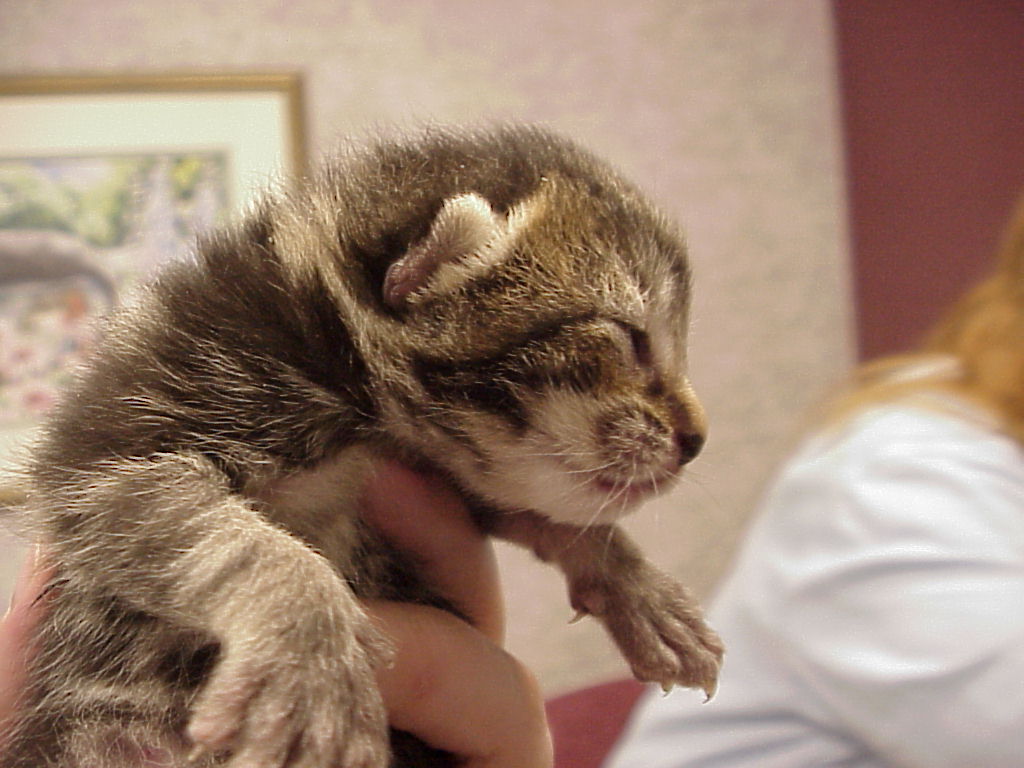
Behavior & Training : Kittens at 2 weeks of age will weigh about 7 ounces (just shy of 1/2 pound) and have pink skin, and round bodies. If you pinch their skin gently, it should spring back into place quickly. Kittens should wiggle energetically when picked up, and should migrate towards its mother when placed back down. Healthy kittens rarely cry.

To tell whether kittens are male or female, look under the tail. Females will have two holes close together - the vulva is a vertical slit or teardrop below the anus. Males will have two holes farther apart - the opening for the penis is separated from the anus by a little bump (the scrotum) which may be difficult to see or feel at a young age. The best thing to do is find two kittens who look different under the tail and compare. By the time the kittens are ready for forever homes, it should be much more obvious, so don't despair if you can't tell this early what you have.

2-3 Weeks of age
Feeding: Bottle feed formula according to the manufacturer's instruction about every 2 - 3 hours until kittens are full but not bloated- usually kittens will eat at least 1/2 tablespoon of formula per feeding.

Environment: Floor temperature of the nest box can be a little cooler, now - about 75-80 degrees.

Behavior & Training : If there is a mother cat (queen), she will begin to spend more time out of the nest, though she won't wander far.

Kittens should weigh about 10 oz (about 2/3 pound). Their ears will start to stand up. Kittens will start to crawl around day 18 and can usually stand by day 21. Kittens will start to play with each other and explore their environment. Their baby teeth will start to come in (erupt) during this period.

The next six weeks are a critical socialization period. Kittens will learn how to act like a proper cat by watching their mother and interacting with their litter-mates. Additionally, human handling during this period is very important, too. Interaction with children may be too frightening, since even gentle children can be awkward with tiny kittens, so should be supervised closely while visiting. 

3-4 Weeks of age
Feeding: Bottle feed formula per manufacturer's instruction every 2 - 3 hours until kittens are full but not bloated- usually kittens will consume at least 1/2 tablespoon of formula per feeding. At this stage kittens may start lapping from a bowl.

Environment: Floor temperature of the nest box can be much closer to normal room temperature - 70-75 degrees from this point onward.

Behavior & Training: Kittens should weigh about 13 ounces (0.8 pounds). Their eye color will start fade from blue to the adult color, but may not reach its final color until 12-16 weeks of age. Kittens can now focus on the world with an ability similar to adults. They will start to groom themselves, though their mother will continue to do most of the serious cleaning.


4-5 Weeks of age
Feeding: By 4 weeks, your kittens should be eating and drinking from a saucer. Now is the time to start gradually weaning them. Introduce solid food by warming some pate-style canned food and mixing it with a small amount of water or formula to create a soupy gruel that they can lap at.

Without a mother cat to show them what to do, kittens will invariably walk, sit, play, slide in and track food everywhere. Offering gruel on the tip of a finger or wiping a little across a kitten's lips or teeth will help them associate the smell of food with eating behavior. Because it will take several meals before the kitten will end up with more food in its stomach than on its fur, you should continue to offer a decreased amount of formula by bottle-feeding - about 3 tablespoons (1-1/2 oz.) formula every 8 hours. This will simulate the weaning process.

This is a critical time to continue watching the kittens' weight. They should continue to gain weight through the transition from milk or formula to solid food.  If a surrogate mother or the actual mother is present, the kittens will continue to try to nurse, but she will become more and more agitated by this process. Just like small children who gain comfort from pacifiers or thumb-sucking, kittens will continue to perform nursing behavior even after they no longer gain any nutrition from it. Most cats will eventually grow out of this behavior, but it can persist long term in some cats.

Fresh water in a stable, shallow bowl.

Behavior & Training : This is the age that you can also start litter training. Make sure to provide a low sided box, as kittens are not very big. Use a low box with one inch or less of litter. As mentioned in our previous article, a disposable cake pan is perfect. Cut-off cardboard boxes also work well.

Most people think that cats need to be trained to use the litterbox, but in fact, it is an instinct for them. Even kittens raised without a mother cat will gravitate towards a box full of sandy litter and figure out what to do pretty quickly. You can speed the process by placing a kitten in the box after a nap, after meals, and after play, and (the first time or two) guiding him gently to dig in the litter. However, even if you don't do this, they will discover the box on their own.

Just like young children who are potty training, it is good to make sure that wherever the kittens are, a litter box is handy. Otherwise, they may get distracted and find themselves too far from the box with a very insistent need to go! Since most kittens are born with some type of intestinal parasite, make sure to keep the litter box very clean to prevent cross-contamination and re-infection. Cats also do not like their litter to be near their food, so make sure there is a good amount of separation between the two.

5-6 Weeks of age
Feeding: Feed four times daily, gradually thickening the gruel. At this age, you can introduce dry food and water. If your foster litter has a mother, she will continue the weaning process. If your kittens are reluctant eaters, you can try mixing any non-onion-containing meat-flavored human baby food with a little water, but this is not a long term solution, because cats need taurine in their diets or severe developmental issues of the heart and eyes can occur.  

Behavior & Training:  A good rule of thumb from this point forward is that a kitten should gain one pound a month. At 4 weeks, they should weigh about 1 pound, at 8 weeks (2 months) they should be about 2 pounds and at 12 weeks (3 months), they should weigh about 3 pounds. At this age, kittens can start to roam around the room, under supervision. The strongest, most curious kitten will figure out how to get out of the nest. The others will quickly follow. Male and female cats should start to become more easily distinguished as male anatomy develops.

Play with your kittens daily! Kittens love to climb and explore, so sit on the floor and allow them to get to know you. This game allows them not only to get exercise and develop muscle coordination, but to become comfortable with humans. Some kittens may be fearful at first; do not force yourself upon them. You can sit in the room and read or watch quiet television or listen to quiet music, and allow shy kittens to become desensitized. This is a very important step in allowing kittens to develop a confident, social attitude. As they become more adventurous, you can start to introduce other sounds, such as vacuum cleaners and dishwashers. Many very shy and secretive kittens were not abused as kittens as so many people believe, but were just never introduced to the normal noises and activities in a human home at an early age.   


6-7 Weeks of age
Feeding: By this age, your kittens should be eating canned and dry food well. You should offer food to them at least three times daily. Watch for any bullying among littermates, and ensure that all kittens are getting their fair share. They may not eat much at a single sitting, because their tiny stomachs are acorn-sized, but they like to eat at frequent intervals throughout the day. This is how a cat instinctively wants to eat, even as an adult - they spend most of the day hunting and only eat for a few minutes at a time. Frogs, bugs, rodents and birds do not make large meals.

Behavior & Training: By this time, you have "mini-cats." They will wash themselves, use scratching posts, play games with each other, their toys, and you, and many will come when you call them.

7-8 Weeks of age

Feeding: Offer wet food 3 - 4 times a day (each kitten will be eating a little over one can of food per day). Leave down a bowl of dry kitten food and water for them to eat and drink at will. If you have a litter with a mother, she will allow very little nursing.


8+ Weeks of age
Feeding: Offer wet food twice daily. Kittens should have free access to dry food and water all day.

Behavior & Training:  If all your kittens are two pounds in weight, you can start to consider finding them homes at this point, however, a large amount of social development occurs in the next 4 weeks, so the longer the kittens can remain together, the better it will be for their long-term happiness. At 3 pounds in weight, we recommend early spay or neuter surgery. It is much easier to find homes for kittens that have already been spayed or neutered and have had some vaccines and a clean bill of health from a veterinarian.

Remember: A healthy kitten is playful, has bright eyes with no discharge, a sleek coat, and a plump belly. Younger kittens are content to sleep between feedings. Normal body temperature for a kitten is 100 - 102.5. Unfortunately, kittens do become ill and sometimes die while being fostered, so it is important to take steps to prevent disease and treat it appropriately as soon as it appears.

Monday, September 9, 2013

Raising Orphaned kittens Part 1: Overview

If you find a kitten that is less than 8 weeks of age, that kitten will need fostering, either by a human or another nursing female cat. Raising orphaned kittens is a big commitment, but can also be very rewarding. If you're not sure about the age of your stray kitten foundling, please check out our previous blog article on the topic. The following are some considerations that may affect your decision to take on this responsibility.

Orphaned kittens may carry illnesses into your home that could affect your resident animals' (or humans') health. Most commonly, they may suffer from upper respiratory infections and intestinal parasites, but can also carry diseases such as calicivirus, distemper, or rabies. It is important to keep orphaned kittens isolated from your other cats in the household until you are certain they are healthy. You should also make sure that any other pets in your home are up to date on their vaccinations.

  • For the protection of both parties, young children should not handle the kittens. 
  • You should check the kitten for fleas before bringing it into your house, because fleas can spread disease among cats and to people. 
  • You should wash your hands with soap and water hands after handling animals, fecal waste, or litter boxes, before handling your own animals or children and you may also want to change clothes. 
  • You should routinely disinfect the orphaned kittens' quarters and the entire premises before new kittens are introduced. Remove all biologic materials and soak litterboxes with a mild bleach solution (1 part bleach to 32 parts water) for at least 10 minutes. All surfaces, as well as bowls and toys need to be disinfected so it would be best to keep the kitten(s) in a carpet-free area. Tiny kittens do well in large pet carriers or dog crates. 

Supply list
  • Nest Box or carrier  - You will want a box that allows you to easily check on the kittens, with plenty of room for the mother (if there is one) and the growing kitten(s).
  • Newspapers or absorbent pads - Keep several layers in the bottom of the box, and they will come in handy when the kittens start to roam around the room and are introduced to their litter box.
  • Big litter box for mother cat (queen) - the mother cat will prefer a normal sized litterbox, but it will be too large and the sides will be too high for the kittens.
  • Small litter box for kittens - An oblong, disposable cake pan is perfect. Cut-off cardboard boxes also work well.
  • Cat litter
  • Water bowls - Heavy and impossible to tip. Should be stainless steel or porcelain/ceramic, NOT plastic, as plastic is difficult to disinfect because it is so porous, and some cats have sensitivities to plastics.
  • Food bowls (at least 2) - One is for dry cat food, the other for canned food. You can use TV dinner trays, paper plates or whatever you have; any relatively flat plate or saucer will do. The larger the litter, the larger the plate should be so that no one gets crowded out.
  • Food - You should have dry kitten chow, canned cat food (any brand for adults or kittens), and all-meat baby food (must not contain vegetables or onion powder). Offer several choices to weaned kittens to determine their preferences.
  • Heating pad, hot water bottle, or infrared lamp  - Prior to three weeks of age (open eyes and erect ears), kittens need an environment that is about 85°. It is best to provide them a heat source of some kind, but you must be sure that the kittens have the ability to move away from the heat if they become too warm. Do not put kittens directly on a heating source, but insulate them from it with towels. If using an electric heating pad, make sure to cover any electrical cords so that the kittens do not play with them or bite them. Alternatively hot water bottles, rice bags, or special microwaveable heating disks can be used as heat sources. These should also be covered by towels, and should be changed regularly to ensure that they stay warm for the kittens to snuggle up against.
  • Clean towels and blankets
  • Toys - Plastic toys that can easily be disinfected are best. Disposable toys such as empty toilet paper rolls, empty 12-pack cardboard soda boxes, old stuffed socks, caps from soda bottles and paper bags are good toys as well. Young kittens do not appear to react to catnip. Make sure to kitten proof the kitten's nursery, because anything can become a toy: drapes, venetian blind cords, lamp shades, electrical cords and breakables, etc.
  • Scale - a food or postal scale is very helpful in monitoring small kittens' growth, which should average about 4 ounces a week.
FEEDING:
  • Kittens should nurse from mother, or be fed with a bottle, syringe or dropper with kitten milk replacer (not regular milk) every 2-3 hours. 
  • They should start by eating at least 2ml milk at a time.They will increase their food intake quickly.In as little as one week, they may drink 10-15ml per feeding. By the time they are about ready to start canned food (4-5weeks of age) they may each drink half a bottle apiece. 
  • At 4-5weeks of age you may start giving canned food.Mix with milk replacer at first to get to a porridge type consistency; at first the kittens will try to suck up their canned food like they did the milk, so it has to be liquid consistency.  


BATHROOM:
  • After eating, use a warm wet cotton ball, Kleenex, or baby wipe to stimulate their bodily functions.The first couple of days kittens may not have any stools until they start eating well.After that, their stools may be a soft, pudding consistency for a week or so. 
  • After the first couple of days they should defecate at least a couple of times per day, though they may defecate every time as well.If kitten is not defecating at least once a day, they may be constipated. Observe for straining, vocalizing and/or vomiting. -A thermometer can be used to help stimulate defecation.If kitten is very constipated he might need fluids under the skin (contact Exclusively Cats Veterinary Hospital for suggestions) 
  •  Kittens will most likely urinate every time they are stimulated. -The amount of urine and stool output should increase substantially over 2-4weeks -At 3 weeks of age you may try kittens in a litter pan. Put them in the pan, and they should use it fairly well right away. Cats’ instincts prepare them to urinate and defecate in dirt/sand type materials. Kittens may have a few accidents at first around or near the box. Do not be alarmed, this should resolve over a few weeks.
  • Often the kittens will turn around and step in their stools because their coordination isn’t great until about 8 weeks of age.You should scoop the boxes as soon as kittens go to help prevent this.If they do step in anything, you may bathe their feet with warm water and a mild soap.Try not to wet their entire bodies at a time because they are not great at regulating body temperature until they are a little older.
 
An orphaned kitten being housed in a carrier

LIVING CONDITIONS:
  • Babies are unable to regulate their body temperature very effectively until about 3 weeks of age. Keep them warm and covered with a light blanket.You may also use a “snuggly” heated disc underneath blankets as well. Do not put too many covers over them, as they may overheat as well. -You may keep them in a carrier for the first few weeks. 
  • After they start using the litter box at approx 3 weeks of age, you may put them in a large play pen, or small bedroom or bathroom where they are not able to fall/jump off of anything. 
  • At approx 8 weeks of age, you should be able to try and incorporate the babies into the household. Make sure to supervise them at first to make sure the other cats will get along with them.  
 
This kitten is dehydrated, and has an IV catheter placed

WHAT TO LOOK FOR:
  • Watch closely for respiratory signs.Kittens do not have great immune systems, and can perish from infection if not treated appropriately. 
  • Aspiration pneumonia is very dangerous for kittens; be careful when feeding not to give more milk than they can swallow at one time. 
  • Watch stool and urine output closely, and observe for any signs of constipation from the milk formula.
  • Look for lethargy/or inappetance. 
  • If you ever have any questions about kitten health please call us at 248-666-5287 or email us at ecats@exclusivelycats.com

Monday, July 22, 2013

Kitten Care: How old is the orphaned kitten I found?


Extremely young kittens will be better off if they can stay with their momma or be fostered by a mother cat with a litter

At Exclusively Cats Veterinary Hospital, we commonly get calls from people who have found a stray or orphaned kitten and are unsure of what to do. Much of orphaned kitten care depends on the age of the kitten. Being able to age a kitten definitely takes some practice, especially if the kitten is sick or injured. There are some general guidelines that you can use to help narrow it down.

0 – 3 days: At birth, kittens usually weigh between 3-4 oz. The umbilical cord is still attached and the eyes and ears are sealed shut. Kittens this age rely on their mother’s grooming to stimulate urination and defecation. If they have no mother, they will need your assistance to eliminate. They also need to eat a minimum of 6 times daily, or about every 4 hours.

7 - 10 days: The eyes begin to open. They are usually completely open by  day 10. At this age, they should weigh about 6-8 oz. At this age, they usually eat about 5 times daily.
Ears still mostly closed, eyes just beginning to open.

2 - 3 weeks: The kitten begins to stand. The center 4 deciduous incisors (the small teeth at the front) begin to come in. Between 3-4 weeks, the outer 2 incisors and the canines begin to come in. The ears start to stand up at about 3 and ½ weeks. At this age, kittens can start to orient towards sights and sounds. At this age, they should weigh 10-12 oz and will eat about 4 times daily. This age is the beginning of the most important socialization period.

4 weeks: The kitten begins playing and exploring her environment. They become steadier on their feet. Upper and lower premolars start to come in. They also start to eat on their own somewhere between 4-5 weeks of age. At this age, they can also eliminate without assistance. At one month, most kittens should weigh about 14-16oz or close to 1 pound and will eat at least 3 times daily.

5 weeks: They should be fairly confident on their feet by this age. This means that they can run around!
Blue eyed babies who are running around

6 weeks: The kittens are extremely active. Their eyes generally change from blue to blue/gray then yellow/green between 6 1/2 to 7 weeks.

8 weeks (2 months): All baby teeth should be erupted at this point. Kittens of this age are unlikely to need bottle-feeding. Two-month-old kittens should weigh about 2 pounds. After this age, socialization with humans becomes increasingly difficult, and kittens are more likely to display feral behavior as time goes on.

12-16 weeks (3 ½ to 4 months): The center four Incisors begin to erupt. At this age, most kittens are over 3 pounds and can safely be spayed or neutered. This is the ideal age at which to separate a litter of kittens and find them new homes. After this age, playtime becomes less social and more independent, and most of the rules of “cat etiquette” have been learned.
Kittens ready for new homes

16-18 weeks (4-4 ½ months): Outer Incisors erupt. Upper premolars and molars start to erupt. At 4 months, most kittens should weigh about 4 pounds.

6 months: Canines and lower premolars start to erupt. Weight is usually around 6 pounds.
       
28 weeks (7 months): All adult teeth should be fully erupted.

Tooth diagram and chart from the Humane Society of the United States

Friday, February 1, 2013

Meet Miss February!


 Annabelle

I am so excited to be the “February cat” for Exclusively Cats calendar. When my mom took my calendar picture she was not even sure I was going to survive as I was a very sick cat. I was between six and seven months old and only weighed 3.9lbs. Since she was submitting photos of all the family felines for the calendar contest, she felt she needed to submit my picture too.  I am glad to say that I am alive today and a healthy, happy kitty weighing 9.5lbs. What a difference five months of great vet care, good nutrition, lots of love and a warm, dry place to live can make for a scrawny sickly cat. See how good I look now!

Me in August around 6.5 months old
So here is my story according to my mom and dad. It started in mid August 2012….actually it really started in October 2011 when my mom’s first true feline love passed away. Her cat friends told her that another kitty would find her just like her angel kitty did many years ago. But my mom kept thinking that no cat could find her when her neighbor rescued all the kitties in the area. So she went in search of a new kitty and found two kittens, my brother Maksim and sister Aleksandra (Lexie).


Look at me now –I grew into my large paws
But little did my mom know a desperate kitty needing a good home would find her…….many miles from her home on a farm in Pennsylvania. I was waiting in a cornfield for just the right person to come along that day. There were many cars that arrived with lots of people but I waited for the last car. I knew it had my new mom and dad. When the car parked and the people got out I went running from the cornfield across the lane to my new humans. When my mom first saw me she thought I was one of the barn cats because her sister lived on a farm, but then I walked over to my dad meowing for help and let him scratch my head me so she knew that I was not already living on the farm because those cats don’t like to be touched.

I followed my mom and dad around all day during the family picnic except when I fell asleep next to Gryphon the dog and I filled my belly with cat food.   My mom and dad decided to bring me home to MI while they tried to locate my original owners. My mom told my dad she would find a good home for me if no one turned up in PA but my dad knew all along that she would never give me up unless she found my first owner. My mom’s sister put up signs around the farm in PA advertising that I was found and my mom called every rescue agency and vet’s office in the area. When a mean lady at a vet’s office laughed at my mom for trying to find my old family (no one bothers reporting a lost kitten around here) my mom called my dad and told him the kitten was staying. You see I am a very smart cat….I knew which car to wait for and that my mom needed to have another cat” find her” to help heal her broken heart……we both needed each other.

So off to Exclusively Cats I went. I first saw Dr. Brooks, then Dr Bailey and then Dr. Palen. They told my mom that I was between 6 and 7 months old even though I was so tiny. I was filthy dirty and even had tar on my paws and front leg.  I had worms and ear mites and possibly FIP. I came home from the vet with meds for the worms and mites but then began a journey over the next five weeks of multiple vet visits including a couple of days in the animal hospital. I had high fevers that came, went and came again. I had no appetite and would only eat when finger fed. I had no interest in my toys or the other kitties in the house.  I had an upper respiratory infection and severe diarrhea. They thought I might have ring worm but that was negative. I developed lameness in my front legs first then my back legs.  I was on many different meds but nothing worked. Finally…… they found the right medicine and the fevers and lameness went away.

WOW, I started eating and eating and eating, finally gaining some weight. My coat grew back soft, thick, shiny and full.  I was tired of being kept in a separate room and one night I climbed up and over two stacked baby gates….they were at least 5 feet tall. When my mom got up the next morning and found me sleeping on the chair in the hearth room she took the gates down and let me be with my brother and sister………I was so very happy.

Then my mom got a call from Dr. Palen.  She knew it couldn’t be good when Dr Palen was personally making the call. My second test for Feline Leukemia came back positive. Oh no….I had to go back in a separate room and get a special test. It was a looooooong week before my mom got good news……it was a false positive and I was negative for FeLV. I was HAPPY…. HAPPY …..HAPPY (and so was my mom) to be out of that room and back playing and sleeping with my best buddies Maks and Lexie. You can see how happy we are to be together.

Kitty Pile----Maks, Lexie and Annabelle
I got my name from my mom and dad’s granddaughter who saw me the day after I found them and told them that I looked like an Annabelle but they could call me Belle if they wanted. Mostly they call me Annie-belle although relatives still call me the “Cat of the Corn” and Corn Cat.

My favorite things really are my mom and dad. I follow them around all day getting lots of hugs and attention and my mom calls me a “talker”..…whatever that means…… and says I talk more than Maks which is supposed to be a lot. Maks is my favorite kitty to play with and Lexie is my favorite kitty to snuggle with. I love to chase the laser light and the wand toy with all the shiny strands. My other favorite wand toy is the katipide. 

I do have one bad habit….I like to chew things. I chew at all the plants, I chew the string on shoes, I chew the carpet on the cat tree. I chew the lid of the laptop. I chew on fingers,  I chew the bottom of the wood cabinet. My favorite thing to chew is rubber bands. If I find one I steal it and hide it away in my favorite hiding place (under the bed) so I can chew on it whenever I feel like it. If there is anything accidentally left on the floor I chew on it. My mom says that I am going to be the cat that ends up in the ER with some foreign objects in their stomach……she is not happy about this. But I say everyone is allowed one bad habit. It is not like my brother and sister don’t have any…….well my brother does….my sister doesn’t seem to have a bad habit. Maybe I should teach her one.

I am finally starting to trust people again. I will let my mom hold me on her shoulder and give me hugs and kisses and I sit on my dad’s lap while he works on the computer. I also just decided to really like belly rubs.

I will come when called (for treats of course) and also sit for them when my mom asks me to.

You see I am a very smart cat…..some say very lucky…. for on that hot day in August on a farm over 300 miles away I knew to wait for that last car and run to my mom and dad so I had a safe and warm place to sleep, a full belly each night and so my mom’s heart no longer feels broken. 

Thanks to everyone that voted for me.
Annabelle Hruska


Friday, June 8, 2012

Samson's Story: Rags to Riches


White persian stray cat
Samson, day 1, September 2012
White persian cat with hair loss and wounds
Samson's wounds and hair loss (see his rat tail?)
Do you think you would ever say that becoming a stray was the best thing that ever happened to a cat? We didn’t think so, either, but in Samson’s case, it may be true!

Samson was a stray Persian-mix cat, approximately 2-3 years old, that was found by one of our clients in September 2011. He was un-neutered, loaded with fleas, missing half of his haircoat, and covered in wounds. He had 4 torn toenails and was terribly thin – only 5.25 pounds. He also had significant dental disease. After a negative Feline Leukemia Virus test and a negative Feline Immunodeficiency Virus test, the people that found him decided to keep him. We treated his wounds, his fleas and his intestinal parasites and neutered him. Due to his fragile condition, we did not vaccinate him at that time.

Ringworm glowing green under black light
Spots of ringworm glowing under black light
White Persian cat with trimmed coat
Samson in January 2012, still fighting ringworm...
Once his wounds had healed, he broke out with ringworm – a skin fungus that he likely picked up while he was outdoors, but may also have had prior to becoming a stray. Samson turned out to have one of the worst and most persistent cases of ringworm that we have ever seen – he was covered with lesions and had to be medicated with oral medications and medicated baths for almost 7 months! We use a black light to look for fluorescence on the hairs when they are infected with ringworm. Poor Samson looked like a glowing leopard!

Feline mouth with gingivitis and dental calculus
Samson's uncomfortable mouth, filled with gingivitis and calculus
Now that he has finally fought off the ringworm, he has more than doubled his weight (10.6 pounds!) is healthy enough that we have been able to vaccinate him, and he is staying with us Tuesday for a dental cleaning and oral surgery to fix his mouth. Unfortunately, after looking at his dental x-rays and probing his teeth with a special probe, it is clear that all of his teeth are diseased except his canines. Perhaps it is genetic, as it is in many cats, or perhaps his time as a severely malnourished stray had some effect on his oral health, but either way, after talking with his owner about options, we will be extracting all the diseased teeth, today. Fortunately, cats are still able to enjoy their food with only a few teeth left, and Samson will be much healthier without all the bacteria festering in his mouth.
A white Persian cat with full coat
Samson, May 2012, ringworm free!

Samson has been so lucky to find such a patient and loving home where he is well-fed and well-cared-for and his new owners are willing to deal with his multiple health issues.

Friday, September 23, 2011

I found a....feral? Stray? Does it matter?

A grumpy-looking feral tomcat

The difference between the right word and the almost right word is the difference between lightning and a lightning bug.
Mark Twain 


On September 19th, we had three cats brought into the hospital for exam that were “found cats”. Some found cats are strays and some are ferals. How do you know what the difference is?


A feral cat is a cat that was born or grew up in the wild and is unfamiliar with human contact. These cats do not seek out human companionship, and often will hiss, growl or attempt to escape from human advances, no matter how friendly. Feral cats are often un-neutered, or bear scars from fighting or frostbite.

Three stray cats being fed by an elderly woman
These cats are unlikely to be feral.

On the other hand, a stray is a cat that is tame, or only slightly shy when exposed to people. They are often cats who have become lost or who have been abandoned from their homes. Many stray cats are neutered or front declawed. They often make homes near humans – under porches, in garages, or in backyards, and are often reliant upon humans for food. They may come beg at your doorway or seek you out when you are outside.


If you see or trap a cat in your yard, Alley Cat Allies has a great comparison chart with visuals to help you determine if you are encountering a feral cat or a stray.


Both feral and stray cats do have the potential to trust humans and become good companions, but it is much harder to acclimate feral cats to humans. Generally the best time to tame feral cats is when they are kittens younger than 12 weeks of age. After that, it becomes increasingly difficult to tame them, and there are some feral cats that will never become socialized well-enough to bring indoors.

A large number of feral tabby cats
Cats in a feral colony

It is estimated that there are more than 60 million feral cats in the U.S. and additional lost or abandoned stray cats. There are probably feral cats living in your neighborhood that you never see! Since cats are only asocial, not antisocial (they don’t hate living in groups, but they don’t require social groups to survive and can live on their own, if needed), feral and stray cats often form loose social groups called colonies near food sources such as dumpsters or areas where there are large numbers of prey. Feral cats maintain a territory of up to several acres, and their hunting grounds may intersect with various other stray and feral cats. Un-neutered cats within the colony will breed and produce more feral cats – each female has an average of 1.4 litters per year with an average of 3.5 kittens per litter. This is why when a person with good intentions starts feeding a stray or feral cat in their backyard, they soon find that there are quite a large number of cats suddenly coming to eat!


A wild-born cat has an average lifespan of only 4-5 years, but may occasionally live to be up to 8 years of age. An indoor cat that is released into the wild will often survive a much shorter amount of time due to a lack of crucial survival skill development that feral cats learn from their mothers in the wild. In contrast, indoor cats live an average of 12-16 years, but can occasionally live into their mid-twenties with good preventive health care.
If you have a new cat that is visiting your house, it could be a:
  • Feral cat
  • Stray with feral tendencies
  • Lost pet or indoor/outdoor pet
  • Neglected cat owned by people who just don’t care.
A feral gray tabby cat that has been ear-tipped
This feral cat has been ear-tipped.

To keep feral populations down, it is recommended that stray cats be caught and fostered until the owner can be found, or photographed and posted as a lost pet in local neighborhoods and businesses. Feral cats that would not make good pets can be caught, tested for Feline Leukemia and FIV and then neutered so that they cannot reproduce (called a “Trap/Neuter/Release”). Often these cats are ear-tipped so that they are not caught and taken in for surgery on a repeated basis. If the cat you are seeing has a tipped ear (about ¼ of the left ear is removed), it is because someone has neutered and released this cat at some point in its life.
If you are having a problem with feral cats, there are resources online that can help you humanely deter and control feral cats that are causing problems.


Indy Feral Incorporated nuisance prevention tips Indy Feral Inc. is a charitable organization operating in Marion County Indiana that has sterilized 22,329 feral cats since 2002 and found homes for 2,717 friendly cats/kittens removed from colonies. This year alone, they have spayed or neutered 895 cats (January through September 2011). That gives a small picture of just how big the feral cat population is in the U.S.!

Alley Cat Allies brochure on deterring feral cats  Alley Cat Allies is a non-profit organization based out of Bethesda, MD which has resources on becoming a rescuer of feral cats, or manager of a feral colony, including traps and information on raising feral kittens.

Last but not least, the ASPCA has compiled a good resource of feral cat information, including suggestions on how to socialize feral kittens.
And of course, if you have questions about a cat in your area - what to do with it, how to catch it, or other concerns, our staff would be happy to help answer your questions as well!

Oh, and the three we saw on the 19th? All three were strays. None of them were microchipped.

One was kept by the family that found him. We neutered him, treated him for fleas and worms, combed out his mats (he is a Persian mix, but due to the fleas, only had a mohawk of hair down his spine, and no hair on his tail!) and examined some healing wounds on his side.

Another went to Backdoor Friends Purebred Cat Rescue. He was  already neutered and front declawed and a purebred shaded-silver Persian.

The third cat went home with the family that found him while they decided what to do with him because he was FIV positive (deciding between keeping him and taking him to a sanctuary for FIV positive cats). We neutered him, extracted a painful, infected, broken canine tooth and treated him for worms. He subsequently escaped back outside and is a stray again - but this time, someone is out there looking for him, hoping to bring him home.