Showing posts with label feral cats. Show all posts

Monday, July 22, 2013

Kitten Care: How old is the orphaned kitten I found?


Extremely young kittens will be better off if they can stay with their momma or be fostered by a mother cat with a litter

At Exclusively Cats Veterinary Hospital, we commonly get calls from people who have found a stray or orphaned kitten and are unsure of what to do. Much of orphaned kitten care depends on the age of the kitten. Being able to age a kitten definitely takes some practice, especially if the kitten is sick or injured. There are some general guidelines that you can use to help narrow it down.

0 – 3 days: At birth, kittens usually weigh between 3-4 oz. The umbilical cord is still attached and the eyes and ears are sealed shut. Kittens this age rely on their mother’s grooming to stimulate urination and defecation. If they have no mother, they will need your assistance to eliminate. They also need to eat a minimum of 6 times daily, or about every 4 hours.

7 - 10 days: The eyes begin to open. They are usually completely open by  day 10. At this age, they should weigh about 6-8 oz. At this age, they usually eat about 5 times daily.
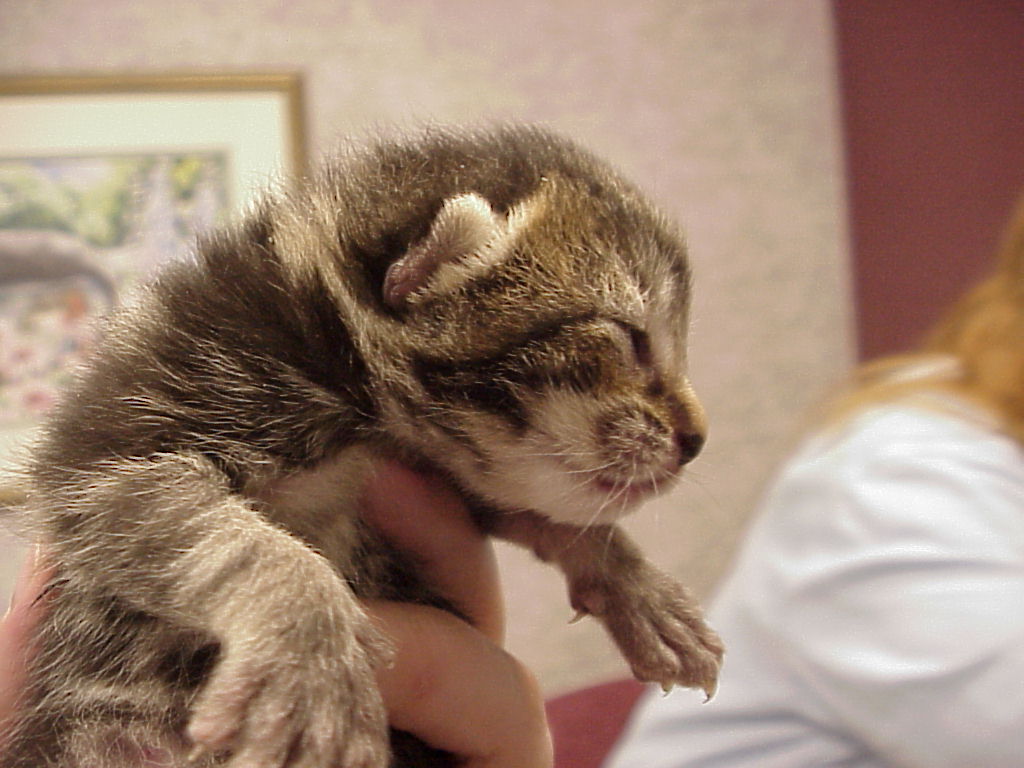
Ears still mostly closed, eyes just beginning to open.

2 - 3 weeks: The kitten begins to stand. The center 4 deciduous incisors (the small teeth at the front) begin to come in. Between 3-4 weeks, the outer 2 incisors and the canines begin to come in. The ears start to stand up at about 3 and ½ weeks. At this age, kittens can start to orient towards sights and sounds. At this age, they should weigh 10-12 oz and will eat about 4 times daily. This age is the beginning of the most important socialization period.

4 weeks: The kitten begins playing and exploring her environment. They become steadier on their feet. Upper and lower premolars start to come in. They also start to eat on their own somewhere between 4-5 weeks of age. At this age, they can also eliminate without assistance. At one month, most kittens should weigh about 14-16oz or close to 1 pound and will eat at least 3 times daily.

5 weeks: They should be fairly confident on their feet by this age. This means that they can run around!
Blue eyed babies who are running around

6 weeks: The kittens are extremely active. Their eyes generally change from blue to blue/gray then yellow/green between 6 1/2 to 7 weeks.

8 weeks (2 months): All baby teeth should be erupted at this point. Kittens of this age are unlikely to need bottle-feeding. Two-month-old kittens should weigh about 2 pounds. After this age, socialization with humans becomes increasingly difficult, and kittens are more likely to display feral behavior as time goes on.

12-16 weeks (3 ½ to 4 months): The center four Incisors begin to erupt. At this age, most kittens are over 3 pounds and can safely be spayed or neutered. This is the ideal age at which to separate a litter of kittens and find them new homes. After this age, playtime becomes less social and more independent, and most of the rules of “cat etiquette” have been learned.
Kittens ready for new homes

16-18 weeks (4-4 ½ months): Outer Incisors erupt. Upper premolars and molars start to erupt. At 4 months, most kittens should weigh about 4 pounds.

6 months: Canines and lower premolars start to erupt. Weight is usually around 6 pounds.
       
28 weeks (7 months): All adult teeth should be fully erupted.

Tooth diagram and chart from the Humane Society of the United States

Monday, December 19, 2011

Feline Inappropriate Urination: Acting out all over the house!

When medical issues have been ruled out, and husbandry issues have been resolved, if a cat is still eliminating outside the box, it is likely to be due to a behavioral issue.  Unfortunately, while litterbox environment and medical issues are relatively straightforward to address, behavioral issues can be complicated.

New furniture can stress your cat.
One of the most common causes of behavioral inappropriate elimination is stress. Stress can come from a variety of sources.  It can be due to a bold or aggressive animal re-establishing his territory or a timid, shy animal urinating because he is a “victim” of his social environment (being passive-aggressive). A change to the household that disrupts the cat’s schedule may also be a contributing factor to a cat choosing not to use the litterbox -- such as a new baby, visitors staying in the home, a child going off to college, a change in someone’s work schedule, a move to a new home, new furniture, a new pet, a family vacation, renovations to the home, a visit from a plumber or other repair-person, etc. In some cases, the behavior will resolve on its own after the event (such as vacations, visitors, and renovations), and in other cases, the behavior may be ongoing (new furniture, a baby, a new home). Each type of stressor may have several solutions.

For example:
If your cat eliminates inappropriately when you go on vacation, you may find that you can curb the behavior by boarding the cat while you are gone, hiring an in-home sitter versus having a neighbor stop by the house once or twice daily, or by taking your cat with you. Discussions with your veterinarian may even lead to recommendations for medicinal therapy while you are gone to alleviate anxiety.

If you are planning on getting a new pet or having a baby, preparing your cat for the new addition may head off any potential behavioral issues. Also, making sure to introduce the new pet to the resident cat on a gradual basis will help lessen the stress your cat may feel about a new addition.

When planning to move to a new home, it is often helpful to establish the cat in the new home prior to moving day, if possible, so that their first exposure to the new home is not amidst chaos. If your cat can be set up in a room with all his familiar things and you can avoid moving things into that room right away, that will also help. If your cat can’t be moved ahead of time, then moving your cats into a room that will be little-disturbed on moving day, such as a bathroom or walk-in closet may also help. Let the cat become accustomed to the moving-day room before allowing him out to explore the whole house. That way, if something about the new house is frightening, he has a safe place to retreat to.

Sometimes inappropriate elimination can become so ingrained in a cat that even once the stress has been removed, the behavior continues. If this is the case it is a good idea to seek advice from your veterinarian as to how to re-train your cat. 

Spraying posture - standing near a vertical surface, tail erect
If a cat chooses to eliminate near a door or window, it is likely that either the presence of feral/stray or wandering neighbor cats may be causing your cat stress, anxiety or frustration or stimulating your cat to mark his territory and warn off these tresspassers. It is important to determine if your cat is urinating or spraying, as these behaviors are approached differently. Spraying is generally performed in a standing position with the tail raised, and the urine is deposited on a vertical surface such as a wall or piece of furniture (though it may run down the wall and puddle on the floor). Spraying tends to deposit small amounts of urine as compared to the size of the urine clumps you find in the litterbox. The tail may appear to quiver or vibrate. When your cat is urinating, he will squat and deposit a large amount of urine on a horizontal surface.
Urinating posture - squatting

It is most commonly the male cat that sprays, but it is not unheard of for female cats to spray, also. Spaying and neutering your cats will help prevent this issue in most cats, as the lack of male and female hormones will dull the desire to mark and maintain territory, and the need to advertise sexual availability – which are the primary reasons that cats urine mark. However, about 10% of neutered males and 5% of neutered females also spray. In households with more than seven cats, the likelihood of spraying is high. 

If outside cats frustrate your cat, you may be able to address the problem by discouraging stray cats from visiting your house. A plant called Coleus canina, also known as the “scaredy cat plant” or the “pee-off plant” is a deterrent to cats, dogs and foxes. Coleus plants are those that you often see with brightly colored leaves. This species of Coleus has green foliage and small, spikes of pretty blue flowers in the summer. The plant only smells to the human nose when touched. In Michigan, Coleus plants are annuals, but can easily be propagated and cuttings can be kept in a frost-free place over winter. They prefer a dry, sandy soil and lots of sunlight and should be planted every 1-2 yards for best results.
Coleus canina flower

Cats also hate the smell of the herb rue. It has beautiful blue-tone leaves and tiny yellow flowers. Cats are also usually deterred by the smell of citrus, so placing orange or lemon peel in your yard may help deter strays. Similarly, coffee grounds, blood meal, cayenne pepper, lavender oil, lemon grass oil, citronella oil, peppermint oil and eucalyptus oil can be used near areas where outdoor cats like to hang out.

Avoid feeding birds or squirrels in your yard if your cat is bothered by stray cats.

Motion detectors that trigger sprinklers can be used to deter them from coming onto your property. Additionally, you can discourage your cat from looking outside by closing blinds or shades, or making the windowsill inaccessible. Double-sided tape, tin foil or strips of carpet runner on the sill may also deter your cat. 

Spraying can also result from territorial disputes between cats in the same household. They may need to be separated and reintroduced slowly, using food treats to reward and encourage peaceful behavior. This re-introduction can successfully develop good relations between cats in some cases, even if the spraying has been going on for a long time.

While the presence of other cats, lack of access to prey species or sexual maturity are the most common reasons that cats perform spraying behavior, other causes can be new or unfamiliar scents in the home (such as new furniture, or digging out the Christmas tree from the attic or bringing a live tree into the home) or frustration due to lack of mental stimulation. Often, spraying new items with a pheromone called Feliway can help lessen your cat’s desire to mark. This product mimics the scent of cat cheek gland secretions. Many cats will not spray on areas that have this scent. Increasing the amount of playtime for an under-stimulated cat may help ease frustration.

Behavior-related elimination issues are often addressed with anti-anxiety medications, such as Prozac (fluoxetine), BuSpar (buspirone), Elavil (amitriptyline), and Clomicalm (clomipramine). Anxitane is a neutraceutical (nutritional therapy) supplement of L-Theanine that has also been shown to aid in decreasing anxiety in cats. Medications are useful in helping to decrease behavioral inappropriate elimination, but they should always be used in conjunction with changes to the home or other environmental changes with the goal of hopefully weaning the cat off the medication, if possible.
More information about inappropriate elimination:
Lovin' the Litterbox: Husbandry Reasons Why Your Cat May Not Use the Litterbox
Kidneys and Crystals and Stones, Oh, My! Medical Reasons Why Your Cat May Not Use the Litterbox
Breaking the Cycle of Smell: How to Stop Habitual Elimination Problems

Friday, September 23, 2011

I found a....feral? Stray? Does it matter?

A grumpy-looking feral tomcat

The difference between the right word and the almost right word is the difference between lightning and a lightning bug.
Mark Twain 


On September 19th, we had three cats brought into the hospital for exam that were “found cats”. Some found cats are strays and some are ferals. How do you know what the difference is?


A feral cat is a cat that was born or grew up in the wild and is unfamiliar with human contact. These cats do not seek out human companionship, and often will hiss, growl or attempt to escape from human advances, no matter how friendly. Feral cats are often un-neutered, or bear scars from fighting or frostbite.

Three stray cats being fed by an elderly woman
These cats are unlikely to be feral.

On the other hand, a stray is a cat that is tame, or only slightly shy when exposed to people. They are often cats who have become lost or who have been abandoned from their homes. Many stray cats are neutered or front declawed. They often make homes near humans – under porches, in garages, or in backyards, and are often reliant upon humans for food. They may come beg at your doorway or seek you out when you are outside.


If you see or trap a cat in your yard, Alley Cat Allies has a great comparison chart with visuals to help you determine if you are encountering a feral cat or a stray.


Both feral and stray cats do have the potential to trust humans and become good companions, but it is much harder to acclimate feral cats to humans. Generally the best time to tame feral cats is when they are kittens younger than 12 weeks of age. After that, it becomes increasingly difficult to tame them, and there are some feral cats that will never become socialized well-enough to bring indoors.

A large number of feral tabby cats
Cats in a feral colony

It is estimated that there are more than 60 million feral cats in the U.S. and additional lost or abandoned stray cats. There are probably feral cats living in your neighborhood that you never see! Since cats are only asocial, not antisocial (they don’t hate living in groups, but they don’t require social groups to survive and can live on their own, if needed), feral and stray cats often form loose social groups called colonies near food sources such as dumpsters or areas where there are large numbers of prey. Feral cats maintain a territory of up to several acres, and their hunting grounds may intersect with various other stray and feral cats. Un-neutered cats within the colony will breed and produce more feral cats – each female has an average of 1.4 litters per year with an average of 3.5 kittens per litter. This is why when a person with good intentions starts feeding a stray or feral cat in their backyard, they soon find that there are quite a large number of cats suddenly coming to eat!


A wild-born cat has an average lifespan of only 4-5 years, but may occasionally live to be up to 8 years of age. An indoor cat that is released into the wild will often survive a much shorter amount of time due to a lack of crucial survival skill development that feral cats learn from their mothers in the wild. In contrast, indoor cats live an average of 12-16 years, but can occasionally live into their mid-twenties with good preventive health care.
If you have a new cat that is visiting your house, it could be a:
  • Feral cat
  • Stray with feral tendencies
  • Lost pet or indoor/outdoor pet
  • Neglected cat owned by people who just don’t care.
A feral gray tabby cat that has been ear-tipped
This feral cat has been ear-tipped.

To keep feral populations down, it is recommended that stray cats be caught and fostered until the owner can be found, or photographed and posted as a lost pet in local neighborhoods and businesses. Feral cats that would not make good pets can be caught, tested for Feline Leukemia and FIV and then neutered so that they cannot reproduce (called a “Trap/Neuter/Release”). Often these cats are ear-tipped so that they are not caught and taken in for surgery on a repeated basis. If the cat you are seeing has a tipped ear (about ¼ of the left ear is removed), it is because someone has neutered and released this cat at some point in its life.
If you are having a problem with feral cats, there are resources online that can help you humanely deter and control feral cats that are causing problems.


Indy Feral Incorporated nuisance prevention tips Indy Feral Inc. is a charitable organization operating in Marion County Indiana that has sterilized 22,329 feral cats since 2002 and found homes for 2,717 friendly cats/kittens removed from colonies. This year alone, they have spayed or neutered 895 cats (January through September 2011). That gives a small picture of just how big the feral cat population is in the U.S.!

Alley Cat Allies brochure on deterring feral cats  Alley Cat Allies is a non-profit organization based out of Bethesda, MD which has resources on becoming a rescuer of feral cats, or manager of a feral colony, including traps and information on raising feral kittens.

Last but not least, the ASPCA has compiled a good resource of feral cat information, including suggestions on how to socialize feral kittens.
And of course, if you have questions about a cat in your area - what to do with it, how to catch it, or other concerns, our staff would be happy to help answer your questions as well!

Oh, and the three we saw on the 19th? All three were strays. None of them were microchipped.

One was kept by the family that found him. We neutered him, treated him for fleas and worms, combed out his mats (he is a Persian mix, but due to the fleas, only had a mohawk of hair down his spine, and no hair on his tail!) and examined some healing wounds on his side.

Another went to Backdoor Friends Purebred Cat Rescue. He was  already neutered and front declawed and a purebred shaded-silver Persian.

The third cat went home with the family that found him while they decided what to do with him because he was FIV positive (deciding between keeping him and taking him to a sanctuary for FIV positive cats). We neutered him, extracted a painful, infected, broken canine tooth and treated him for worms. He subsequently escaped back outside and is a stray again - but this time, someone is out there looking for him, hoping to bring him home.