Showing posts with label feline leukemia. Show all posts

Monday, November 23, 2015

Feline Leukemia and Bengal Cats


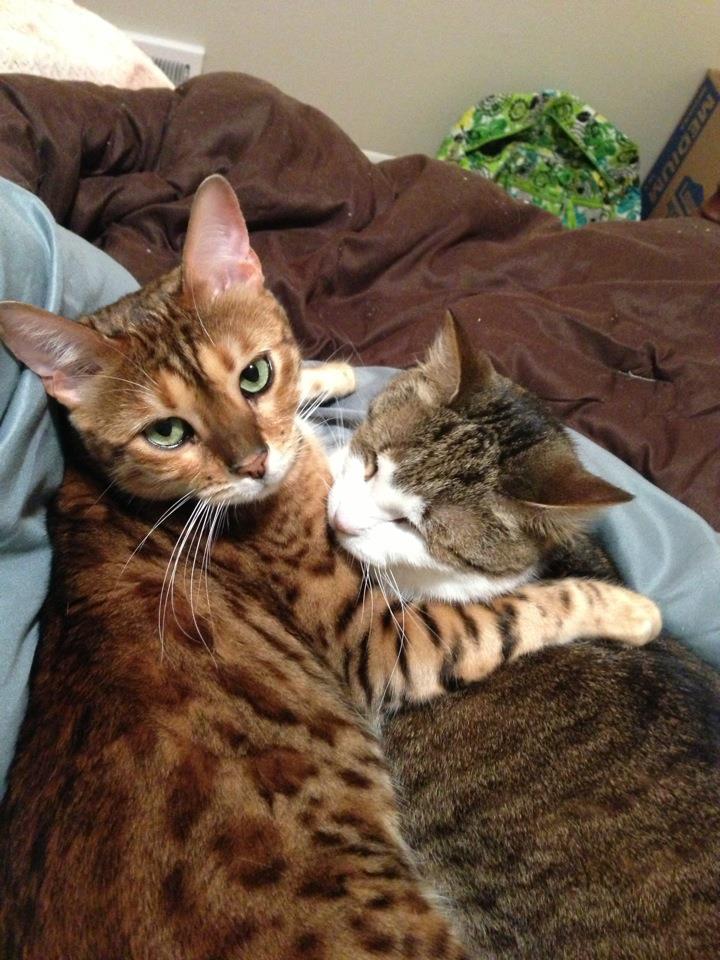
Bengal cat (left) and domestic shorthair (right)
It has come to our attention, recently, that there are a number of breeders and websites that claim that the Bengal breed is immune to Feline Leukemia virus. Unfortunately, this is not the case. There are multiple reports across the nation of feline leukemia positive cats that are Bengals. This myth probably arose due to the origins of the Bengal breed.

The Bengal cat originated in part due to Dr. Willard Centerwall's research at Loyola University in the 1970's - breeding Asian Leopard cats to domestic cats in order to study the inheritance of Feline Leukemia. Asian Leopard Cats are considered to have some PARTIAL immunity to feline leukemia, but Feline Leukemia Virus has been detected in some Asian Leopard Cat cell lines. Unfortunately, when Dr. Centerwall passed away (in the 1980's, we believe), his research was not continued, so no studies have been done to determine how much, if any, partial immunity has been inherited by later generations. According to a European source, pet quality Bengal cats (4-5th generation removed or more from the Asian Leopard cat cross is considered to be a domestic cat and a "purebred Bengal") generally have in average only 12.5% "wild" blood in them (F4 generation = 6-14%, F5 generation 3-12%), , which argues that the likelihood that they have any partial immunity is very unlikely. Needless to say, the fact that there are Bengal cats out there that are testing positive for Feline Leukemia Virus is the strongest argument against the claim that they are immune.

Bengal kittens

All felines are at some degree of risk of developing feline leukemia if exposed to the disease - Florida panthers, lions, tigers, etc. Indoor cats are at very low risk of exposure, but any outdoor cat that is not 100% supervised while outside is potentially risking exposure. This is why we recommend that all cats be tested for Feline Leukemia after adoption (or after being found as a stray) and that cats with high risk lifestyles be regularly vaccinated for Feline Leukemia, regardless of their breed.


History of theBengal Cat

Recurrent Demyelination and Remyelination in 37 Young Bengal Cats with Polyneuropathy
 

Monday, October 13, 2014

Disease Monograph: Feline Leukemia - Part 2: Diagnosis, Prevention and treatment


Diagnosis of Feline Leukemia

To diagnose this disease, there are two types of blood test. One is called an enzyme-linked immunosorbent assay (ELISA test) and the other is called an immunofluorescent antibody (IFA) test. It is highly recommended to test cats prior to giving the leukemia vaccine to ensure that the cat is not already positive. If your cat is positive for FeLV, the vaccine will not help your cat fight the infection. The ELISA test is a quick and readily-available color change test that detects FeLV virus presence in the blood by testing for a protein that the virus creates when it replicates. This test can detect the virus at any stage of infection and can display positive results within a few days of infection. False positives can occur, due to the nature of this disease, so if your cat has only been tested once and tests positive, it may be a good idea to wait 2-3 months and re-test. Additionally, if you test a cat immediately upon bringing it into the household, you should test again about 60 days after its last possible exposure to the disease (whether it came from a shelter, was outdoors as a stray, or came from a breeder or friend).

In some cases, the tears or saliva of a cat can be tested with the ELISA method, but it turns positive only in late stages of infection and can return a false negative result. It can also return false positive results due to the nature of the testing procedure, so it is not commonly performed.

The IFA test is a test for FeLV proteins (antigens) in blood cells that appear at a later progression of the disease. This test may return a false negative result if the cat is in the early stages of the disease. If the IFA test is positive, it generally means that the cat will be unable to fight off the virus. This test is usually sent to a reference lab to confirm positive test results from the veterinary hospital laboratory.

A third type of blood test exists, but is not commonly used for regular screening. This third test is a PCR test and indicates whether there is any FeLV DNA present in the blood.

According to the American Association of Feline Practitioners (AAFP), the recommendation is that the FeLV status of ALL cats should be known, because Feline Leukemia Virus is responsible for the illness and death of more cats than any other disease condition.  Cats who have had a recent known or possible exposure, or cats that are ill should be tested before entering into a home with other cats.

The Six Stages of FeLV infection

1. The virus enters the cat and infects the white blood cells in the tonsils which then travel to the lymph nodes and copy themselves
2. The virus enters the blood stream and spreads throughout the body
3. They lymphoid system (the root of antibody response) becomes affected and further spreads the virus
4. The virus takes over the immune system and the intestinal tract becomes infected.
5. The bone marrow becomes infected if the cat cannot fight off the infection. At this point, the virus has become a part of the cat for the rest of its life. The virus is now carried in newly-made white blood cells that are produced by the marrow. Red blood cell production may be affected, as well.
6. The infection spreads to the cells that line the body cavities and organs, including salivary glands, stomach, esophagus, intestines, trachea, kidney structures, bladder, pancreas and lungs.

The outlook for cats infected with FeLV is grim. Eighty to ninety percent of cats that test positive do not live more than 4 years after diagnosis (on average, about 2.5 years). The other 17% are carriers that may be outwardly healthy, but can spread the disease to other unvaccinated cats. Cats that test positive and appear healthy should be kept in a low-stress environment to help the body conserve energy to fight the disease, but there are no other definitive preventive measures that will stop the disease progression.

Prevention:

This disease is extremely contagious in kittens. Neonatal kittens are 100% susceptible to contracting the virus after one exposure. By 8 weeks, their risk of infection drops to 85% from one exposure. Only about 30-40% of cats become immune after exposure. This means that 60-70% of unvaccinated cats (6 of 10) will contract the virus.

Several different vaccines exist for feline leukemia virus prevention: inactivated virus, recombinant canarypox vector and genetically engineered subunit vaccines. Once a cat has been vaccinated, it takes about 2-3 weeks before the cat develops immunity, so vaccination for Feline Leukemia is best done well before a cat will be at high risk for exposure. Most Feline Leukemia vaccines only provide immunity for 12 months, and therefore need to be boostered annually. The vaccine used at Exclusively Cats Veterinary Hospital is a vaccine that only needs boostering every 2 years, to help reduce the risk of negative side effects. Some cats vaccinated with feline leukemia virus vaccines have had negative side effects - usually mild, but up to and including vaccine induced sarcomas. Your cat is not at risk from contracting FeLV from the vaccine. Since 1992, none of the FeLV vaccines available are capable of causing active infection. Additionally, the vaccine will not cause your cat to test positive on a Feline Leukemia test. While no vaccine is 100% effective, use of this vaccine in high risk cats is highly protective (80-90%) and strongly recommended.

The virus does not survive long outside of the body, only lasting 2 hours at most, and in reality probably only a few minutes, in a dry environment, keeping the litterbox clean and dry is important if there is a feline leukemia positive cat in a multi-cat environment. The virus is also easily killed with bleach and household detergents.

Treatment

Many times, a cat diagnosed with FeLV infection is already feeling sick, and in these cases, a pet owner may opt for euthanasia to end the cat's suffering. Since there is no cure for FeLV infection, and since 80% or more of positive cats will die within three years (most of which occur within 6 months) this may be the most humane option in cases where the cat is severely ill.

Propionobacterium acnes - a potential FeLV treatment
If a cat is diagnosed with FeLV infection and is apparently healthy, the best course of action is to limit the cat's exposure to other cats, keep the cat indoors, limit and prevent stress in the cat's life, feed a high quality diet, and keep her (non-FeLV) vaccinations up-to-date (remember that this disease decreases the effectiveness of a cat's immune system, making her more susceptible to other diseases). Quick response to secondary infections or conditions will help keep the infected cat healthy, longer, as well, so a close relationship with a veterinarian is important. For example, if an infected cat's red blood cell count begins to drop, the cat can receive various treatments aimed at stimulating red blood cell production or circulation - B12 or iron injections, erythropoetin treatment, or even a blood transfusion, if needed.

Additionally, there has been some development of experimental treatment protocols combining the

Polyprenyl immunostimulant - a potential FeLV treatment
use of immunostimulants, antivirals such as interferon and drugs that are in development for human AIDS treatment (these are usually tested in cats before moving on to human trials). However, there have not been many clinical use trials for these treatments, so information about their general effectiveness remains vague and anecdotal. Chemotherapy for FeLV associated cancers is available, but FeLV positive cats do not respond to chemotherapy as well as non-FeLV positive cats, and survival time once cancer develops is usually only about 6 months, despite chemotherapeutic treatment.

FeLV versus FIV

Some people confuse Feline Leukemia Virus (FeLV) and Feline Immunodeficiency Virus (FIV) because they are both retroviral diseases that affect the immune system. Feline Leukemia Virus infection, however, is almost two times more common than FIV. There are two very significant differences between the two diseases:

1) FeLV frequently causes severe illness, especially in young cats, while FIV tends to remain latent or non-illness-causing in the body for 8-9 years or so. It may never cause illness in some cats.
2) FeLV is much more easily transmitted. FIV tends to cause disease primarily following a bite wound, while FeLV can be transmitted through casual contact.

References and Further information:

Disease Information Fact Sheet: Feline Leukemia Virus
http://jfm.sagepub.com/content/suppl/2013/08/14/15.9.785.DC1/5_Fact_sheet_5.pdf
Journal of Feline Medicine and Surgery (2013) 15, Supplementary File

Monday, September 29, 2014

Disease monograph: Feline Leukemia Part 1: What is it?


Feline Leukemia Virus is a disease is transmitted between cats by a virus. The Feline Leukemia virus is a retrovirus from a family of viruses called oncornaviruses - viruses that cause the development of cancers (among other effects). A retrovirus is a virus that interacts with the genetic material of its host in order to reproduce. Feline Leukemia Virus (FeLV) causes immunosuppression, or failure of the body's natural defenses, in many feline species - the domestic cat is most susceptible, but large cat species such as lynxes, Florida panthers, cheetahs and lions have also been reportedly infected. This virus is not known to pass between non-feline species, so humans and dogs appear to be safe.

How is Feline Leukemia transmitted?
Electron micrograph of FeLV - from Wikipedia

The virus is shed in the saliva of an infected cat, and to some degree in respiratory secretions. Most cats receive the virus through the mouth. Generally, it is considered that the virus is transmitted through long term contact with an infected individual - such as sharing litterboxes and food bowls, mutual grooming, or through a bite. Mating behavior may also transmit the virus. Additionally, kittens can contract FeLV from their mother in utero and be positive from birth, or they can contract the virus through their mother's milk. Petting a feline leukemia positive cat and then petting a non-infected cat will not transmit the disease.

The frequency of FeLV positive cats varies greatly between areas. In some areas, the incidence can be as high as 70% in large multi-cat homes where cats have outdoor access. In single-cat, indoor homes, the prevalence is around 3% (3 in 10 cats). FeLV tends to be more common in urban cats (up to 40%) than in rural cats (up to 6%), because cats live in higher population densities and therefore have more contact with each other.

Healthy cats that test positive should not be allowed to roam outside, because they can infect other cats they come across. Additionally, other cats that live in the same household should be vaccinated, and it is recommended that the FeLV positive cat not have contact with the other cats because no vaccine is 100% effective, and the FeLV positive cat may spread other diseases that their weakened immune system allows them to contract.

Signs and symptoms

Not all cats that contract the feline leukemia virus actually develop "leukemia" (cancer of the white blood cells - specifically in the bone marrow), but leukemia is one of the cluster of diseases and symptoms that can develop when a cat is infected with this virus. Common symptoms of FeLV include poor appetite, poor coat and skin condition, fever, lethargy, weight loss, and anemia. Anemia is present in about 25% of all FeLV-related illness. Fifty percent of infected cats that become ill develop immunosuppression, or immune system failure, to some degree.

Various organ diseases can develop, such as liver or intestinal disease. Many cats may experience prolonged healing times after surgery or wounds. Additional signs may include uneven pupil size (anisocoria), swollen lymph nodes (lymphadenopathy), various secondary infections (bladder, skin, respiratory tract - bacterial or viral origins), gingivitis, stomatitis, diarrhea, jaundice, and a type of cancer called lymphosarcoma. Cats that are infected with FeLV are 50 times more likely to develop lymphosarcoma than non-infected cats. Lymphosarcoma (sometimes called lymphoma) is a cancer that consists primarily of a type of white blood cell called "lymphocytes". It can affect almost any organ in the body, but in young cats, it often appears in the chest cavity. In older cats, lymphoma of the intestinal tract is more common. Often in intestinal cases, there is no obvious mass or lump to find, but instead a generalized thickening of the intestine.

  • Pale gums (or pale nail beds)
  • Jaundice - yellow color to eyes, mouth, ears or other exposed skin and/or extremely dark, staining urine
    Jaundice coloring the roof of a cat's mouth
  • Enlarged lymph nodes
  • Chronic infections of respiratory tract, bladder or skin
  • Gingivitis
  • Weight loss/poor appetite
  • Fever
  • Poor coat
  • Progressive weakness/sleepiness/lethargy/reclusiveness/hiding
  • Diarrhea
  • Vomiting
  • Dehydration
  • Breathing difficulty
  • Reproductive problems - sterility, miscarriage

There are four possible paths the disease can take in an infected cat. These potential outcomes depend on the amount of virus the cat is exposed to, the strain of the virus (there are 4 unique strains of FeLV), the cat's initial health level (the effectiveness of his immune system and the presence of any other health complications), and age.

If a cat tests positive for FeLV, one of the following will occur:

1) IMMUNITY - Some cats are able to fight off the virus and become immune. Some of these cats completely eliminate all traces of the virus from their bodies. The cat may have some mild signs of illness - fever, poor appetite, large lymph nodes, lethargy for up to 10 days and then recover. This outcome occurs about 40% of the time, and is more likely in adults than in kittens.

2) PROGRESSIVE INFECTION - The second possibility is that the cat may become infected and develop a compromised immune system. The cat may have a short illness and recover enough to be outwardly healthy for 2-3 years in 50% of the cases. This outcome occurs about 30% of the time, and is more common in kittens than in adult cats. The bone marrow, which produces new blood cells, becomes infected and each new blood cell that is produced will contain more virus, creating a "persistent viremia" or constant presence of virus in the bloodstream. The infection is progressive, gradually taking hold in various body organs. Lymphoma is the final stage of the disease.

3) LATENT INFECTION -  Up to 30% of the time, cats will develop a latent infection. These cats may test positive at first, and then test negative 3-4 weeks later. The virus does not kill the cat's cells once it is inserted into the cellular DNA, but sits in wait. Eventually the body may reject these abnormal cells or the cat will become sick. While healthy, these cats will continue test negative on FeLV tests, but if vaccinated, will not be protected. Pregnant cats with latent infection may test FeLV negative but produce FeLV positive kittens. A latent infection may eventually result in immunity or may develop into active infection at some point in the future. Many cats with lymphoma (a common end-stage of FeLV) do still carry some FeLV DNA and are suspected by some to be latently infected with Feline Leukemia Virus.

4)  CARRIER STATE - Others may experience a "regressive infection" and continue to harbor the virus or particles of virus in a few cells, but the virus cannot replicate. In these cats, there is rarely any sign of illness, and they do not shed the virus. This outcome is extremely rare, occuring only about 1-2% of the time. These cats will test positive on ELISA test but negative on IFA tests. They may remain asymptomatic for a long time, even years. These cats are considered "carriers", and while they may never get sick, they can infect other cats. Eventually, these cats may develop active infection or develop latent infection. 

Friday, February 1, 2013

Meet Miss February!


 Annabelle

I am so excited to be the “February cat” for Exclusively Cats calendar. When my mom took my calendar picture she was not even sure I was going to survive as I was a very sick cat. I was between six and seven months old and only weighed 3.9lbs. Since she was submitting photos of all the family felines for the calendar contest, she felt she needed to submit my picture too.  I am glad to say that I am alive today and a healthy, happy kitty weighing 9.5lbs. What a difference five months of great vet care, good nutrition, lots of love and a warm, dry place to live can make for a scrawny sickly cat. See how good I look now!

Me in August around 6.5 months old
So here is my story according to my mom and dad. It started in mid August 2012….actually it really started in October 2011 when my mom’s first true feline love passed away. Her cat friends told her that another kitty would find her just like her angel kitty did many years ago. But my mom kept thinking that no cat could find her when her neighbor rescued all the kitties in the area. So she went in search of a new kitty and found two kittens, my brother Maksim and sister Aleksandra (Lexie).


Look at me now –I grew into my large paws
But little did my mom know a desperate kitty needing a good home would find her…….many miles from her home on a farm in Pennsylvania. I was waiting in a cornfield for just the right person to come along that day. There were many cars that arrived with lots of people but I waited for the last car. I knew it had my new mom and dad. When the car parked and the people got out I went running from the cornfield across the lane to my new humans. When my mom first saw me she thought I was one of the barn cats because her sister lived on a farm, but then I walked over to my dad meowing for help and let him scratch my head me so she knew that I was not already living on the farm because those cats don’t like to be touched.

I followed my mom and dad around all day during the family picnic except when I fell asleep next to Gryphon the dog and I filled my belly with cat food.   My mom and dad decided to bring me home to MI while they tried to locate my original owners. My mom told my dad she would find a good home for me if no one turned up in PA but my dad knew all along that she would never give me up unless she found my first owner. My mom’s sister put up signs around the farm in PA advertising that I was found and my mom called every rescue agency and vet’s office in the area. When a mean lady at a vet’s office laughed at my mom for trying to find my old family (no one bothers reporting a lost kitten around here) my mom called my dad and told him the kitten was staying. You see I am a very smart cat….I knew which car to wait for and that my mom needed to have another cat” find her” to help heal her broken heart……we both needed each other.

So off to Exclusively Cats I went. I first saw Dr. Brooks, then Dr Bailey and then Dr. Palen. They told my mom that I was between 6 and 7 months old even though I was so tiny. I was filthy dirty and even had tar on my paws and front leg.  I had worms and ear mites and possibly FIP. I came home from the vet with meds for the worms and mites but then began a journey over the next five weeks of multiple vet visits including a couple of days in the animal hospital. I had high fevers that came, went and came again. I had no appetite and would only eat when finger fed. I had no interest in my toys or the other kitties in the house.  I had an upper respiratory infection and severe diarrhea. They thought I might have ring worm but that was negative. I developed lameness in my front legs first then my back legs.  I was on many different meds but nothing worked. Finally…… they found the right medicine and the fevers and lameness went away.

WOW, I started eating and eating and eating, finally gaining some weight. My coat grew back soft, thick, shiny and full.  I was tired of being kept in a separate room and one night I climbed up and over two stacked baby gates….they were at least 5 feet tall. When my mom got up the next morning and found me sleeping on the chair in the hearth room she took the gates down and let me be with my brother and sister………I was so very happy.

Then my mom got a call from Dr. Palen.  She knew it couldn’t be good when Dr Palen was personally making the call. My second test for Feline Leukemia came back positive. Oh no….I had to go back in a separate room and get a special test. It was a looooooong week before my mom got good news……it was a false positive and I was negative for FeLV. I was HAPPY…. HAPPY …..HAPPY (and so was my mom) to be out of that room and back playing and sleeping with my best buddies Maks and Lexie. You can see how happy we are to be together.

Kitty Pile----Maks, Lexie and Annabelle
I got my name from my mom and dad’s granddaughter who saw me the day after I found them and told them that I looked like an Annabelle but they could call me Belle if they wanted. Mostly they call me Annie-belle although relatives still call me the “Cat of the Corn” and Corn Cat.

My favorite things really are my mom and dad. I follow them around all day getting lots of hugs and attention and my mom calls me a “talker”..…whatever that means…… and says I talk more than Maks which is supposed to be a lot. Maks is my favorite kitty to play with and Lexie is my favorite kitty to snuggle with. I love to chase the laser light and the wand toy with all the shiny strands. My other favorite wand toy is the katipide. 

I do have one bad habit….I like to chew things. I chew at all the plants, I chew the string on shoes, I chew the carpet on the cat tree. I chew the lid of the laptop. I chew on fingers,  I chew the bottom of the wood cabinet. My favorite thing to chew is rubber bands. If I find one I steal it and hide it away in my favorite hiding place (under the bed) so I can chew on it whenever I feel like it. If there is anything accidentally left on the floor I chew on it. My mom says that I am going to be the cat that ends up in the ER with some foreign objects in their stomach……she is not happy about this. But I say everyone is allowed one bad habit. It is not like my brother and sister don’t have any…….well my brother does….my sister doesn’t seem to have a bad habit. Maybe I should teach her one.

I am finally starting to trust people again. I will let my mom hold me on her shoulder and give me hugs and kisses and I sit on my dad’s lap while he works on the computer. I also just decided to really like belly rubs.

I will come when called (for treats of course) and also sit for them when my mom asks me to.

You see I am a very smart cat…..some say very lucky…. for on that hot day in August on a farm over 300 miles away I knew to wait for that last car and run to my mom and dad so I had a safe and warm place to sleep, a full belly each night and so my mom’s heart no longer feels broken. 

Thanks to everyone that voted for me.
Annabelle Hruska


Sunday, July 1, 2012

Meet Mr. July!

Orange tabby kitten sleeping
Oliver Simon Trouble-Maker Light
Age: Almost 2
Weight: 12.70 pounds, good body condition
Birthday: July 12, 2010
Gender: Neutered Alpha-Male
Demeanor at the veterinary office: Sweet kitten, but vocal and wiggly!
Feline Friends: Basil and Kitty

How I found my furr-ever home, by Oliver's mom: 
I have had trouble finding and keeping healthy cats my whole life. When I was just a little girl I decided to name my very first cat Princess Sparkle Rainbow Cookie Unicorn Mermaid. As you can imagine this name was difficult to remember and just plain stupid so my parents simply named her Kitty. Kitty-One, as we now call her, was a black and white fluff ball of amazingness and I loved her dearly. My favorite activities included carrying her around and dumping bags of treats on the floor for her to devour. I can imagine she wanted to escape from me - I was too young to know that cats didn’t like to be pulled by their tails and what direction they wanted their fur petted, so she escaped out the front door one day and she never came back.
My parents and I felt the void of a cat-less home and searched for another adorable kitten to replace the one that we had lost when we came across an adorable orange and white kitten with the biggest green eyes I had ever seen and his tiny black calico sister at our local PetSmart. I let my younger sister have the adorable calico whom she named Princess Stormy and I fell in love with my adorable orange cat whom I named, Kitty Happy-Cat Light. These two kittens loved each other, always cuddling and keeping each other safe and comfortable. However it wasn’t meant to last and Kitty’s sister, Stormy, suffered from kidney disease at a young age and had to be put to sleep. 
Some time later, my sister adopted two kittens from Ohio, Batman and Casper, who turned out to have Feline Leukemia. We obviously couldn’t keep them for the risk of Kitty catching this highly contagious disease so we brought them to Leuk’s Landing where they enjoyed the rest of their very short lives.
Although a very, very happy cat, Kitty seemed to feel the loss of his sister and I felt that he needed a feline companion to keep him young and active. I looked for a tiny companion for Kitty every time I went shopping for cat-litter and food until one day I found Oliver Simon Trouble-Maker Light. When he looked up at me with his tiny yellow-green eyes my heart melted and I knew I was going to take him home. You see, I have a weakness for orange cats. I could feel his energy through the little glass enclosure and I knew I had to bring him home. I also picked out a buddy for him to play with, Basil Fat-Fatty Moe Light. Oliver was adopted with his tiny buddy, Basil, from PetSmart on Orchard Lake Road in 2010.
Description of Oliver:
Oliver is the absolute softest cat you will ever feel. His bunny fur is light orange and striped (Our house-keeper calls him the yellow-cat) with an adorable white chin that looks as if he just gulped down a whole bowl of milk. He has replaced Kitty as the Alpha-Male in our household, continuously play-battling Basil for the rights to the throne. He allows Kitty to rule the household, always knowing that he could take command at any moment. Kitty and Oliver seem to have a special bond because they are often spotted having top-secret conversations with each other. 
My friends and I like to think of Oliver as a lion! Oliver’s walk is slow and powerful but he can run at lightening fast speeds. He relaxes in positions of virility and yet is always full of energy, ready to pounce at any moment. Don’t be too intimidated though because Oliver makes the cutest high pitched “prrrr-ow” noise, no fearsome-roar from him! He likes to lay on his back in the center of a room with his hands and feet curled around each other and his big fluffy tail wrapped around his feet. If you don’t pay enough attention to him, even while he is pretending to sleep he will open one eye, “purr-ow” and then close them really quickly so you remember to find out how cute he is being. If you ever can’t find Oliver, it’s because he is sleeping on my bed, which seems to be the communal cat rest-area. On the rare occasion that I allow Oliver to go outside, he mows down the grass in our lawn with his razor sharp teeth and tries to chase butterflies.