High blood pressure? In a cat? All your cat does is lie around all day, grooming himself and sleeping - he couldn't
possibly have high blood pressure, right?
Wrong!
In humans, we think about high blood pressure as a problem of high-stress, high-anxiety people with high-pressure jobs. According to the
American Heart Association, however, science has not definitively proven that stress
causes high blood pressure, even in humans. It is more likely that people under stress will engage in unhealthy activities that ARE linked to high blood pressure - such as smoking, drinking too much alcohol, and eating an unhealthy diet or not exercising regularly.
Unlike human high blood pressure, feline hypertension is not usually a stand-alone disease. It is most often seen associated with another illness, such as kidney disease or hyperthyroidism. However, in cats that have kidney disease, it is often uncertain whether the kidney disease caused the hypertension or chronic hypertension damaged the kidneys.
Symptoms: Just as in humans, there are few, if any, outward signs of high blood pressure in cats.
 |
| The "bubbles" in this photo of the inside of a cat's eye indicate areas where the retina is detached due to chronic high blood pressure |
The most common sign of high blood pressure, and the one most recognizable by owners, is sudden blindness. Blood vessels under high stress in the eye are at high risk for rupture or leakage, which damages the retina. Over time, this can lead to complete retinal detachment and complete blindness.
Some cats with high blood pressure will develop a heart murmur or a "gallop" rhythm due to damage to the heart - most commonly a thickening or overgrowth of the muscle of the left ventricle.
Sometimes people who start treating their cats for their high blood pressure notice a change in their cat's behavior (for the better!), noting that they seem less anxious, or they have stopped howling at night, or they appear more active.
It is known that in humans, high blood pressure can cause headaches.
This is very difficult to diagnose in cats, however, we know that cats
experience pain in a similar manner to humans, so one might wonder if
cats with high blood pressure also experience headaches. If so, diagnosing and treating high blood pressure would relieve your cat of head pain.
Other outward signs and symptoms that may appear with high blood pressure are associated with the primary disease that is linked to the hypertension: increase in water intake and urine output, dull coat, weight loss, change in appetite (either eating more or eating less), vomiting, diarrhea, constipation, and behavior or personality changes.
Inwardly, chronic high blood pressure can lead to organ damage.
65-100% of hypertensive cats have decreased kidney function
50-70% of hypertensive cats have damage to their hearts
30-40% of hypertensive cats have damage to their retinas which can ultimately lead to blindness if left untreated
15% of cats with high blood pressure have neurologic signs including head-pressing, twitching or seizures
Prevalence and Risk Factors: The cats that are at highest risk for high blood pressure are senior cats, especially those over the age of 10 or those with other health conditions. There does not seem to be a specific breed that is at high risk for high blood pressure.
High blood pressure in older cats appears to be fairly common, especially as a secondary problem associated with other diseases. Exactly how common is still up for debate. In researching for this article, many studies disagreed about the numbers, and most of the studies were performed with 100 or fewer cats - but we do know that hypertension is a serious issue that we can easily diagnose and treat.
Somewhere between 20-65% of cats with chronic kidney disease have hypertension.
Somewhere between 9-23% of cats with hyperthyroid disease have hypertension.
Somewhere between 17-50% of cats with high blood pressure have hypertension that is not associated with another problem.
Diagnosis: High blood pressure in cats is diagnosed with a blood pressure reading, very similar to the readings taken in humans. While oscillometric (electronic, automatic) blood pressure machines exist and are quite accurate in humans and dogs, the Doppler method of blood pressure examination is generally recommended as the most accurate in cats. The oscillometric units are often unable to detect feline blood pressure (in up to 52% of cases!), take longer to get a result, were less precise and often read lower than the actual pressure.
Checking a blood pressure with the Doppler method is painless and most cats are quite calm and unconcerned by the process. After the cat has time to acclimate itself to the exam room, the technician attaches a small cuff (the same kind that is used in human neonatal medicine) to one of the cat's legs. Preferably, the cat's owner is present to calm and hold the cat for the technician, but occasionally, just like small children, a cat may behave better for a group of strangers than in front of his or her "parents", or they may feed off an owner's anxiety and become anxious, themselves.
A small amount of alcohol is applied to the cat's foot or a small amount of hair is shaved near the paw pad, and then ultrasound gel is applied to the Doppler probe and is it gently pressed against the cat's foot. The Doppler machine is turned on, and the heartbeat becomes audible as a "
whoosh whoosh" noise. Every effort is made to keep the cat calm and relaxed during this process, to avoid artificially raising the blood pressure. Several readings are taken and the average of these readings is recorded.
 |
| Doppler blood pressure machine and supplies |
 |
| The cat either reclines on its side for a rear leg pressure check or sits/lies in a normal position for a front leg reading. In some cats, it may be appropriate to take a measurement from the tail. |
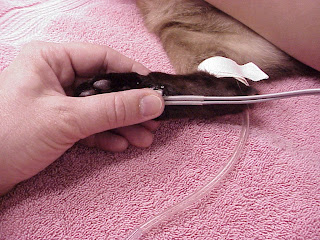 |
| The blood pressure cuff is wrapped around the leg, and some alcohol is used to wet the fur. In some cases, a small amount of fur is shaved near the cat's paw pad. Ultrasound gel is applied to the Doppler probe and then held gently against the foot. The blood pressure cuff is then inflated and several readings are taken. |
Treatment:
Amlodipine is usually the medication veterinarians turn to for treatment of high blood pressure in cats. This medication relaxes the blood vessels to allow the blood to pass more easily. Most cats started on this medication are started on a low dose and then re-checked in a couple weeks to ensure that they do not need to have additional medication. This avoids adverse side effects from a sudden decrease in blood pressure such as weakness or fainting spells, but also allows for appropriate correction of blood pressure that is severely elevated within a short period of time. Other medications such as benazepril and atenolol may be preferable in some cases, depending on the cat's overall health.
Additionally, treating any primary disease such as hyperthyroidism, diabetes, kidney disease, may aid the control of high blood pressure.
Currently,
Exclusively Cats Veterinary Hospital is
participating in a nationwide study of an FDA-regulated investigational
medication for high blood pressure associated with chronic kidney disease in
cats. This clinical trial is designed to determine the effectiveness of the investigational
medication in a real-world situation. We hope you will consider this
opportunity to possibly help your cat and, potentially, many other cats
nationwide.
ANY CAT* over the age of 7 is currently eligible
for a free exam and blood pressure screening.
For more information, call our office at 248-666-5287
or visit www.mycatcanhelp.com.
To get involved, please call our office to schedule an appointment!
*Any cat that is not currently on blood pressure medication, and is not an F1 generation Savannah Cat or Bengal breed.
Selected Resources and References:
More information
:
High Blood Pressure in Cats: Winn Feline Foundation
High Blood Pressure (Hypertension) in cats: FAB cats
Diagnosing Feline Hypertension: Pet MD
All About Hypertension: Tanya's Comprehensive Guide to Feline Chronic Kidney Disease
Hey, Doc, Why Did My Cat Go Blind? by Dr. Eliza Sundahl at Felinedocs.com
Research and Journal Articles:
Management of Hypertension in a geriatric cat: Canadian Veterinary Journal
Managing Hypertension in Cats with Hyperthyroidism: Proceeding of the SEVC
Prevalence of systolic hypertension in cats with chronic renal failure at initial evaluation. J Am Vet Med Assoc. 2002 Jun 15;220(12):1799-804. Syme et. al
Heart and Kidney, A.P. Carr, B. Egner
Feline Systemic Hypertension: Classification and pathogenesis, E Rosanne Jepson, BVSc (Dist) PhD MRCVS∗
Feline Systemic Hypertension: Diagnosis and Management, Rebecca L Stepien, BS DVM MS DipACVIM (Cardiology)⇓
A comparison of CAT Doppler and oscillometric Memoprint machines for non-invasive blood pressure measurement in conscious cats. Jepson et al. 2005.
The Prevalence of Ocular Lesions Associated with Hypertension in a Population of Geriatric Cats in Auckland, New Zealand. Carter et. al, 2013
Routine health screening: findings in apparently healthy middle-aged and old cats. Paepe et. al. 2013
Systemic Hypertension in Cats: Current Issues in Diagnosis and Therapy, AAFP 2011 Conference 9/9-9/11. Daniel F. Hogan DVM, DACVIM (Cardiology)


