Showing posts with label cat adoption. Show all posts

Friday, July 11, 2014

Meet the Cats of July!

Messrs. and Miss July - Joey, Roger, and Delilah 
As told by Joey
Eight years ago, while still a very small kitten, I (the Tuxedo on the left) was found wandering the halls of a Catholic high school in Plano, TX. After a brief stay with a family, and an incident with two schnauzers that I still say was not my fault, Mommy picked me up from a shelter.
Joey

Me and Mommy are now far away from Texas - we live on a small lake in Waterford, with Daddy and lots good of smell-o-vision. In October 2012, I had a stay-cation at Exclusively Cats, and I came home with two cats of my own, Roger and Delilah.

Trisha rescued "Dodgie" and "'Lilah" from underneath a Dumpster in Flint, and I'm very happy that they're my cats now. Roger, the big black cat on the right, and Delilah, the little gray and white cat in the middle, have come a long way since we all came home almost two years ago. They started out being very shy, hiding behind the drier, but now they take naps with me, and we chase each other all over the house. Roger is still very shy around the bipeds, but Delilah will jump up on the couch - or let Daddy scoop her up - for rubs and scritches. She also likes to fling toys off the top of the cat tree and send them across the den.

Roger
I started out as the big brother, but Roger may be a little bit bigger than me (just a little). I still win when we wrestle. Just sayin'. I see another cat who lives outside, Yeti, and he gets the best food ever that Mommy and Daddy put out for him. Daddy says it's the same kibble I eat, but I know better. I hope I get to adopt him soon, too!


Kitty BFFs!

Monday, June 30, 2014

Why are my cats fighting? Part 3: Finding solutions - the 5 "R"s


Gray tabby cat and orange tabby cat fighting | Exclusively Cats Veterinary Hospital Waterford, MI

If you have read part 1 and part 2 of this series, you now may have a good idea what reasons may be behind your cat's aggression and you have a list of behaviors and locations that clarify the aggression. However, what you really want is a solution, right?

Some forms of mild territorial aggression, such as conflict that occurs after the introduction of a new cat to the household, will resolve themselves over a period of 4 months. Temporary aggression issues, such as conflict after a veterinary visit or other traumatic event, may resolve in 24-48 hours.

Gray cat being petted on the cheek | Exclusively Cats Veterinary Hospital Waterford, MI
Rub cats around the cheeks and face to transfer scents
Re-Scent: If your cats only have problems after one of them visits the veterinarian (non-recognition aggression), try to schedule vet visits at the same time, or segregate the cat that went to the vet in one room with food, water and litter, to let him regain the familiar smell of the household and de-stress before re-introducing him to your other cats. You could speed the process by rubbing the cats with the same towel around their ears and cheeks - the areas that cats use to mark their territory and rub other cats - and then across their bodies.


Re-Introduce: For troubles with a new cat in the house, or long-standing territorial issues, try re-introduction of the cats. Generally, the aggressor cat is the one that should be treated as the "new" cat and the victim should be treated as the "existing" cat. Use rewards to reinforce desired behaviors, but do not physically punish fighting. It will NEVER help the situation, and may make the situation worse. Patience is a big key to working with remodeling your cat's relationships - your goal in cases of aggression is not to make your cats into best buddies, but to give them the ability to tolerate each others' presence without fighting.

Poolga image by mckibillo | Exclusively Cats Veterinary Hospital Waterford, MI
Method of exercising cats by mckibillo on Poolga
Redirect: Don't punish aggressive behavior, because that will cause stress, which may increase aggression. Don't reward aggressive behavior by trying to distract the aggressor with treats or attention, either. Instead, try to distract the aggressor before a fight occurs by redirecting his attention with an interactive wand toy, a game of fetch, or a laser pointer or flashlight and try to lure him away from the impending fight. Reward the cat when you catch him acting neutrally towards the victim.

Resource management: Increase the desirable space in your house by adding vertical territory, such as cat trees, perching shelves, or giving cats access to upper levels of existing shelving with ramps and stairs. Make sure that there are plenty of feeding and watering stations, so that essential resources can't be completely blocked, and make sure that you have at least one more litter box than the number of cats in your home, preferably at least one box on each level of your house, as well. This will help prevent inappropriate elimination related to resource blocking or stress.

Remedies:
Medications: If aggression issues are significant, your veterinarian may recommend the introduction of calming medications or anti-anxiety drugs to aid your efforts to train your cats to tolerate each other. These medications will help take the edge off the bully's attacks, or decrease the victim's reaction to aggressive posturing from the aggressor cat. Drugs are generally not the cure for the problem, but can be a useful tool to aid in implementing behavioral conditioning. Sometimes only one cat needs to be medicated, but sometimes the problem is significant enough that both cats need to receive drug therapy in addition to behavioral therapy. Medications such as fluoxetine, buspirone, alprazolam, clomipramine and elavil are prescribed based on the information that a cat owner provides about the types of aggressive incidents that occur. Because the dosages are different for humans and cats, and because the recommendation for medication is based on the behavior of the cat, it is only recommended to start behavioral drug therapy with the guidance of a veterinarian.

In addition to prescription medications, some of the other products that we often incorporate into behavioral solutions are pheromone products, wraps and treats.

Feliway | Exclusively Cats Veterinary Hospital Waterford, MI
Feliway
Pheromone products: Calming pheromones help decrease the stress levels in the household and lower the intensity levels of the aggressive encounters. Products such as Feliway and NurtureCalm contain pheromones associated with marking "happy places" and the chemical a mother cat produces to calm and reassure her kittens.

Wraps: The Thundershirt is a product based on information from studies of autistic children and adults indicating that pressure therapy, massage, and the use of a hugging machine can relieve anxiety. In addition, swaddling of infants has been shown to calm them. While research and controlledstudies are still in the works for this therapy, it is not harmful to employ them in an effort to calm hyper-anxious pets as a part of a behavioral plan.
Black cat in Thundershirt | Exclusively Cats Veterinary Hospital Waterford, MI
Mr. B wears a Thundershirt to help him deal with all the cats in the hospital
 
Treats and Supplements: The pill Anxitane and Composure treats contain L-Theanine, (Gamma-ethylamino-L-glutamic acid) which is derived from the mushroom Boletus badius and Camellia sinensis tea leaves. L-Theanine causes a calming effect without drowsiness.

You will probably need to resign yourself to the fact that your cats will never be best friends. If aggression is a significant issue between your cats, the best you may be able to hope for is tolerance of the other cat's presence, and that can take months of baby steps forward (and a few steps back) to accomplish. However, if you are patient, and if you let the cats tell you when you can move forward, you will hopefully eventually be rewarded with a peaceful (if not amicable) household.

Monday, July 22, 2013

Kitten Care: How old is the orphaned kitten I found?


Extremely young kittens will be better off if they can stay with their momma or be fostered by a mother cat with a litter

At Exclusively Cats Veterinary Hospital, we commonly get calls from people who have found a stray or orphaned kitten and are unsure of what to do. Much of orphaned kitten care depends on the age of the kitten. Being able to age a kitten definitely takes some practice, especially if the kitten is sick or injured. There are some general guidelines that you can use to help narrow it down.

0 – 3 days: At birth, kittens usually weigh between 3-4 oz. The umbilical cord is still attached and the eyes and ears are sealed shut. Kittens this age rely on their mother’s grooming to stimulate urination and defecation. If they have no mother, they will need your assistance to eliminate. They also need to eat a minimum of 6 times daily, or about every 4 hours.

7 - 10 days: The eyes begin to open. They are usually completely open by  day 10. At this age, they should weigh about 6-8 oz. At this age, they usually eat about 5 times daily.
Ears still mostly closed, eyes just beginning to open.

2 - 3 weeks: The kitten begins to stand. The center 4 deciduous incisors (the small teeth at the front) begin to come in. Between 3-4 weeks, the outer 2 incisors and the canines begin to come in. The ears start to stand up at about 3 and ½ weeks. At this age, kittens can start to orient towards sights and sounds. At this age, they should weigh 10-12 oz and will eat about 4 times daily. This age is the beginning of the most important socialization period.

4 weeks: The kitten begins playing and exploring her environment. They become steadier on their feet. Upper and lower premolars start to come in. They also start to eat on their own somewhere between 4-5 weeks of age. At this age, they can also eliminate without assistance. At one month, most kittens should weigh about 14-16oz or close to 1 pound and will eat at least 3 times daily.

5 weeks: They should be fairly confident on their feet by this age. This means that they can run around!
Blue eyed babies who are running around

6 weeks: The kittens are extremely active. Their eyes generally change from blue to blue/gray then yellow/green between 6 1/2 to 7 weeks.

8 weeks (2 months): All baby teeth should be erupted at this point. Kittens of this age are unlikely to need bottle-feeding. Two-month-old kittens should weigh about 2 pounds. After this age, socialization with humans becomes increasingly difficult, and kittens are more likely to display feral behavior as time goes on.

12-16 weeks (3 ½ to 4 months): The center four Incisors begin to erupt. At this age, most kittens are over 3 pounds and can safely be spayed or neutered. This is the ideal age at which to separate a litter of kittens and find them new homes. After this age, playtime becomes less social and more independent, and most of the rules of “cat etiquette” have been learned.
Kittens ready for new homes

16-18 weeks (4-4 ½ months): Outer Incisors erupt. Upper premolars and molars start to erupt. At 4 months, most kittens should weigh about 4 pounds.

6 months: Canines and lower premolars start to erupt. Weight is usually around 6 pounds.
       
28 weeks (7 months): All adult teeth should be fully erupted.

Tooth diagram and chart from the Humane Society of the United States

Monday, June 10, 2013

Welcome Home! 5 tips to help introduce a new cat into your household.


Two adult cats snuggling.
Marley (left) was introduced to Curie when she was two yrs old and he was a tiny kitten. At first, she hated him...


Baby hugging a black cat
Introducing cats to children is similar to introducing a new cat
Have you thought about adopting a new cat in celebration of "Adopt a Cat Month" this June? If so, you may be wondering how to best handle the introduction of the new cat into your household to make things go as smoothly as possible with your existing cats. If you've already read our blog article about introducing your cat to a new baby, you probably already have some idea of how to introduce a new cat, but if you've never
done it before, you may want some suggestions.

1. Slow and steady - First of all, the best thing that you can do is NOT let the new cat out of the carrier right away. Place the carrier containing the new cat in the middle of the room and let your resident cats approach and investigate the new cat on their own terms. If they immediately seem curious, calm, and playful, you may be lucky enough to have cats that don't need a lengthy introduction. At this point, if the new cat is parasite-free and has been vaccinated and tested for diseases like Feline Leukemia and FIV, you can cautiously let the new cat out and observe face-to-face interactions. Be ready to step in and separate the cats if things get too tense.

It is ideal to have your new cat checked out by your veterinarian before you bring them into your home, but this is not always feasible or practical. If the new cat is not fully "vetted", you should not allow face-to-face contact until you have had the new cat checked out. You don't want to expose your resident cat to parasites or diseases. It is easier to treat one cat for ringworm, roundworms, fleas or ear mites than it is to treat your whole household. It is also not uncommon for a newly adopted cat to develop an upper respiratory infection shortly after adoption (no matter where they came from - breeder, shelter, stray, Craig's List...) because the stress of entering a new home can decrease the strength of the immune response. So, it may be prudent to keep your new cat separate for a few days, just to make sure he doesn't start sneezing.
Three cats snuggling
Delilah and Roger, the two cats on the right, are brother and sister. They were successfully introduced to 6 year old Joey (left) as shy adults. Their owners had planned to board Joey with us while on vacation, so while he was at our hospital, we were able to introduce them all in a neutral environment. They have plenty of toys, cat trees and other valuable resources at home - enough to share, their owners used a lot of positive reinforcement during the introductory period, and it also helped that Roger and Delilah came from an environment with lots of cats living communally. The adjustment period was very short and Joey transitioned smoothly from being a single cat to being a "big brother".

Otherwise, if your resident cat is hissing or growling or seems fearful, you should plan to keep the new cat separate for a while. Set up a spare room with food, water and litter and a cozy bed, and prepare to be patient. This room becomes a safe haven for the new cat, allowing him to establish a place that is "his" within the new home. This can help prevent future issues when he is introduced to the other cats in the home.

2. Scents-able suggestions - Your resident cat's biggest objection to the new cat is likely to be its smell. The new cat doesn't smell like your house - it smells like the rescue (hundreds of other cats!), the pet store (dogs!), or the outdoors (the scary unknown!). One way to accelerate the introduction process (if things are progressing smoothly) is to allow the new cat to sleep on some blankets or towels and then present these items to your resident cat. Once your new cat has spent a few days in the spare room (with plenty of visits for snuggles and pets to keep him from being lonely), switch the two cats. Put your resident cat in the spare room for a period to investigate the new smell in a non-threatening way. Let the new cat out and about in the house to allow him to explore and pick up more of the scent of the house. While he is out in the house, he will likely rub on furniture, play with toys and find a nice place to sleep. This will  deposit some of his own scent in the house, meaning that the smell of the "colony" will smell more like him.
Encourage play under a closed door and reward positive behaviors with treats. Here, Mr. B is spending some quality time with Mona Lisa, while she is boarding.

The addition of Feliway spray may help ease the transition, too. Feliway is a synthetic calming pheromone that will not only de-stress your cats, but will also help make them smell more similar. You can use the spray on individual items in the home, or place diffusers in both the room where the new cat is isolated, and in critical areas in the rest of the house where your cats spend most of their time.

Before you start to allow the cats visual socialization, feed the cats on either side of the door to the room where the new cat is staying. Cats are usually very food motivated, and being able to smell each other while enjoying a yummy treat will help them associate each other's smell with a positive experience. You can also encourage play underneath the door with feather toys or toys on strings that will encourage the cats to stick their paws underneath the door. Eventually, they may begin to play with each other in addition to the toys, with the door as a visual block to prevent aggression.

Once the new cat is starting to socialize with the other cats, reward any positive interaction or even calm non-interaction with treats.

3. Yours, mine and ours - Make sure that when your new cat comes out into the rest of the house, you adequately increase the number of litterboxes. There should be one more litterbox than the number of cats in the house, and ideally one box on every level in your home. For more about avoiding litterbox issues, please read our series of blog articles about inappropriate elimination.

Each cat should have its own food bowl and place to sleep, at a minimum. Much of the stress in a multiple
Multiple litter boxes in one spot
To a cat, this is only one litterbox.
cat household comes from competition for resources. A large number of food bowls, beds or litterboxes all in a row look like multiple resources to people, but to a cat, if they're all in the same location, they're all the same resource. Provide barriers between items to block cats' view of each other to decrease stress - for example, feeding one cat around a corner from the other.

4. Feline highways - Your new and resident cats may seem to be getting along well, without any fighting, but that may not mean that conflict is not there. We had a recent case where a cat in the home started urinating outside the litterbox after the introduction of another cat. Everything seemed quiet in the house, no fighting - the cats just avoided each other. However, after the owner went home and kept a close eye on the two cats, it became apparent that the new cat was blocking the resident cat from the litterbox. Every time he got up to go to the box, she would run up the stairs ahead of him, use the box, and then sit between him and the litterbox and just stare. Since there was only one box in the house, the poor fellow had no choice but to choose an alternative location to urinate! The addition of several more boxes in the house on different levels of the home made it so that there was no way for the new cat to block the resident's access to all litterboxes, and the problem resolved.

It is important that there be multiple access routes to all cat-related resources - food, water, litter, windows and beds - whatever your cat feels is most important. That may mean adding a new cat tree or two, some cat shelves on the walls, or putting out additional food and water bowls elsewhere in the house. Remember to "think vertical" - your cat does! Adding some elevated areas for your cat to climb or jump up to will increase the square footage of your cat's territory exponentially in your cat's eyes. Jackson Galaxy of "My Cat Fron Hell" on Animal Planet calls this process "Catification".
Cat shelves on the wall.
"Catification" can be very subtle.

It has been suggested that in order to minimize stress between cats in the same household, a minimum of 1.7m2 of floor space per cat is necessary. This is equivalent to just over 18 square feet of floor space per cat.   In a study of pairs of cats in homes, cats were observed to keep a distance between themselves of 1–3 meters, suggesting that cats housed together in the same room should be able maintain a respectful distance from each other (roughly 3-10 feet) (horizontal OR vertical distance, that is). Even cats that are best friends will spend about 50% of their time out of each other's sight. (from: The Welfare of Cats)

5. When your efforts fail - Depending on your cat, the introduction may take a few hours, a few days, weeks or months. As long as you are making slow progress, you haven't failed. The worst thing that you can do at this point is to become impatient and rush things. You can actually cause the problem to become worse if you do.

Key into your cats' signals. If either cat shows signs of stress or hostility at any stage of the introduction, stop and re-evaluate. Go back to a step in which all cats are calm and wait a few days to try again. You can extend each phase of the introduction by adding "baby steps". If cats are playing happily under the door, but opening the door causes hostility, you can prop the door slightly open with a door stopper, or set up baby gates, install a screen door, or use your imagination to make the introduction even more gradual.
Gray and white cat smelling an orange tabby through a screen
Non-threatening socialization through a screen door

Get your veterinarian involved. At Exclusively Cats Veterinary Hospital, our staff is well-versed in cat behavior and can offer specific recommendations that are tailored to your unique situation. In some cases, it may be necessary to add in a behavioral medication to aid the introduction. Some cats are hyper-aggressive or extremely shy and may need a course of anti-anxiety or calming medication in order to facilitate a good relationship. In some cases this medication may only need to be used for a short period, while other cases may need long term therapy.

Wednesday, May 1, 2013

Meet Mr. May!

Mr. May, Cooper, black and white cat in a basket

 Cooper

Age: 23 months
Weight: 12.45#, slightly overweight
Gender: Neutered male
Demeanor at the vet's office:  Sweet boy!
Feline Friends: Angus, Mozart and Hogan

Ever know a cat described as charm and love itself?  Well, I’m that kind of cat – My name is Cooper.  In September of 2011, Dad responded to an adoption ad for a Maine Coon.  They were directed to a pet store in another town.  There I was in a middle cage, surrounded by other kittens, looking lost and confused.  The caretaker pointed me out to Dad, who held me to gauge my temperament.  I was calm in his arms and when we went into another room with other people, I clung to him for security.  
 Mom wondered what was wrong with my eye and paw.  I had an accident in the bathtub where the caretaker kept me and other kittens.  Fortunately, I was brought in for medical attention.  My eye doesn't fully close while I'm sleeping, but my vision is OK.  The Pet Store adoption area was like a circus and Mom felt sorry for me.  Although I was no Maine Coon, Dad loved me on the spot.  Before the paperwork was completed, I was in Mom's arms outside in the car.  Once home, I was sequestered in the upstairs suite as is customary when introducing a new cat to a cat-home.  
E-cats re-checked my vision; my paw had ringworm so I was treated for that.  Mom and dad would play with me in my room, change clothes, and go back to my new brothers.  I saw one brother in particular through the door as it opened a few times.  When I was free to meet my brothers, the door was opened and I rushed out.  Hogan (Ho-ho) was waiting for me.  He jumped on me and we ran down the steps together.  We've been together ever since.  
I have two older brothers, Angus-10, Mozie-8.  Hogan is two, and I will be two this month.  My older brothers and I don't interact much, but you can find me with Hogan.  In fact, I smelled like Hogan's breath for the first few weeks out of my room!  Hogan is long and lean; I am sturdy and small.  We zip through the house together and I can match Hogan step for step.  On occasion he tests his mettle with me but it always ends in a stalemate of licking each other.  
Despite my damaged eye, I am the #1 flycatcher in the house.  They just don't escape me!  Even when I'm out on the Catio, I carry my fresh catch into the house for inspection.  My favorite toy is a blue mouse on an elastic string.  I carry it around and deliver it to Mom's side of the bed, and Dad's desk in his office.  I also love Nasty Santa - he's not naughty, but he's been stitched and washed a number of times so I'm grateful he's still intact.  My brothers and I seem to time-share all the cat beds, people beds, people chairs, windowsills, and cat trees found throughout the house.  Now that we're older, Ho-ho and I don't fit into most of the beds together.  There's a large one atop the armoire.  When Ho-ho and I are sleeping there together, it makes Mom so happy as he and I are still very close.  Dad loves to take pictures of me and that is why you see me as Mr. May in this year's calendar.  
Cooper and Hogan, two cats snuggling
Cooper and Ho-Ho, snuggling


When it is feeding time, you will see me prancing in the kitchen, back arched, wrapping my boa of a tail around the neck of my brothers.  I just get so excited!  I'm a good eater; Angus and I eat whatever is served.  As they call Hogan Ho-ho, Mom and Dad call me Cu-cu, which morphed into Cuckleberry.  If I don't get my bowl fast enough, I "meow" which is more like a long, piercing squeak.  Hence, I'm sometimes called Squeakleberry.  

I nurse Mom's earlobe around 4 a.m.  Despite the early hour, she recalls the caretaker's stories of my early life and she hugs me tight – glad that I’m hers.  When I drew blood on her earlobe, I had to be weaned.  Now I simply snuggle and purr on Mom.  When company comes over, I run and hide.  Mom calls to me and tells me when they are gone.  I have a very sweet, shy nature, tho I'm known for stealing things from off of dad's desk.  

Dad makes juggling balls.  On occasion, a ball was found in different areas of the house.  One day, five balls were missing.  Dad looked everywhere and couldn't find them.  Eventually, they were discovered in a pile under the table in a corner where the TV is.  I guess I was putting my "babies" in a nest.  Dad knows to hide them from me now.  I can hear mom and dad chuckle from time to time when they look at my small stature and laugh as they recall that they were told that I was a Maine Coon.  Grateful to fate, they are very happy to have me.  All I ever wanted was to be loved - and I am.
Cooper, black and white cat sleeping
Cooper, happy and loved!

Friday, March 29, 2013

New Kitten FAQ


Cute blue eyed kitten
KITTENS: RECOMMENDATIONS FOR NEW OWNERS

We would like to congratulate you on the acquisition on your new kitten.  Owning a cat can be an extremely rewarding experience, but it also carries with it quite a bit of responsibility.  We hope this document will give you the information needed to make some good decisions regarding your kitten.

First let us say that we are grateful that you have chosen us to help you with your kitten's health care.  If you have questions concerning any subject related to your kitten's health, please feel free to call our hospital.  Either one of the technicians or one of the doctors will be happy to help you.

How should I introduce my new kitten to its new environment?

A cat is naturally inclined to investigate its new surroundings.  At first, you should limit the cat's area of exploration so that these natural tendencies do not create an unmanageable situation.  After confining the cat to one room for the first few days, you should slowly allow access to other areas of the home. 

What type of playing should I expect from a kitten?

Kitten getting tummy rubs
Kittens love to play with just about ANYTHING! 
Stimulating play is important during the first week.  Stalking and pouncing are important play behaviors in kittens and have an important role in proper muscular development.  If given a sufficient outlet for these behaviors with toys, your kitten will be less likely to use family members for these activities.  The best toys are light weight and movable.  These include wads of paper and small balls.  Kittens should always be supervised when playing with string or ribbons to avoid swallowing them.  Any other toy that is small enough to be swallowed should also be avoided. 

Can I discipline a kitten?

Disciplining a young kitten may be necessary if his or her behavior threatens people or property, but harsh punishment should be avoided.  Hand clapping and using shaker cans or horns can be intimidating enough to inhibit undesirable behavior.  However, remote punishment is preferred.  Remote punishment consists of using something that appears unconnected to the punisher to stop the problem behavior.  Examples include using spray bottles, throwing objects in the direction of the kitten to startle (but not hit) her,  and making loud noises.  Remote punishment is preferred because the kitten associates punishment with the undesirable act and not with you.

When should my kitten be vaccinated?

There are many diseases that are fatal to cats.  Fortunately, we have the ability to prevent many of these by the use of very effective vaccines.  In order to be effective, these vaccines must be given as a series of injections.  Ideally, they are given at about 6-8, 12, and 16 weeks of age, but this schedule may vary somewhat depending on several factors. 
The routine vaccination schedule will protect your kitten from five diseases: distemper, three respiratory organisms, and rabies.  The first four are included in a combination vaccine that is given at 6-8, 12, and 16 weeks old.  Rabies vaccine is given at 12 or 16 weeks of age.  Leukemia vaccine is necessary if your cat does or will go outside or if you have another cat that goes in and out since this deadly disease is transmitted by contact with other cats, especially when fighting occurs.  A vaccine is also available for protection against feline infectious peritonitis (FIP); this vaccine is probably not necessary for all cats and is recommended in selected situations.

Why does my kitten need more than one vaccination for feline distemper, upper respiratory infections, and leukemia?

Kittens receive a temporary form of immunity through their mother's milk while nursing.  This immunity is in the form of proteins called antibodies.  For about 24-48 hours after birth, the kitten's intestine allows absorption of these antibodies directly into the blood stream.  This immunity is of benefit during the first few weeks of the kitten's life, but, at some point, this immunity fails and the kitten must be able to make its own long-lasting immunity.  Vaccinations are used for this purpose.  As long as the mother's antibodies are present, vaccinations do not "take."  The mother's antibodies will neutralize the vaccine so the vaccine does not get a chance to stimulate the kitten's immune system.

Many factors determine when the kitten will be able to respond to the vaccines.  These include the level of immunity in the mother cat, how much of the antibody has been absorbed, and the number of vaccines given the kitten.  Since we do not know when an individual kitten will lose the short-term immunity, we give a series of vaccinations.  We hope that at least two of these will fall in the window of time when the kitten has lost the immunity from its mother but has not yet been exposed to disease.  A single vaccination, even if effective, is not likely to stimulate the long-term immunity which is so important. 

Rabies vaccine is an exception to this, since one injection given at the proper time is enough to produce long-term immunity.

Do all kittens have worms?

This is a type of roundworm
Intestinal parasites are common in kittens.  Kittens can become infected with parasites almost as soon as they are born.  For example, the most important source of roundworm infection in kittens is the mother's milk.  The microscopic examination of a stool sample will usually help us to determine the presence of intestinal parasites.  We recommend this exam for all kittens, if we can get a stool sample.  Please bring one at your earliest convenience.  Even if we do not get a stool sample, we recommend the use of a deworming product that is safe and effective against several of the common worms of the cat.  It is important that deworming be repeated in about 3-4 weeks, because the deworming medication only kills the adult worms.  Within 3-4 weeks the larval stages will have become adults and will need to be treated.  Cats remain susceptible to reinfection with hookworms and roundworms.  Periodic stool analysis and/or deworming throughout the cat's life may be recommended for cats that go outdoors.

Tapeworm segments in a cat's fur
Tapeworms are the most common intestinal parasite of cats.  Kittens become infected with them when they swallow fleas because the eggs of the tapeworm live inside the flea.  When the cat chews or licks its skin as a flea bites, the flea may be swallowed.  The flea is digested within the cat's intestine; the tapeworm hatches and then anchors itself to the intestinal lining.  Therefore, exposure to fleas may result in a new infection, which can occur in as little as two weeks.  Cats may also become infected with tapeworms if they hunt and eat mice.

A lungworm under the microscope

Cats infected with tapeworms will pass small segments of the worms in their stool.  The segments are white in color and look like grains of rice.  They are about 1/8 inch (3 mm) long and may be seen crawling on the surface of the stool.  They may also stick to the hair under the tail.  If this occurs, the segments will dry out, shrink to about half their size, and become golden in color. 


Tapeworm segments do not pass every day or in every stool sample; therefore, inspection of several consecutive bowel movements may be needed to find them.  We may examine a stool sample in our office and not find them, then you may find them the next day.  If you find them at any time, please notify us so we may provide the appropriate drug for treatment.
Giardia organisms


Depending on a kitten's history, other common parasites that we look for are lung worms, heartworms, and infections with single-celled organisms like Giardia or Coccidia.


There are lots of choices of cat foods.  What should I feed my kitten?

Diet is extremely important in the growing months of a cat's life, and there are two important criteria that should be met in selecting food for your kitten.  We recommend a name-brand food made by a national cat food company (not a generic or local brand), and a form of food made for kittens.  This should be fed until your kitten is about 12 months of age.  In the United States, we recommend that you only buy food which has the AAFCO certification.  Usually, you can find this information very easily on the label.  AAFCO is an organization which oversees the entire pet food industry.  It does not endorse any particular food, but it will certify that the food has met the minimum requirements for nutrition.  Most of the commercial pet foods will have the AAFCO label.  Generic brands often do not have approval.

Feeding a dry, canned, or semi-moist form of cat food is acceptable. At Exclusively Cats Veterinary Hospital, we recommend feeding a small amount of dry food and 3-6oz of canned food daily.  

Each type of food has advantages and disadvantages.  Dry food is definitely the most inexpensive.  It can be left in the cat's bowl at all times.  If given the choice, the average cat will eat a mouthful of food about 12-20 times per day.  The good brands of dry food are just as nutritious as the other forms. 

Semi-moist and canned foods are also acceptable.  However, both are considerably more expensive than dry food.  They often are more appealing to the cat's taste; however, they are not more nutritious.  If you feed a very tasty food, you are running the risk of creating a cat with a finicky appetite.  In addition, the semi-moist foods are high in sugar.

Table foods are not recommended.  Because the foods we eat are generally very tasty, cats will often begin to hold out for these and not eat their well-balanced cat food.  If you choose to give your kitten table food, be sure that at least 90% of its diet is good quality commercial kitten food.

We enjoy a variety of things to eat in our diet.  However, most cats actually prefer not to change from one food to another unless they are trained to do so by the way you feed them.  Do not feel guilty if your cat is happy to just eat one food day after day, week after week.

Commercials for cat food can be very misleading.  If you watch carefully you will notice that commercials promote cat food on one basis, TASTE.  Nutrition is rarely mentioned.  Most of the "gourmet" foods are marketed to appeal to owners who want the best for their cats; however, they do not offer the cat any nutritional advantage over a good quality dry food, and they are far more expensive.  If your cat eats a gourmet food very long, he will probably not be happy with other foods.  If he needs a special diet due to a health problem later in life, he will be very unlikely to accept it.  Therefore, we do not encourage feeding gourmet cat foods.

How do I ensure that my kitten is well socialized?

Mother siamese mix with kittens
The socialization period for cats is between 2 and 12 weeks of age.  During that time, the kitten is very impressionable to social influences.  If the kitten has good experiences with men, women, children, dogs, other cats, etc., she is likely to accept them throughout life.  If the experiences are absent or unpleasant, the kitten may become apprehensive or adverse to any of them.  Therefore, during the period of socialization, we encourage you to expose your cat to as many types of social events and influences as possible.

What can be done about fleas on my kitten?

Adult flea
Many of the flea control products that are safe on adult cats are not safe for kittens less than 4 months of age.  Fleas may not stay on your kitten all of the time.  Occasionally, they will jump off and seek another host.  Therefore, it is important to kill fleas on your new kitten before they become established in your house.  Be sure that any flea product you use is labeled safe for kittens.
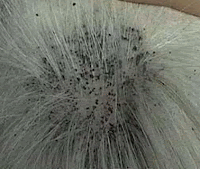
Flea dirt on a cat
This is "flea dirt" - a sure sign of fleas
Flea and tick dip is not recommended for kittens unless they are at least 4 months of age.  Remember, not all insecticides that can be used on dogs are safe for cats and kittens. 

In addition to flea treatments and preventives, it is important to control fleas in the environment by thoroughly vacuuming areas where the kitten spends time.

Can I trim my kitten's sharp toe nails?

Kittens have very sharp toe nails.  They can be trimmed with your regular finger nail clippers or with nail trimmers made for dogs and cats.  If you trim too much, you will cut into the quick of the nail which will bleed and be painful.  If this happens, neither you nor your cat will want to do this again.  Therefore, a few points are helpful:
Trimming cat nails


You can use normal human nail clippers to trim your cat's nails.1. If your cat has clear or white nails, you can see the pink of the quick through the nail so it is easy to avoid.

2. If your cat has black nails, you will not be able to see the quick so only cut 1/32" (1 mm) of the nail at a time until the cat begins to get sensitive.  The sensitivity will usually occur before you are into the blood vessel.  With black nails, it is likely that you will get too close on at least one nail.

3. If your cat has some clear and some black nails, use the average
     clear nail as a guide for cutting the black ones.

4. When cutting nails, use sharp trimmers.  Dull trimmers tend to crush the nail and cause pain even if you are not in the quick. 

5. You should always have styptic powder available.  This is sold in pet stores under several trade names, but it will be labeled for use in trimming nails.

What are ear mites?

Cat ear mite
Ear mite under the microscope
Ear mites are tiny insect-like parasites that live in the ear canal of cats (and dogs).  The most common sign of ear mite infection is scratching of the ears.  Sometimes the ears will appear dirty because of a black material in the ear canal; this material is sometimes shaken out.  The instrument we use for examining the ear canals, an otoscope, has the necessary magnification to allow us to see the mites.  Sometimes, we can find the mites by taking a small amount of the black material from the ear canal and examining it with a microscope.  Although they may leave the ear canals for short periods of time, they spend the vast majority of their lives within the protection of the ear canal.  Transmission generally requires direct ear-to-ear contact.  Ear mites are common in litters of kittens if their mother has ear mites.

Why should I have my female cat spayed?

Spaying or ovariohysterectomy is the removal of the uterus and the ovaries. It offers several advantages:

1.      The female's heat periods result in about 2-3 weeks of obnoxious behavior.  This can be quite annoying if your cat is kept indoors.  Male cats are attracted from blocks away and, in fact, seem to come out of the woodwork.  They seem to go over, around, and through many doors.  Your cat will have a heat period about every 2-3 weeks until she is bred.

2.      It has been proven that as the female dog gets older, there is a significant incidence of breast cancer and uterine infections if she has not been spayed.  Spaying before she has any heat periods will virtually eliminate the chances of either.  There is mounting evidence to believe that this is also true of cats.

3.      Spaying prevents unplanned litters of kittens.

4.      If you do not plan to breed your cat, we strongly recommend that she be spayed before her first heat period.  This can be done anytime after she is 5 months old.

Why should I have my male cat neutered?

Neutering or castration offers several advantages.  Male cats go through a significant personality change when they mature.  They become very possessive of their territory and mark it with their urine to ward off other cats.  The tom cat's urine develops a very strong odor that will be almost impossible to remove from your house.  They also try to constantly enlarge their territory which means one fight after another.  Fighting results in severe infections and abscesses and often engenders rage in your neighbors.  We strongly urge you to have your cat neutered at about 6 to 9 months of age.  If he should begin to spray his urine before that time, he should be neutered immediately.   The longer he sprays or fights, the less likely neutering will stop it.

If I choose to breed my cat, when should that be done?

If you plan to breed your cat, she should have at least one or two heat cycles first.  This allows her to mature physically and she will be a better mother without so much physical drain.  We do not recommend breeding after 5 years of age unless she has been bred prior to that.  Having her first litter after 5 years of age is more physically draining to her and increases the chances of her having problems during the pregnancy and/or delivery.  Once your cat has had her last litter, she should be spayed to prevent the female problems older cats have.

My kitten is already becoming destructive with her nails.  What can be done?

There are several options that can be considered: offering scratching posts, frequent nail clipping, nail shields, surgical declawing, and tendonectomy.

1.      Offering desirable scratching posts near the area where your kitten is scratching is an important tool in helping direct them to appropriate places to express this natural behavior. Many people make the mistake of sticking a scratching post in a far corner or offering scratching accessories that are too small or unstable. Cats need a post that allows them to stretch to their full length to scratch and sturdy enough not to fall over when they do so. You may need to experiment to learn if your cat is a vertical scratcher or a horizontal scratcher, and whether he or she prefers wood, sisal rope, carpet or cardboard as a scratching texture. There is a new product called FeliScratch that is a synthetic copy of the Feline Interdigital Pheromone that they excrete when they scratch. Applying this to a desirable scratching post will help your cat choose an acceptable place to scratch in your house. 

2.        The nails may be clipped according to the instructions above.  However, your cat's nails will regrow and become sharp again in about 4-7 days.  Therefore, to protect your property, it will  be necessary to clip them one to two times per week.

Soft nail caps protect the nails, but do keep them extended
3.      There are some commercially available products that are called nail caps.  These are generally made of smooth plastic and attach to the end of the nail with a special glue.  The nails are still present, but the caps prevent them from causing physical harm.  After 2-4 weeks the nails will grow enough that the caps will be shed.  At that time, you should be prepared to replace them. While soft nail caps protect your furniture from scratching, they do keep the nails in a state of extension, and can cause painful, severe problems if not changed regularly.

4.      Surgical declawing is the removal of the nail at its base.  This surgery is controversial, and you can read further about position of the AAFP on this surgery on their website. This is done under general anesthesia and with proper surgical techniques and adequate pain control, post-surgical discomfort should not exceed that of any other surgical procedure, especially when it is performed on a kitten. As with any surgical procedure, there can be complications and side effects. It should be noted that a declawed cat will not realize the claws are gone and will continue to "sharpen" the claws as normal on various objects, including scratching posts and furniture items. This surgery can be performed as early as 12 weeks of age or anytime thereafter.  It can also be done the same time as spaying or neutering.  Once declawed, your cat should always live indoors since the ability to defend itself is compromised.

5.      Tendonectomy is the surgical removal of a small part of the tendon on the bottom of each toe.  This tendon is needed to make the nail extend.  The cat retains its nails, but it cannot extend them for sharpening and scratching.  The disadvantage of this procedure is that the nails continue to grow and may grow into the pads.  Therefore, the nails should be clipped every 7 to 14 days.

You can also consider additional ways of modifying behavior, which may prevent the cat from scratching furniture in the house or being destructive.

This client information sheet is based on material written by Ernest E. Ward Jr., DVM.