Showing posts with label feline arthritis. Show all posts

Monday, June 15, 2015

Bladder stones: A Technician's Perspective


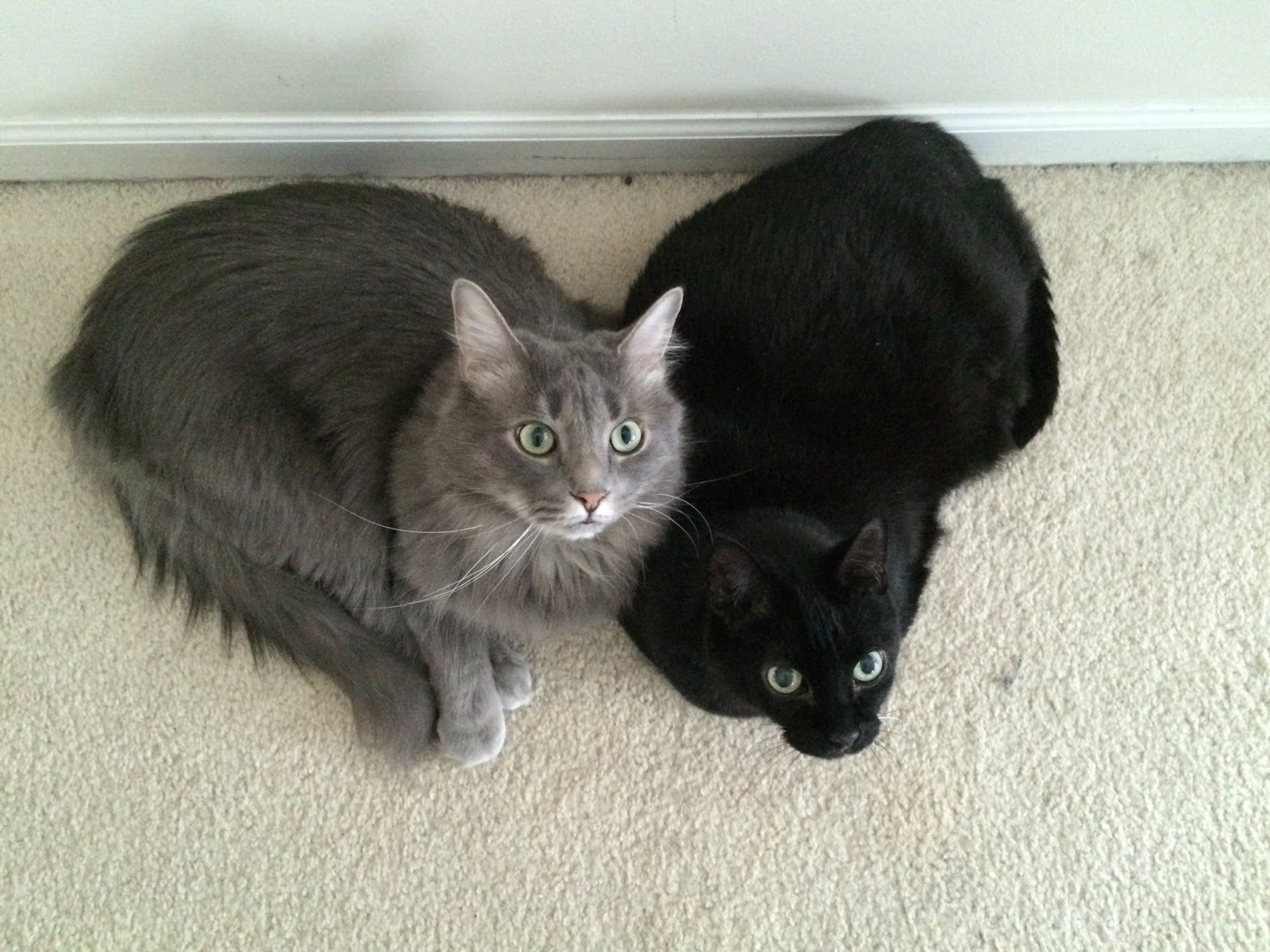
Can you tell which cat has bladder stones?


In light of the numerous cases of bladder stones, crystals and inappropriate urination issues we have seen in the last month, I thought that I would share my own experience with bladder stones, in the hopes that others will take away the same lessons that I learned.

Marley
For over a decade, I shared my life with two lovely cats who were brother and sister. Mina, the sister, is still with me, but I lost Marley to lung cancer in 2013. Both cats came from a rescue group in East Lansing, siblings from a litter of hand-raised kittens whose mother had died when they were 10 days old. Both cats were fairly healthy during their younger years - Marley had a congenital cataract, Mina had some foul diarrhea. Marley had chronic skin allergies. Both cats went through a period of time when they had adverse vaccine reactions. Mina occasionally has bouts of bronchitis. Together, they
kept my hands full!

In September of 2009, I noticed that Marley had stopped squatting to urinate. I was annoyed by the habit, because he would stand in the litterbox and a big stream of urine would splatter out onto the floor in front of the box. I watched this go on for two weeks, because he didn't seem to be in pain - he didn't vocalize or strain when he urinated, he didn't seem to be going all that frequently - maybe 2-3 times daily. He didn't seem to be drinking more water than usual, and the urine wasn't bloody. I wondered if he had developed some arthritis in his hips - after all he was 9 years old at the time. I brought him in to work with me and after a thorough exam, we took hip x-rays. Dr. Brooks looked at the x-ray and said, "Well, his hips are fine, but he has bladder stones." I thought she was teasing me. I couldn't believe it. I looked for myself. Sure enough, there they were - 7 stones (I would share the x-ray, but it is in attic storage, now, and I don't like attics). A few weeks later, I scheduled him for surgery - I forget now, why I waited. It might have been a busy surgery schedule. I might have been saving up money. Anyway, it was a dumb idea to wait, because I was on pins and needles the whole time, worrying that he might become obstructed with a stone. This was a little silly, not because it wasn't possible, but because it takes weeks to months for stones to form, so he could have become obstructed at any time prior to his diagnosis, and I had not been worried, before. Worrying wasn't going to help him. Surgery was the only option.

Calcium oxalate stones
Surgery went smoothly, and 7 large stones (and two smaller stones that were not visible on the x-ray) were removed. We sent off the stones for analysis at the Minnesota Urolith Center and the report stated that they were 70% Calcium Oxalate Monohydrate and 30% Ammonium Acid Urate stones. After surgery, Marley didn't like using the clay litter we use here in the hospital, so he urinated bloody urine on the floor and towel until we switched him back to scoopable clumping litter. At home, he resumed urinating in the box normally, squatting like a good boy.

After that, he switched to a canned stone-prevention diet. Calcium oxalate stones do not dissolve with a dietary change, but they can be prevented from re-forming in many cases. Marley had bladder radiographs and urine rechecks every 6 months until 2012. I had a baby and went on maternity leave around the time that he was due for a recheck. In retrospect, I should have brought him in for a recheck early, but I was caught up in my own medical issues at the end of my pregnancy, and I figured a few months' delay was not that important.

But it was. In May of 2012, four months after the birth of my daughter, I was scheduling Marley for a
One large stone that required surgery to remove, and the many smaller stones we expressed.
repeat cystotomy. He had a bladder full of stones again. They were smaller, this time, but one stone was large enough that it could not be expressed. Marley recovered well from his second cystotomy and continued to do well until July 2013, when cancer took its toll.

Mina
Shortly after I lost Marley, his biological sister, Mina, started vomiting. She has had occasional bouts of acute vomiting, and was empirically
diagnosed with inflammatory bowel disease in 2005. In August 2012, she had a bout of vomiting that lasted about a week, and I brought her in for abdominal x-rays. At that time, she was having no issues urinating in the litterbox. She did not have any intestinal abnormalities, but there was a shadow in her bladder, which turned out to be a "puddle" of small stones. Fortunately, since she is a female, we were able to express all the small stones out of her bladder, and surgery was avoided. We sent in the stones to the Minnesota Urolith Center and they were 100% Calcium Oxalate stones. She has also been eating a crystal prevention diet and so far, she has had no further sign of stones on any of her followup xrays or urine samples.

If I had taken my own advice, many years ago, and fed canned food to my cats more often, I might

Sometimes, a lot of small stones look like one large stone
never have had to deal with this issue, as their urine might have been more dilute and less likely to form stones. I was very fortunate that neither of my cats decided to start urinating outside the litterbox due to discomfort - in fact, they are both very good examples of the fact that cats hide their problems from their owners. As a technician, I should be more attuned to signs and symptoms of illness, and I was unaware of the issues my own cats had. They are also a good testament to the importance of follow-up. Even if your cat seems fine after a treatment or procedure, it is important to follow-up on schedule. If I had brought Marley back 3 months earlier for a recheck, he might have been able to avoid the second cystotomy surgery. It may be that Mina will be one of the lucky few cats that never re-forms stones after a cystotomy, but you can be sure that I will continue to check her every 6 months!
Mina would rather nap than have a bladder recheck

Monday, May 13, 2013

Feline Arthritis Part 2: 7 Things That You Can Do at Home to Help


Arthritis changes to an elbow joint
 How exactly do you diagnose your cat with arthritis? Your veterinarian may feel differences between the joints on one side of the body versus the other, or may feel abnormalities within the joints. The cat may display the same signs that you are witnessing at home, or adrenaline may take over and mask the problem. Patience and a calm, cat-friendly environment may allow the cat to relax and allow us to see the problem or, if not, our doctors have a few tricks up their sleeves to investigate further. However, the most effective diagnostic tool for arthritis is often an x-ray. Usually two views of the limbs are taken and analyzed for narrowing in the joint space, thickening of the bone, or formation of new, irregular bony projections in or around the affected joint. It doesn't matter whether there are many joints that are affected or just one - arthritis changes to the bones means pain with movement - a lack of joint cushioning so that bone grinds on bone. Ouch!

One arthritic pair of vertebrae in the lumbar spine
Multiple thoracic (upper back) vertebrae with arthritis changes
In our previous post about feline arthritis, we discussed medical treatments that are available for cats with arthritis to help rebuild and protect joints and decrease pain. However, there are things that you can do at home to help your arthritic cat, as well. Most of the home care options include environmental changes.


  1. Make or buy pet stairs to allow your cat access to favorite spots in the house like beds or couches. This can be as simple as moving a footstool next to a favorite armchair to make one big jump into a set of small jumps.
  2. Make sure that you have a litterbox on every level of your house so that your cat does not have to go far or up and down a lot of stairs to visit one. This will prevent inappropriate urination or defecation around the house. If it is too much work to get to the litterbox, you can bet that many cats will make their own box somewhere else. Also make sure that the edges of the box are not too high, so that it is easy for your elderly cat to get in and out of the box. It may be a good idea to cut down the side of the litterbox a little to help them out. 
  3. Providing extra soft beds at floor level, or even heated beds will help your cat rest more peacefully and wake with less soreness. 
    Thickened toenail that is traumatizing a toe pad.
  4. Make sure that food and water are easily accessible, not up high on a counter, and possibly elevated a little for cats with cervical (neck) pain. 
  5. Cats with arthritis may need extra grooming assistance, and should have their claws checked and trimmed frequently. If they are wearing their nails unevenly, a nail could get caught and torn, or could grow into a toe pad and become painful and infected.
  6. Weight control. Another change that helps arthritic cats is to make sure that they are not carrying around a lot of extra weight. Extra pounds put extra pressure on already complaining joints, so put your pudgy oldster on a diet to ease the burden on his aching joints. Work with your veterinarian to determine a good weight loss plan – you don’t want your cat to crash-diet, because that can cause other health problems.   
  7. Getting your cat up and moving more can help with weight loss and flexibility. With adequate pain control, your cat should show a renewed interest in play, and you should use that to your advantage. For cats with a reluctance to play, you may try offering meals in a food ball, such as the Eggcercizer, which you can find in our office. Ask our hospital kitties for a demonstration! 

Monday, April 15, 2013

Feline Arthritis Part 1: Three Approaches to Treatment


Lumbo-sacral spondylosis - OUCH!


 Have you noticed that your cat is having a hard time getting up and down the stairs? Maybe he’s not sleeping on the end of the bed anymore, or not hopping up into your lap as frequently? Perhaps your cat has a litterbox in the basement, but recently has started urinating upstairs where she spends most of her time? Is your cat’s coat looking scruffier than it has in the past – maybe because he or she is not spending as much time twisting around to groom? Is your cat grumpier than usual, or snappish when you pet certain areas? Maybe your cat just doesn’t like to play as much as in the past, or takes a long time to sit or lie down comfortably.

All of these things are clues to diagnosing feline arthritis. A 2002 study looking at x-rays of older cats showed that about 90% of cats over the age of 12 have evidence of degenerative joint disease (DJD), and a similar study determined that about 20% of those cats do not display any signs or symptoms of the arthritis changes to their bones. Rarely, if ever, do cats actually limp or cry out in pain when they have arthritis – it is usually much more subtle, and better discovered by cataloguing what the cat is NOT doing than by listing what the cat IS doing. Once you and your veterinarian have come to the conclusion that arthritis is a problem for your cat, there are several options for treatment.

Neutraceuticals

The first several options deal with rebuilding and protecting the joints. There are several products that help with this. 
  • Cosequin is a powder that can be mixed with canned food 1-2 times daily that supplies glucosamine and chondroitin to the cat. Glucosamine hydrochloride acts as a building block of cartilage by supplying a key nutrient that keeps cartilage cells healthy and functioning properly. The specific chondroitin sulfate, exclusive to Cosequin, is the most pure form available on the market. Manganese ascorbate is necessary to optimize the production of cartilage components. Glucosamine and chondroitin can take 6-8 weeks to reach full effect. 
  • Science Diet makes a therapeutic joint care diet called J/D that has shown definite benefits in studies – both for the treatment of arthritis and for the promotion of joint healing after orthopedic surgery in dogs and cats. This diet contains ingredients such as glucosamine and chondoitin and essential fatty acids that slow the degradation of cartilage, repair cartilage, and L-carnitine to encourage fat-burning while maintaining good muscle mass. J/D can take up to 28 days to show noticeable improvement.
     
  • The glycosaminoglycan Adequan is an injection that can be given at home weekly for 5 weeks and then once every other week for the rest of the cat’s life. Adequan shuts down enzymes which destroy collagen, joint proteins, and hyaluronic acid in degenerative joint disease and stimulate the production of protein, collagen, hyaluronic acid and other aspects of a fully functioning joint. While Adequan is marketed only to dogs, its use has safely been studied and tested in cats.
  •  Finally, omega-3 fatty acid supplements have been shown to help relieve joint inflammation, as well. Avoid fatty acid supplements that contain vitamin D, as they often contain a level of this vitamin that is higher than is safe for pets.


Pain Control

While cats cannot tolerate Tylenol as a medication, or most other non-steroidal anti-inflammatory (NSAIDS) medications that work so well in dogs, there are a few NSAIDS that can be used with care in cats, such as Metacam and Onsior. These medications aim to relieve joint inflammation to make the cat more comfortable. NSAIDS approved for cats do require close monitoring of the kidneys to ensure there are no contraindications – they should not be used in cats with chronic or acute renal disease, liver disease or used in debilitated or dehydrated cats. 
Other options for pain relief include Buprenorphine, Tramadol and Gabapentin.
  • Gabapentin is an anti-seizure medication that has been shown to provide pain relief, although the exact mechanism of action is not known. In humans, it has been used to treat restless leg syndrome, fibromyalgia and diabetic neuropathy. 
  • Tramadol is a mild opioid medication that acts similarly to codeine in relieving moderate to severe pain. 
  • Buprenorphine is another opioid drug that works well for relieving moderate chronic pain. Often, it is given orally into the cheek pouch rather than making the cat swallow the medication immediately, because it is absorbed better in the mouth than in the stomach.

Alternative Medicine

Finally, there are alternative medicine treatments that may help with arthritis. Our office carries a product called DevCor Mobility Pro that contains Corydalis Yanhuso Root, Devil’s Claw, and Boswellia serrata, which studies have shown to help support mobility and flexibility by decreasing inflammation. While neither laser therapy or acupuncture have had extensive effectiveness studies done, many people find that one 
treatment or the other help their pets. Laser therapy involves multiple ongoing treatments that help stimulate blood flow and cellular activity, interrupt transmission of pain impulses to the brain, and stimulates endorphin release. Acupuncture uses very thin needles to stimulate nerves and activate certain areas on the body to help relieve pain and decrease inflammation as well as stimulate healing. Hydrotherapy (swimming), if your cat will tolerate it, may also be beneficial, though it is more commonly used following orthopedic surgery or skeletal trauma. Some people have even reported positive response to chiropractic care or massage therapy.