Showing posts with label holiday safety. Show all posts

Thursday, December 18, 2014

How do I keep my cat from chewing on my Christmas tree?

Even though most cats do not chew bones like dogs, a good number of them will occasionally get it into their head to gnaw on one thing or another - especially at Christmas when that amazing cat toy comes out of the basement or, even better, comes in from the outdoors to stand there, just asking to become a jungle gym and oral health device!


Chewing behavior can be normal in cats - an expression of curiosity and exploration, teething behavior in young cats, or a result of play, however chewing can also be an expression of boredom or an obsessive-compulsive disorder, and can quickly become destructive!

How do you keep your cat from gnawing the Christmas tree? Here are some tricks to try:


  • Place a heat or motion sensor under the tree, such as the Scranimal, which emits an audible sound when the cat enters the 10 foot x 3 foot area that  it protects. There are other similar products that emit ultrasonic sounds if an audible sound would be a problem at night. 

  • Wrap tree branches in reach with tin foil, bubble wrap, or double sticky tape. Once the tree is no longer fun to chew, the cat will leave it alone and you may be able to remove the deterrent.

  • Wipe branches with a cloth sprayed with Bitter Apple. It is best not to spray Bitter Apple spray liberally in your home because some people find the spray residue obnoxious. Take small items outside to spray with Bitter Apple. 

  • You can combine two deterrents in one and wrap the branches in double sticky tape that have been dipped in cayenne or hot pepper.

  • If your cat likes chewing on dangling things, you can try hanging CET Cat Chews from his cat tree to simulate the tree he is chewing on. It may help to have a cat tree located in the same room as (but not right next to) the Christmas tree. This will give your cat an alternative perch in the same room as the tree which will hopefully prevent him from climbing up into the tree.


  •  You can offer your cat an alternative plant to chew on by growing or purchasing some Cat Grass and placing it in the same room as (but not next to) the tree.

  • If all else fails, you may need to relocate your Christmas tree and/or decorations to a room cat can't access. In the case of the tree itself, you can remove the lower branches (artificial or natural) that the cat can easily reach and hope that he does not try to get up higher in the tree to chew on the upper branches.

Additionally, this WikiHow Article has some great tips on cat-proofing your tree in other ways.

Tuesday, December 24, 2013

Warm Holiday Wishes from ECVH to you!


Does your cat get that certain sparkle in his eyes, this time of year? You know, that certain festive sparkle that can only come from the center of a well-lit Christmas tree? If so, we hope that you and your Christmas decorations survive the holidays, intact! 

If you have a mischievous cat, please make sure to read our holiday survival guide. It may help make the holidays pass a little more smoothly.

Helping your Cat avoid the Emergency Room this Holiday:
Part 1: On the First Day of Christmas, my True Love Gave to Me – a Cat in a Christmas Tree!
Part 2: On the Second Day of Christmas, my True Love Gave to Me - Two Toxic Plants!
Part 3: On the Third day of Christmas, my True Love Gave to Me - Three Family Parties!
Part 4: On the Fourth Day Of Christmas, my True Love Gave to Me - Four Mewling Kittens!

 From all of us here at Exclusively Cats Veterinary Hospital to all of you, and all your cats, we hope that whatever winter holiday you celebrate is fun, festive and full of family and friends (furry and otherwise)!

Saturday, December 22, 2012

On the Fourth Day Of Christmas, my True Love Gave to Me, Four Mewling Kittens: How to Help Your Cat Avoid the Animal Shelter this Holiday (pt. 4)


Orange cat in Christmas decorations
While this part of the holiday hazard series is not about emergencies, it does address another serious holiday pet topic. As pet ownership is a huge commitment, giving a kitten as a gift should be considered with great caution.  For one thing, cost is a huge consideration – not of the cat itself (depending on the breed), but of the financial commitment that is involved in the cat’s day-to-day care in addition to veterinary costs. If you Google “yearly cost of owning a cat” you’ll get hundreds of results, ranging from $100/month to over $1000/month for food, litter, veterinary care and toys. These estimates do not take into account medical emergencies (hopefully no holiday-related problems, since you’ve read this blog!) or chronic health issues. The first year of life also tends to be quite a bit more expensive because kittens receive a series of vaccines, and will need to be spayed or neutered (this will cut down on medical costs later in life by preventing unwanted pregnancies, reduces the risk of certain types of cancer, and prevents unwanted behavioral problems for which many cats end up unwanted in shelters). 

Whatever the cost per month, you should be certain that the recipient of the cat is aware of the ongoing cost and prepared to give the cat the financial investment to keep it healthy. Often, especially in this time economic slump, many pets end up in shelters or on the streets because people are no longer able to provide care and shelter for their pets. 
Also, consider the effect on other pets and people in the household. Are you giving a kitten to a teenager who will be going off to college in a few months and possibly be unable to house the cat in the dorm with them? Is anyone in the household allergic to cats? Do you own a large, hostile dog or a boa constrictor that might find a tiny kitten to be a great snack?
Kittens are hard to come by at Christmas time because cats tend to breed during the summer months, so also consider that, if a feline friend is welcome as a gift, maybe an older cat would be a good choice. It may be best to plan to visit the shelter or rescue* together to pick out the new cat, to make sure that the person receiving the cat is getting a cat that they feel a connection with.
If forethought is put into the decision to make a gift of a cat, then the gift can be up to 20 years or more of valuable companionship, but it is not a gift to be given lightly.
*While many people choose purebred cats, remember that only about 20-30% of shelter cats ever get adopted. Consider adopting a rescued pet. Petfinder.com can even help you locate purebred cats that need adoption at local shelters and rescues, if only a purebred will do.

Saturday, December 15, 2012

On the Third day of Christmas, my True Love Gave to Me, Three Family Parties: How to Help your Cat Avoid the Emergency Room this Holiday (pt. 3)


Depending on how you feel about your family, you may just want to crawl under the bed with your terrified cat when the time comes for holiday parties and family get-togethers. Depending on your cat, these parties can be fun or they can be extremely traumatic. Some cats hide for days after a party.
Brown tabby hiding in blue jeans
Hiding
If you are planning a boisterous holiday party with lots of guests, you might want to consider boarding your cat during the holiday. Otherwise, to help a shy cat cope, you can prepare a sanctuary in advance – a bed, food, water and litter – in a low-traffic area, a closet or the basement where sounds will be more muffled, and plan to keep them in their sanctuary for the duration of the party. Feline pheromone spray or a diffuser and items with your kitty’s own smell on them will help create a calming scent. Show your cat this area before the big day so she will know it’s her safe place. Cats that are frightened because of large numbers of people might dash for the door, or curious cats may slip outside along with an unwary visitor. This is an excellent reason why even indoor cats benefit from being microchipped. It is also a good idea to request that family members keep their own pets at home. Cats are creatures of habit, and the holidays are stressful enough without having an interloper to deal with. In addition, the last thing that you want to be doing just before Christmas dinner is rushing your cat to the ER with a bite wound if the animals decide that they don’t want to play nicely anymore.
Other concerns about holiday parties and visitors include inappropriate elimination. Some cats will urinate or defecate outside the box when they are overly stressed or anxious – another reason to consider isolating your cat in its sanctuary or planning to board her.
If you have specific concerns, antianxiety drug therapy could be discussed with your veterinarian. There are many calming medications available, ranging from human anti-anxiety drugs to herbal and homeopathic supplements, so you and your veterinarian can discuss which option would be most effective for your cat.

Gray and white cat in boarding cage
Foxy poses in a boarding cage
If you will be traveling throughout the holidays and your cat is not going with you, the most ideal option for pet care is to have a non-traveling family member stay in the home with the cat. This allows the cat the comfort of a familiar face and surroundings to provide the least interruption of his or her normal routine. A qualified pet sitter is the next best choice – someone who is trained to recognize signs of illness. Ideally, the sitter would stay in your home with the cat, or visit a minimum of twice daily for 30 minutes or more.  The third option would be for cat owners to board their pets at a reputable feline-only boarding facility. There are a lot of holiday hazards that a cat can get into at this time of year, so cats should not be left alone unattended. Cats with medical problems and daily medications should not be without their medications at this time of high stress.
 

Saturday, December 8, 2012

On the Second Day of Christmas, my True Love Gave to me, Two Toxic Plants: Helping your Cat Avoid the Emergency Room this Holiday (pt. 2)


Black and white cat in pointsettias


Many people decorate their homes with festive holiday plants that are gorgeous to look at, but may be deadly if eaten. In addition, many are busy baking and cooking in preparation of big family meals together. Since we’re so busy, sometimes we may not notice if our mischievous cat is trying to snack on something she shouldn’t.
Here are some of the top holiday items that cats love to eat (but shouldn’t!):

Plants
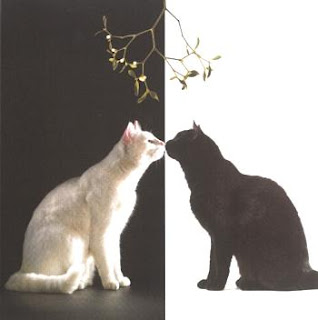
Black cat and white cat under mistletoe
Mistletoe should be kept well out of cats' reach
First of all, it is important to note that even non-toxic plants can cause coughing, choking, stomach upset or mild vomiting. Sometimes a leaf can even become lodged in a nostril or scratch or irritate an eye. If your cat eats a plant and needs to seek medical attention, it is always a good idea to bring the plant that was eaten with you to the vet – that way if you are uncertain of the species, your vet may be able to identify it and determine the treatment needed. Also, bringing the plant helps to evaluate exactly how much and what part of the plant was eaten. A tiny bite of a certain plant leaf may be safe, while the berry or flower of the same plant is lethal.
Holiday plants vary in their toxicity. Lilies (all of the Lilium family and Hemerocalis species), amaryllis bulbs and mistletoe are the most dangerous. If you or anyone in your household suspects that your cat may have ingested any part of a lily, no matter how small, please seek immediate veterinary attention. Hesitation may mean the difference between life and death for your cat! If more than 6 hours pass between lily ingestion and treatment, your cat’s chance of recovery decreases from fairly good to guarded-to-poor, and you can expect some long-term kidney damage.
There are several species of mistletoe including Phoradendum and Viscum – some of which are highly toxic and some of which are less so. Any type of mistletoe ingestion should be brought to the attention of your veterinarian.
Black cat outdoors in holly bush
Cats should be monitored around holly
Holly (Ilex spp.) – certain species contain the methylzanthine Theobromine (also theophylline which is used as a respiratory aid, and caffeine – I'm sure you know what that does!) in all parts, but concentrated in the leaves. Theobromine is the toxic substance that is also found in chocolate. Leaves can cause cuts or irritation in the mouth and esophagus. The berries, which contain glucosidic saponins, are mildly toxic to humans in small quantities, but can cause toxicity to varying degrees in pets. It is best to contact a veterinarian if your pet has ingested holly.
(for more about Holly toxicity)
Jerusalem cherry (Solanum pseudocapsicum) is a decorative species of nightshade with bright red berries that are poisonous.
Poinsettias (Euphorbia) have gotten a bad rap as an extremely poisonous plant due to an urban legend dating back to 1919. They do cause some intestinal upset, but rarely cause death. Pine needles and Christmas cactus usually cause irritation and intestinal upset but are less toxic. The most common signs of plant toxicity are: vomiting, diarrhea, abdominal pain, and excessive salivation (drooling).
Black and white cat in pointsettias
Poinsettias aren't as bad as many people think
If you have a live tree, Christmas tree water may contain fertilizers or preservatives and stagnant tree water can breed bacteria, but ingestion of a small amount of water does not usually cause severe issues. Covering the water with chicken wire or other mesh allows you to refresh your tree, but prevents your cat from drinking the water. Pine sap is not toxic but is sticky and hard to remove. Cats may lick excessively or pull at their fur if sap becomes adhered to their fur. Vegetable oil works better than shampoo when removing sap from your cat’s fur.
Exposure to plants in the Lily family is far and away the most serious holiday threat. Dr. Bailey has seen more deaths in cats due to this, than all the other toxic plants combined.
Some non-toxic winter plants that you can safely place in your home include: Christmas palm (Veitchia merrillii), Christmas orchid (Cattleya trianaei), Christmas dagger fern (Polystichym spp), and Mistletoe cactus (Thipsalis cassutha).

Foods

Red persian cat and onion plants
Cats and the onion family don't mix
All members of the genus Allium (onion, garlic, leek, chives, shallots, and scallions) can be poisonous to both dogs and cats. Toxicity can cause damage to the red blood cells (RBC), resulting in Heinz body anemia. In particular, cats are 2 to 3 times more susceptible to RBC damage from these components than other species. While specific studies have not been done with garlic as to the safe levels of ingestion, acute onion toxicosis occurs in animals that eat more than 0.5% of their body weight at one time (less than 2 Tbsp. for a 10lb. cat). However, smaller doses given regularly over a period of time will cause the same problem.
Drinks with milk or cream such as alcoholic eggnog are a concern both because most cats are lactose intolerant and because cats are very sensitive to alcohol due to their small size. Even small amounts of alcohol can be fatal.
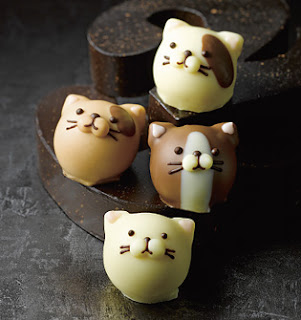
Cat chocolates by Goncharoff
Goncharoff cat-shaped chocolates
Chocolate ingestion can be serious, leading to seizures, if a large quantity is ingested. Chocolate toxicity varies by type of chocolate ingested – baker’s chocolate contains a higher concentration of Theobromine than white chocolate. Any ingestion of chocolate should warrant a call to your veterinarian, however. This is usually less of an issue for cats than dogs since they don’t seem to want to eat pure chocolate, but it should still be kept out of reach.
You should refrain from giving bones to your cats. Unlike dogs, cats do not have the instinct to gnaw on bones – and even dogs can damage or prematurely wear down their teeth with too much bone-chewing. Small bones can cause choking or bowel obstructions. Ingestion of broken bones can cause perforations of the intestinal tract, so if you offer turkey meat, make sure it is boneless.
In addition, the herbs and spices that the turkey or chicken is cooked with can be a problem. Sage is an herb that cats are extremely sensitive to, and can cause an upset stomach or depression of the nervous system. Also, as above, onions and other members of that family can cause anemia. If you want to offer your cat turkey, cook up some unseasoned bits on the side, rather than sharing from the family’s bird. It is doubtful that cats can taste the spices the same way humans can, anyway.
Medications
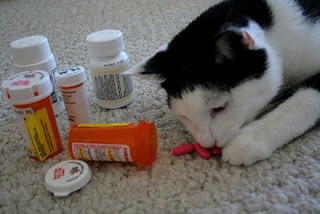
Black and white cat with pill bottles
Many of the poisoning cases we see are due to pill ingestion
Medications are not something that people think about as a holiday hazard, but during this chaotic time, when many guests may be staying in your home, be vigilant about any medications that may spill, especially as family members that may be coming to stay may bring in medications that aren't usually in your house.

Cats lack some liver enzymes and metabolize many medications poorly; one Tylenol or Ibuprofen can be fatal to a cat. If your cat is on medications for her own health issues, ingesting additional human medications may interact with those she has already taken with devastating results.

If you think your cat has ingested someone's medication, please call a veterinarian right away. Have the pill vial handy while you are on the phone and bring it with you to your appointment so that you can give all the important information to the doctor about what kind of medication it was, the dose and an estimate of how many pills were in the bottle. Make sure that you are also aware of all the medications your cat normally takes and when the most recent dose was given. If your cat has ingested someone else’s medication and is due for a dose of their own medications, DO NOT give the normal medications until you have spoken with your veterinarian.

Most of the poisoning cases we see at Exclusively Cats Veterinary Hospital are due to improper medication ingestion - either cats eating dropped pills from a human or other pet in the house, accidental overdoses when more than one family member gives the medication on a busy or chaotic day, or from mixed up medications such as a dog parasite product being accidentally applied to a cat.

Return to the First Day of Christmas

Monday, November 19, 2012

On the First Day of Christmas, my True Love Gave to Me – a Cat in a Christmas Tree: Helping your Cat avoid the Emergency Room this Holiday (pt. 1):


While most people enjoy the holiday season of friends, family, feasting and frivolity, your cat may not feel the same way. The holidays are a time when we are busier than usual, so our cats may be bored and looking for excitement. In addition, we bring lots of new fun (and hazardous) toys into the house. What a perfect opportunity for your cat to get into some mischief!

Here are some of the top holiday items that cats love to play with (but shouldn’t!):

Ribbons
Cats love to play with ribbons and tinsel, but they can be devastating if swallowed, knotting up and clogging the intestinal tract. Tinsel, especially the loose "icicle" type, should be avoided if you have cats in your household.
Any ribbon-play should be supervised. Make sure that all package-wrapping materials are put away where the cat cannot access them when you are done wrapping. Once the packages are wrapped, make sure the cat is not nibbling at the ribbons and bows under the tree, or wherever the presents are displayed.
If you notice a string or ribbon hanging out of your cat’s mouth or rear end, do not attempt to pull it out. If the string is knotted up inside, tugging on it can cause devastating trauma to the intestinal tract. Seek a veterinarian’s care immediately if you suspect your cat has swallowed a length of ribbon, string or tinsel.
Signs that your cat may have been “Naughty” instead of “Nice” include vomiting, especially multiple times in a row, or unproductive vomiting, lethargy, depression, fever, poor appetite or refusal of food, or a tense or painful abdomen (vocalization when picked up, sitting in unusual positions, hiding).

Ornaments

Fragile ornaments, especially those made of glass, may be broken and ingested, as can the ribbon, hooks or wire holding the ornaments on the tree. If you have a young cat, it is best to put a tree up first, before decorating it. If the kitten shows any inclination to climb the tree, you may want to minimize how many family heirlooms you hang on it! Also, you may want to stabilize the tree by attaching a guide wire to the wall so that the cat doesn’t knock it over. If it is possible to keep your tree behind closed doors, all the better, but many cats do begin to ignore the tree after they have thoroughly investigated it. Hang the most non-breakable and “boring” ornaments at the bottom of the tree where they are in the cat’s line of sight, and the most interesting ones where the cat is less likely to see them. Ornaments that move on their own should be avoided, unless your cat is uninterested in the tree as they are more tempting than regular ornaments.

Liquid Potpourri

Liquid potpourri can be toxic to the liver as well as causing burns if heated. Additionally, the cationic detergent in liquid potpourri is a corrosive substance and can cause severe chemical burns to the skin or eyes. Part of the concern about liquid potpourri is that it is an oily substance that is not easy to remove quickly and will remain on the skin and hair coat, continuing to cause damage as you try to remove it. Cats that have skin contact with liquid potpourri should be immediately bathed in mild liquid dishwashing soap, with special attention paid to the area between the toes since they may have walked in the potpourri. It should be assumed that if the cat has potpourri on its skin, it has probably tried to groom itself and will likely have eaten some, which is a much more critical problem. Liquid potpourri can cause severe ulceration of the mouth, tongue and esophagus, some of which may not become apparent until several hours after exposure. Cats that have been affected with liquid potpourri should see a veterinarian as soon as possible.

Candles

Candle flames are hypnotizing to cats and look like great toys to a cat. Make sure they are placed in areas where the cat cannot play with them and burn a paw, singe off all its eyebrow whiskers, or knock them over and start a fire. For those with extra-curious cats, a battery-operated candle may be a better option.

Cords


Electric light cords may also be tempting to cats but can cause serious burns in the mouth if chewed. Keeping cords hidden and out of reach will help. “Bitter Apple” is a spray that is available at most pet stores that has a bitter taste to discourage your cat from chewing on cords. You can also wrap dangling cords with bubble wrap or double-sided tape to discourage chewing. Cords can also be a strangulation hazard.
Walk around your house with your cat in mind, and remove possible hazards from temptation. Make sure to take a few extra moments each day and spend some time with your cat. Keeping your cat feeling like he is still the center of the universe will help prevent boredom and the need to find new things to play with. The holidays are a busy time, but a few extra moments’ consideration can save you and your cat from a devastating situation.

Wednesday, July 4, 2012

Summer safety tips

Black cat looking up at fireworks


Summertime can be nerve-wracking for cats because so many holidays are celebrated with fireworks. Many cats will run for the bed when there’s a mere knock on the door or a ring of the doorbell. When firecrackers go off, it can be devastating to a timid kitty. To help your cat cope, you can prepare a sanctuary in advance – a bed in a closet or the basement where the sounds will be more muffled. Feliway spray or a diffuser and items with your kitty’s own smell on them will help create a calming scent. Show your cat this area before the 4th of July so she will know it’s her safe place. It might also help to spend the evening in the room with your cats, petting them and offering soothing words.

Cat with dilated pupils hiding under bed If you have tried offering a secluded room in the past and your cat is still traumatized,  you might want to ask your veterinarian about a mild sedative or tranquilizer, just to get the cat through the day.  Try to check on your cat every couple of hours, petting her and talking to her. Try to keep to her normal feeding schedule as much as possible, since cats are stressed by changes in routine.

If your cat normally spends time outdoors, it would be best to keep him indoors for the day. Unfortunately, there are people who find it amusing to tie strings of firecrackers to cats’ tails. Curious cats may receive burned paws or faces from lit fireworks or sparklers, or may receive burns from falling sparks. Playing with unlit fireworks may result in ingestion of heavy metals – not rock band music, but toxic substances such as potassium nitrate and arsenic. At night, your cat may also be at risk for being hit by falling burning debris or misfired rockets.

Calico cat looking at cooking supplies
If you are planning a boisterous barbecue with lots of guests, you might want to consider boarding your cat during the holiday. Otherwise, it is a good idea to keep your cats in their sanctuary with food, water and litter for the duration of the party. Cats that are frightened because of large numbers of people might dash for the door, or curious cats may slip outside along with an unwary visitor or through a door that was accidentally left open. This is an excellent reason why even indoor cats benefit from being microchipped!

Even if it's just family, try to discourage people from feeding your kitty scraps from the barbecue, though she might beg. Feeding something other than a normal diet at a time of high stress can cause diarrhea or result in vomiting later. Also, many barbecued foods are seasoned with garlic and onions, which are toxic to cats, or other seasonings that may cause stomach upset. It is never a good idea to offer beer or other alcoholic drinks to pets, or leave it where pets can reach it. It takes a much smaller amount of alcohol to poison a pet than it does a human. Signs of alcohol poisoning are weakness, depression, coma and death.

Only use sunscreen and insect repellents that are designed for cats. DEET (N,N-Diethyl-meta-toluamide) is not a product recommended for use in pets and can cause neurological problems. Do not use dog products on cats. Pyrethrins have a very narrow range of safety, so using the wrong size product can poison your pet. Any product containing permethrin is toxic to cats! In fact, it is much safer to use products that do not contain permethrins or pyrethrins, such as Revolution and Advantage Multi (heartworm and flea preventive products all in one), or Advantage (flea prevention only) and Frontline (flea and tick protection). Ingestion of sunscreen products can cause drooling, vomiting, diarrhea, excessive thirst and lethargy. 

Make sure to protect your cats from heartworm disease with monthly preventives, even if they live indoors. Heartworm disease is transmitted through the bite of a mosquito, and mosquitoes occasionally come indoors. This year is projected to be an especially bad year for mosquitoes due to the mild winter weather.

Photo of reasearch cats that glow in black light
Note: Eating a glow stick will not make your cat glow. Sorry!
Keep matches and lighter fluid away from pets. Lighter fluid should not be used to treat fleas or remove ticks. Lighter fluid can irritate the skin and causes stomach irritation if groomed off the fur. If the fumes of lighter fluid are inhaled, it can cause aspiration pneumonia or other respiratory issues. Certain matches contain chlorates which can damage blood cells, cause respiratory distress or cause kidney damage. 

Do not allow pets to wear or play with glow jewelry. The glowing substance inside these products is not highly toxic, but can cause stomach irritation and excessive drooling. Small parts may be swallowed and require surgical removal.

Citronella candles or other products can cause stomach irritation if ingested.

Gray tabby in swimming pool
Make sure that your pool is pet safe!
Many people inflate pools for their children in the summer if they don’t have a year-round pool. Never leave pets unattended around a pool of any kind. Fence your full-sized pool with a secure gate, and never leave your pet inside the fenced pool area unsupervised.  Make sure pets can get out of the pool. If a pet jumps or falls in and doesn’t know how to get out without help, it may panic and drown. If your cat falls into a chlorinated pool, make sure that you thoroughly wash the coat thoroughly, and make sure that if your pool does not have stairs or a ramp to get in and out (ladders don’t count!), that you make sure that your cat does not have access to the pool – they won’t be able to get back out if they fall in! Try not to let pets drink pool water. Chlorine and chemicals used to keep pools free of algae and contaminants can cause pet health problems, such as dry mouth or gastric distress, and small wading pools with standing water can become contaminated with single-celled organisms such as Giardia, which can cause diarrhea. 


Brown tabby on a flag
Summer is a time of relaxation and carefree fun in the sun – make sure that you take precautions to keep it that way for your pet, too!